Apple CEO Tim Cook: "Price Increases Are Unavoidable" as AI Drives Memory Costs Skyrocketing
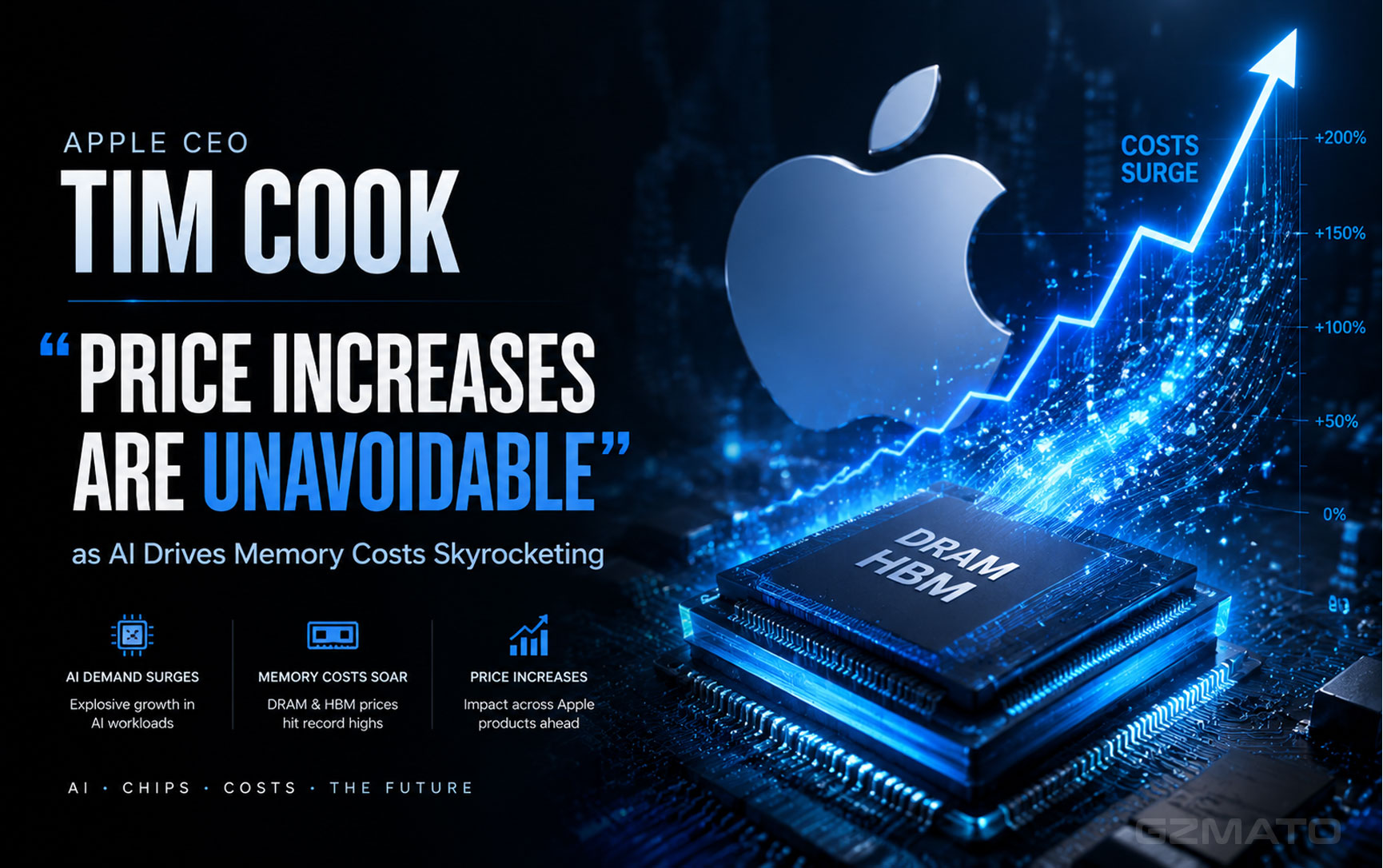
Apple CEO Tim Cook: "Price Increases Are Unavoidable"
Apple CEO Tim Cook has confirmed what many consumers feared: iPhones, Macs, and iPads are about to get more expensive [citation:1].
In an exclusive interview with the Wall Street Journal, Cook stated that Apple plans to raise product prices to offset the surge in memory and storage chip costs driven by AI demand [citation:1][citation:8].
"Unfortunately, price increases are unavoidable," Cook said. "We are doing our best to mitigate the significant cost increases being passed on to us, and we have tried to shield our customers. But the situation has become unsustainable" [citation:1][citation:8].
This is not a rumor or analyst speculation. It is the CEO of the world's most valuable consumer electronics company publicly acknowledging that the AI boom has broken the traditional supply-demand balance for memory chips — and consumers will pay the price.
The Root Cause: AI Is Eating the Memory Market
Cook explained the problem in clear terms: AI companies are consuming an increasing share of memory and storage chip production, leaving less for consumer devices [citation:1][citation:10].
The surge in AI data center construction has created unprecedented demand for high-bandwidth memory (HBM) and enterprise-grade SSDs. Memory manufacturers — Samsung, SK Hynix, and Micron — are allocating more of their advanced production capacity to these higher-margin AI products [citation:1][citation:10].
"There's less supply at a time when consumers want devices, and the memory suppliers are passing along huge price increases," Cook said. "We need memory pricing and supply to return to reasonable levels for consumer products" [citation:1][citation:7].
The challenge is structural, not temporary. Cook described the situation as a "hundred-year flood" — something he has never seen in over 40 years of working in electronics supply chains, spanning IBM, Compaq, and Apple [citation:1][citation:5][citation:9].
DRAM (Memory): Like an office desk — used for active work. Smartphones use DRAM to run apps you're currently using.
NAND (Storage): Like a filing cabinet — used for long-term storage. Smartphones use NAND to store photos, videos, and apps.
Both are under pressure. Cook noted that DRAM is the bigger concern because more capacity is being allocated to AI servers [citation:1][citation:10].
By the Numbers: How Bad Is It?
The numbers behind Cook's warning are staggering:
| # | Metric | Data |
|---|---|---|
| 1 | iPhone Pro price increase needed | $270 (TechInsights estimate to maintain profit margins) [citation:1][citation:8] |
| 2 | Micron & SK Hynix stock growth (12 months) | Over 800% [citation:1] |
| 3 | Kioxia & SanDisk stock growth (12 months) | Over 4,600% [citation:1] |
| 4 | IDC 2026 smartphone forecast | 1.09 billion units, down 13.9% — "most pessimistic forecast ever" [citation:2][citation:4] |
| 5 | Morgan Stanley price forecast | US smartphones and PCs to rise 15% in 2026 [citation:1][citation:8] |
| 6 | Consumer DRAM supply gap (by 2027) | Up to 15% shortfall [citation:8] |
Memory and storage prices have increased by over 300% since 2023, and TechInsights predicts the trend will continue through 2027 [citation:3][citation:8].
Which Products Will Be Affected?
Cook did not specify which products will see price increases or when they will take effect [citation:1][citation:7]. However, analysts and industry observers have clear expectations:
iPhone 18 Series (September 2026)
Apple's next major product launch is expected in September, featuring the iPhone 18 series and potentially a new foldable iPhone [citation:1][citation:5]. TechInsights estimates that the next iPhone Pro could need a $270 price increase just to maintain current profit margins if Apple passes on the full cost [citation:1][citation:8].
Apple already charges premium prices — the iPhone 17 Pro Max with 2TB storage is currently $1,999 [citation:3]. The iPhone 18 Pro Max or an iPhone Ultra folding phone could easily cross the $2,000 threshold [citation:3].
Mac and iPad (Imminent)
Price increases may come sooner for Macs and iPads. Apple already raised the Mac mini's starting price in May by eliminating its entry-level configuration [citation:1][citation:5][citation:7]. Cook noted that "depending on which product and memory configuration, we will make appropriate pricing adjustments and use different ways to express them" [citation:1][citation:5].
What Won't Be Affected?
Products that use few memory chips — like AirPods — are unlikely to see price increases [citation:3].
"A Hundred-Year Flood": Cook's Warning
Cook emphasized the unprecedented nature of the current situation:
"In my 40-plus years of experience, in any field, I have never seen anything like this before." [citation:1][citation:5]
He traced his career through IBM, Compaq, and Apple — three of the most important companies in the history of computing — and said that in all that time, he had never seen commodity component prices fluctuate as dramatically as they have over the past six months [citation:1][citation:8].
Apple spends tens of billions of dollars annually on memory and storage chips, making it one of the world's largest buyers [citation:1][citation:8]. Historically, Apple used its purchasing power to squeeze suppliers and keep prices low. Now, with AI companies entering the market with even larger demand and a willingness to pay premium prices, Apple is suddenly finding itself waiting in line [citation:1][citation:10].
This is a structural shift, not a temporary blip. The memory market is transitioning from a commodity-driven, cyclical industry to a strategically critical supply chain where AI demand dictates pricing and allocation. For consumers, this means the era of falling electronics prices may be over.
The China Factor: Cook Calls for Re-examining Supply Sources
One of the most notable aspects of Cook's interview was his response to a question about U.S. restrictions on working with Chinese memory and storage suppliers.
China has national champions in the memory and storage sectors, but U.S. national security regulations require U.S. companies to obtain licenses to work with them [citation:1][citation:8].
When asked whether these restrictions should be eased, Cook responded: "I think everything should be on the table. I think we should look at all sources of supply" [citation:1][citation:8].
This is a significant statement. Cook is not advocating for a specific policy change, but he is signaling that Apple is open to exploring every possible supply source — including Chinese suppliers — as it faces a severe supply crunch.
Cook also ruled out one option: Apple will not build its own memory and storage factories. "We can't do everything," he said. "We know what we're good at" [citation:1][citation:8].
Key Takeaways
| # | Key Takeaway |
|---|---|
| 1 | Apple confirms price increases — Cook stated that "price increases are unavoidable" due to memory and storage cost spikes [citation:1]. |
| 2 | AI is the root cause — AI data centers are consuming an increasing share of memory production, leaving less for consumer devices [citation:1][citation:10]. |
| 3 | iPhone Pro could cost $270 more — TechInsights estimates the next iPhone Pro would need a $270 price increase to maintain Apple's profit margins [citation:1]. |
| 4 | Memory prices up over 300% — DRAM and NAND prices have tripled since 2023, with increases expected through 2027 [citation:3]. |
| 5 | Mac and iPad to be hit first — Price increases may come before the September iPhone launch [citation:1][citation:5]. |
| 6 | "A hundred-year flood" — Cook has never seen such price volatility in 40+ years in the electronics industry [citation:1]. |
| 7 | IDC forecasts 13.9% smartphone decline — The most pessimistic forecast ever, driven by price increases and extended replacement cycles [citation:2][citation:4]. |
| 8 | Cook open to Chinese suppliers — He said "everything should be on the table" regarding U.S. restrictions on working with Chinese memory suppliers [citation:1]. |
- Wall Street Journal — Exclusive interview with Tim Cook
- Financial Times — Apple price increase analysis
- IDC — Smartphone market forecast and price impact analysis
- TechInsights — Memory price estimates and cost modeling
- 凤凰网科技 / 财联社 — Chinese-language coverage of Cook's interview
- NetEase / 网易 — Detailed breakdown of Cook's comments
- CFM闪存市场 — Memory industry structural analysis
iPhones | MacBooks | iPads | Fast Chargers | USB-C Cables | Power Banks | Screen Protectors | Tech Accessories
Special Offer: Use code TECH2026 for discount on your first order!
- Apple price increase
- Tim Cook
- memory shortage
- AI memory demand
- iPhone 18 price
- DRAM shortage
- NAND price