CXMT LPDDR6: World's First Commercial Deployment & A Reality Check
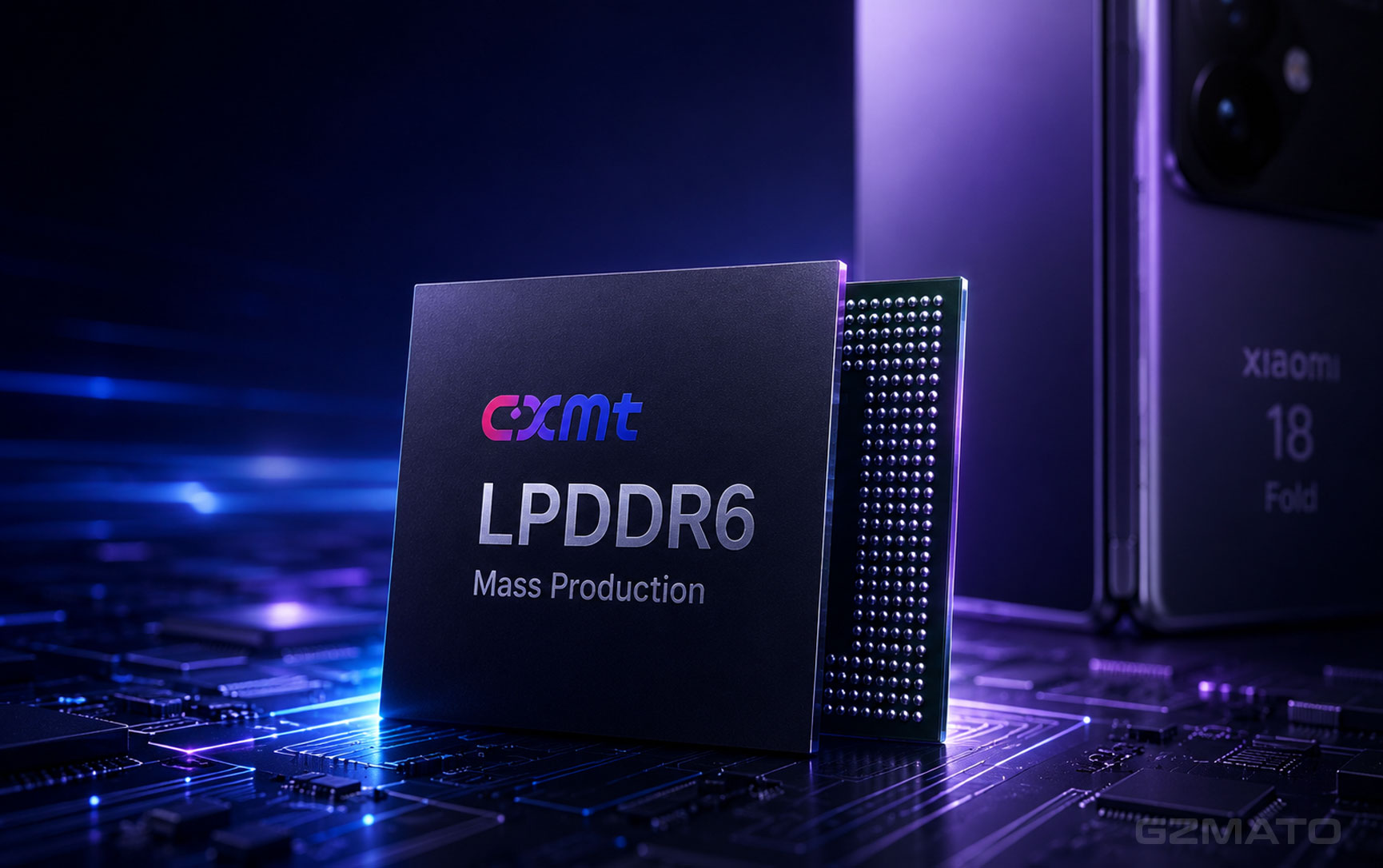
August 29, 2026 — ChangXin Memory Technologies (CXMT) officially announced mass production of its self-developed LPDDR6 memory, with the first batch shipping in Xiaomi's upcoming 18 Fold foldable flagship .
This is the world's first commercial deployment of LPDDR6 — the next-generation mobile memory standard — and the first time a Chinese memory maker has brought a leading-edge memory standard to market ahead of overseas suppliers .
The announcement comes just days after Xiaomi unveiled its in-house Xuanjie O3 3nm SoC, which is the first processor to support CXMT's LPDDR6 . Xiaomi founder Lei Jun called the milestone "very impressive" and said it was "only the beginning" of deeper collaboration among Chinese tech companies .
By the Numbers: 12,800 Mbps, 16GB
CXMT's LPDDR6 memory delivers next-generation performance across several key metrics:
LPDDR6 is the latest mobile memory standard released by JEDEC in July 2025 . It is designed specifically for AI-driven mobile workloads, offering significantly higher bandwidth and lower power consumption than the previous LPDDR5X generation .
The 12,800 Mbps peak rate represents a substantial leap over existing LPDDR5X offerings, which typically max out around 10.7 Gbps in extreme overclocked states . CXMT's chip achieves this while maintaining the low power consumption required for mobile devices.
The chip also introduces on-chip ECC (Error Correction Code) — a feature designed to improve reliability and reduce power consumption during high-speed data transmission .
The Ecosystem Play: Xiaomi, Xuanjie O3, and CXMT
What makes the CXMT LPDDR6 announcement particularly significant is the ecosystem that surrounds it.
Xiaomi's Xuanjie O3 SoC — unveiled on August 24 — is the first processor to support CXMT's LPDDR6 . The pairing of a domestic processor with domestic memory in a flagship smartphone creates China's first end-to-end, in-house flagship chipset .
But the relationship goes deeper. Xiaomi has not only partnered with CXMT as a customer — its venture capital arm has invested in CXMT, creating both supply chain and equity ties .
| Partner | Role in the Ecosystem |
|---|---|
| CXMT | LPDDR6 memory design and manufacturing |
| Xiaomi | Processor design (Xuanjie O3), system integration, device manufacturing |
| SMIC | Manufacturing of Xuanjie O3 SoC (inferred) |
This represents a functional, commercially relevant semiconductor value chain operating inside China — design (Xiaomi, CXMT), manufacturing (SMIC, CXMT), and system integration (Xiaomi) all working together in a flagship product.
Professor Liu Zhiying of the University of Science and Technology of China noted: "An important factor in the growth of Chinese high-tech companies is their ability to connect research, commercialization and market applications, allowing leading companies to pull suppliers across the industrial chain forward."
Reality Check: What the Numbers Actually Mean
CXMT's mass production announcement is significant — but it comes with important context.
Limited Initial Volume
Reuters has reported that Xiaomi is targeting shipments of approximately 200,000 to 300,000 units for the 18 Fold . For a flagship smartphone, this is a relatively limited volume. As one South Korean industry official told The Korea Herald: "If CXMT is producing LPDDR6 mainly for that level of demand, its actual production capacity and yields could still be lower than the mass-production announcement might suggest."
It's worth noting that Xiaomi has not confirmed whether CXMT is the sole LPDDR6 supplier for the 18 Fold . The company may be using the initial launch as a validation run while maintaining flexibility to shift to other suppliers.
Competitors Are Not Standing Still
Samsung and SK Hynix have also developed LPDDR6 products . Their technologies are more advanced in certain respects — Samsung has discussed 14.4 Gbps products , while CXMT's current product operates at 12.8 Gbps . But as industry observers have noted, CXMT's 12.8 Gbps product is more aligned with current market reality and immediate demand .
CXMT's financial position gives it room to invest. The company posted first-half revenue of 150.31 billion RMB (up 874% YoY) and net profit of 77.61 billion RMB — reversing a 2.33 billion RMB loss from a year earlier . The company's market cap has fluctuated around 3.6-3.94 trillion RMB .
Key Takeaways
- 澎湃新闻 — CXMT LPDDR6 mass production, global first commercial deployment, Lei Jun comments
- Global Times — CXMT mass production, Xuanjie O3 pairing, Lei Jun statement, Korean investor reaction
- The Korea Herald — CXMT vs Samsung/SK Hynix comparison, shipment volume details, industry commentary
- 证券之星 / 投资者网 — LPDDR6 technical specifications, market significance, end-side AI context
- China Daily — Wang Peng and Liu Zhiying expert commentary, CXMT financials, market cap, US lawsuit
- 太平洋科技 / 快科技 — LPDDR6 specifications, PoP packaging, bandwidth details
- CNMO — Korean media reaction, development cycle assessment
- 凤凰网 / 观察者网 — Industry development timeline, LPDDR6 standards context


- CXMT
- LPDDR6
- Xiaomi 18 Fold
- Chinese semiconductor
- memory chip
- 12800 Mbps
- ChangXin Memory
- Xuanjie O3
- China tech
- Gzmato
- 2026