A Comprehensive Guide to Working and Living in China as a Business Expatriate

Moving to China as a business expatriate is an exciting opportunity, but it comes with its own set of challenges. From setting up your daily essentials to navigating the local culture, this guide will help you settle in smoothly. Here’s everything you need to know about living and working in China, including SIM cards, bank accounts, mobile payments, currency exchange, transportation, and accommodation.
1. Getting a SIM Card
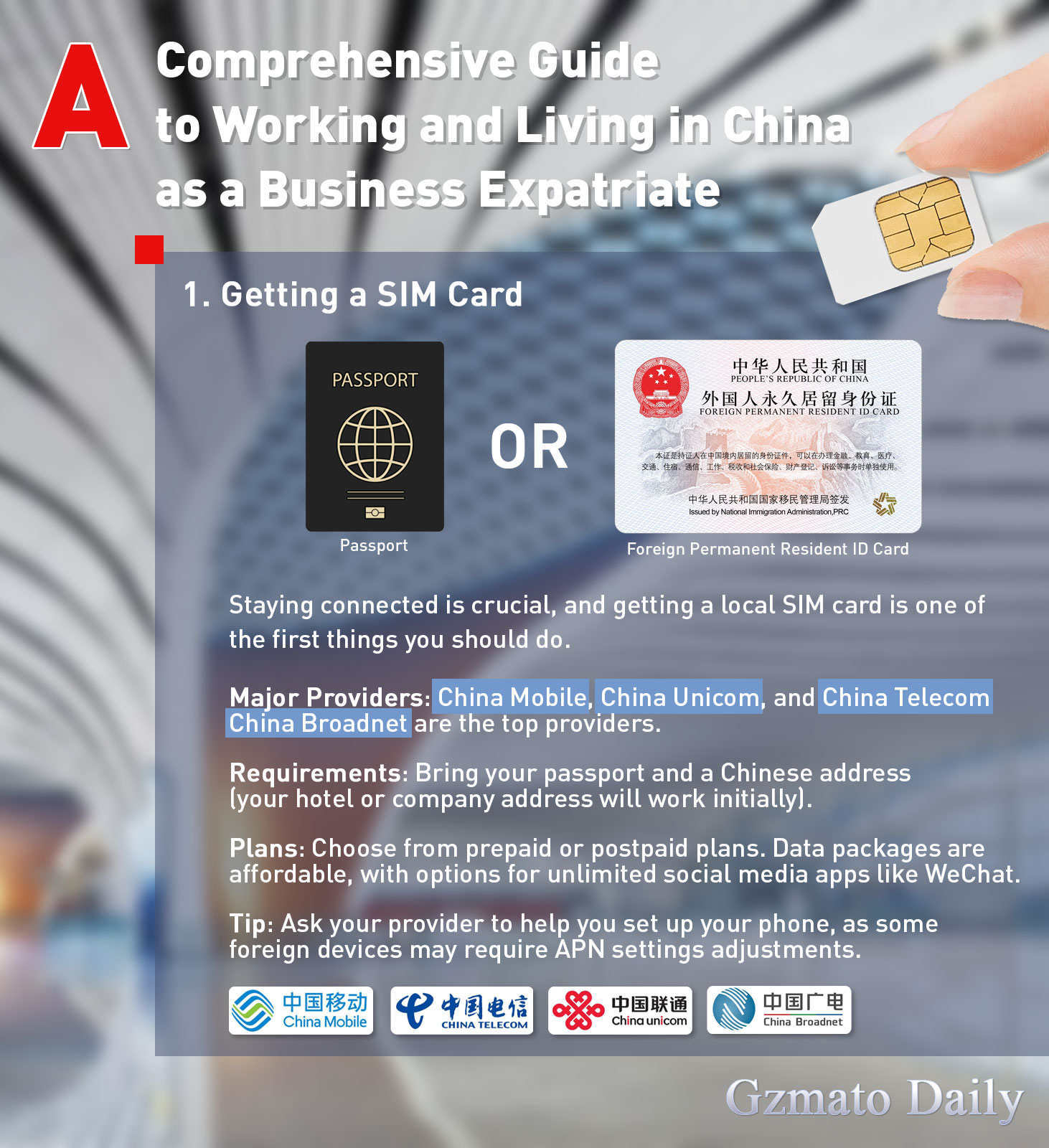
Staying connected is crucial, and getting a local SIM card is one of the first things you should do.
- Major Providers: China Mobile, China Unicom, and China Telecom are the top providers.
- Requirements: Bring your passport and a Chinese address (your hotel or company address will work initially).
- Plans: Choose from prepaid or postpaid plans. Data packages are affordable, with options for unlimited social media apps like WeChat.
- Tip: Ask your provider to help you set up your phone, as some foreign devices may require APN settings adjustments.
2. Opening a Bank Account
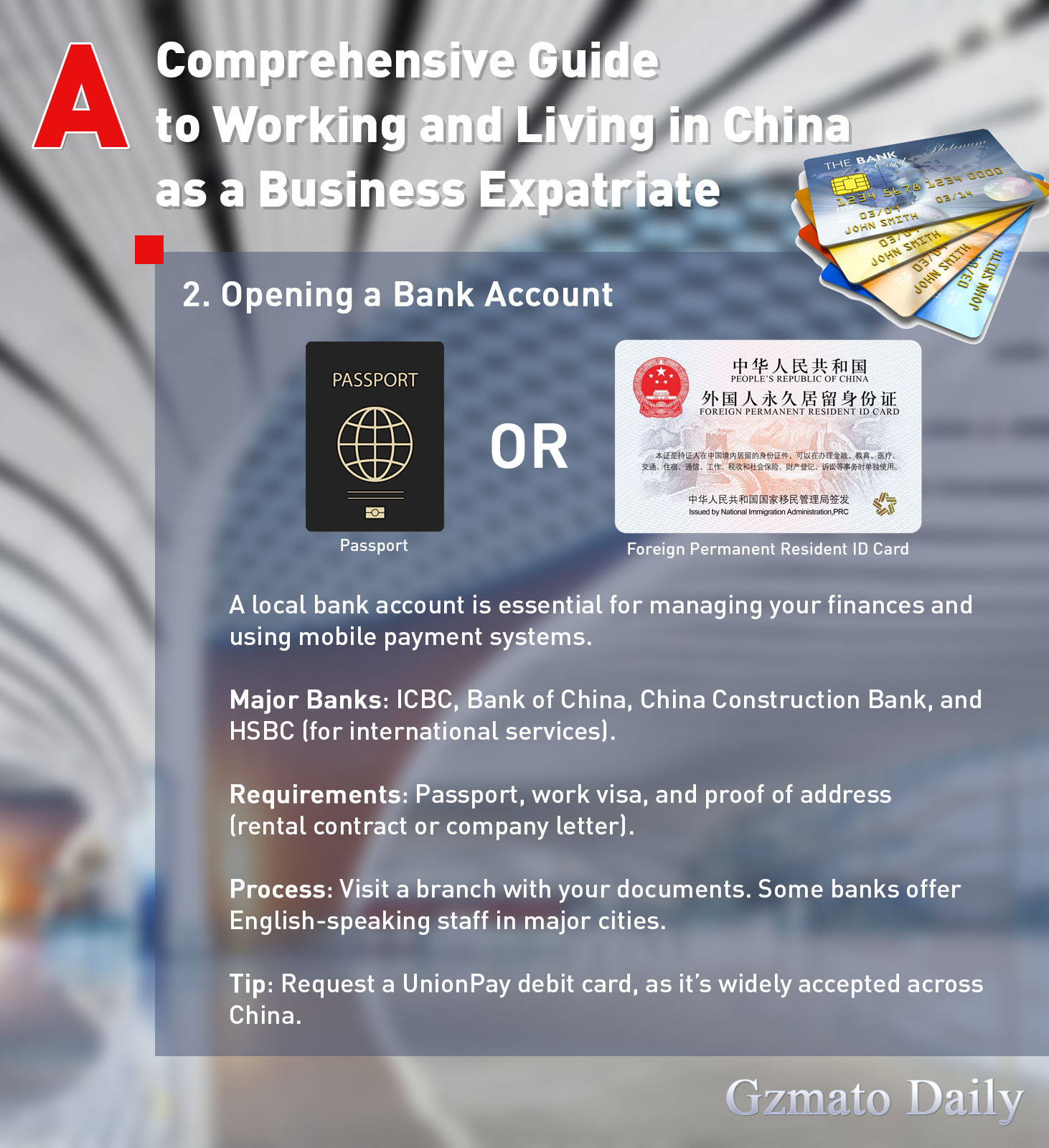
A local bank account is essential for managing your finances and using mobile payment systems.
- Major Banks: ICBC, Bank of China, China Construction Bank, and HSBC (for international services).
- Requirements: Passport, work visa, and proof of address (rental contract or company letter).
- Process: Visit a branch with your documents. Some banks offer English-speaking staff in major cities.
- Tip: Request a UnionPay debit card, as it’s widely accepted across China.
3. Mobile Payments: WeChat Pay and Alipay
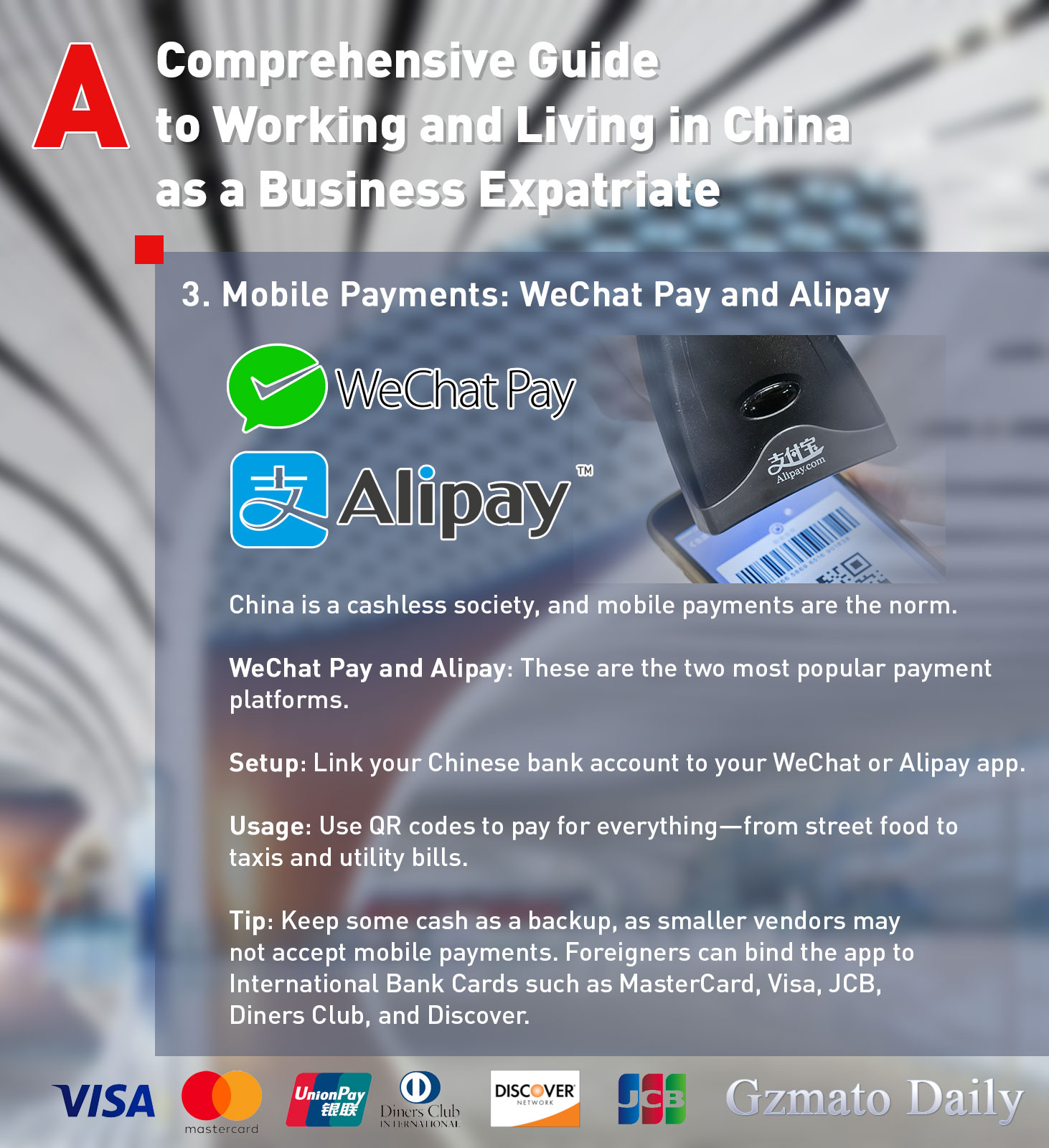
China is a cashless society, and mobile payments are the norm.
- WeChat Pay and Alipay: These are the two most popular payment platforms.
- Setup: Link your Chinese bank account to your WeChat or Alipay app.
- Usage: Use QR codes to pay for everything—from street food to taxis and utility bills.
- Tip: Keep some cash as a backup, as smaller vendors may not accept mobile payments.Foreigners can bind the app to International Bank Cards such as MasterCard, Visa, JCB, Diners Club, and Discover.
Notes for binding international bank cards:
- When binding an international bank card to Alipay or WeChat, it is necessary to obtain authorization from the foreign issuing bank. However, some issuing banks may reject the binding request due to their system's inability to recognize the connection information. In such cases, it is advisable to contact the issuing bank's customer service center or consider using a Chinese bank card instead.
- When using Alipay or WeChat for QR code payments through the bound international bank card, users are not required to pay an additional servicefee if the transaction amount does not exceed 200 yuan; or, users need to pay a service fee at 3% of the transaction amount if the amount exceeds 200 yuan.
- Alipay and WeChat have set transaction limits for bound international bank cards, with an annual limit of 50,000 US dollars and a single transaction limit of 5,000 US dollars. It is recommended that users who have bound international bank cards to the APPs consider your specific use cases before using mobile payment.
- Users of AlipayHK, Wechatpay HK (HKSAR), mPay (Macao SAR), Kakao Pay (Republic of Korea), Touch'n Go eWallet (Malaysia), HiPay (Mongolia), Changi Pay (Singapore), OCBC (Singapore), Naver Pay (Republic of Korea), Toss Pay (Republic of Korea), and TrueMoney (Thailand) can make QR code payments through these e-wallets in the Chinese mainland.
4. Exchanging Foreign Currencies
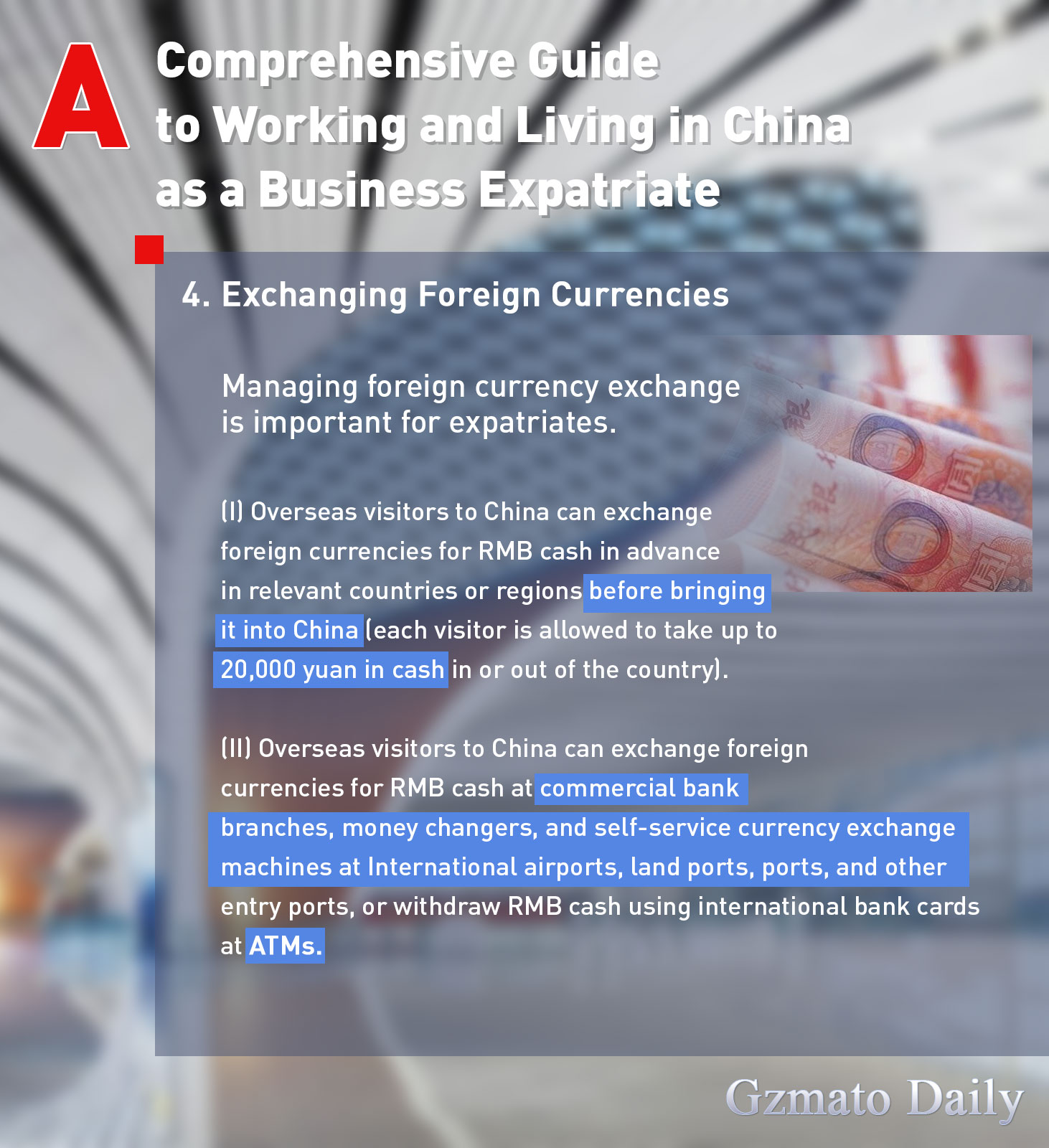
Managing foreign currency exchange is important for expatriates.
- Banks: Major banks offer currency exchange services. Bring your passport and work visa.
- ATMs: Use ATMs to withdraw RMB (Chinese Yuan) with your foreign debit/credit card. Check for international transaction fees.
- Currency Limits: Be aware of China’s annual foreign exchange limit of $50,000 USD per person.
- Tip: Use apps like Wise (formerly TransferWise) for international transfers at competitive rates.
(I) Overseas visitors to China can exchange foreign currencies for RMB cash in advance in relevant countries or regions before bringing it into China (each visitor is allowed to take up to 20,000 yuan in cash in or out of the country).
(II) Overseas visitors to China can exchange foreign currencies for RMB cash at commercial bank branches, money changers, and self-service currency exchange machines at international airports, land ports, ports, and other entry ports, or withdraw RMB cash using international bank cards at ATMs.
5. Transportation: Getting Around in China
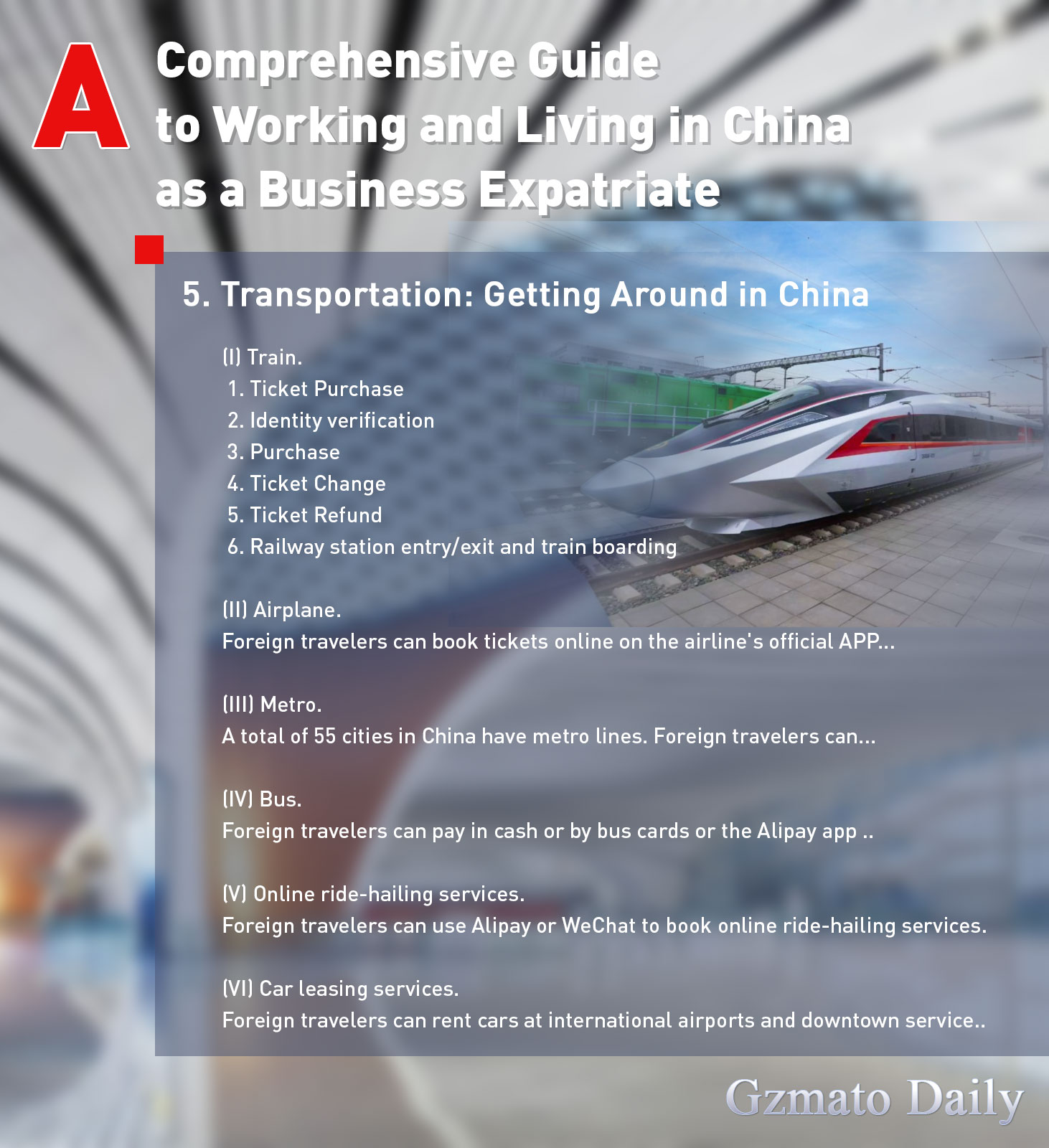
China’s transportation system is efficient and extensive.
- Public Transport:
-
- Metro: Affordable and well-connected in major cities like Beijing, Shanghai, and Guangzhou.
- Buses: Cheap but can be crowded. Use apps like Baidu Maps for routes.
- Taxis and Ride-Hailing:
-
- Didi Chuxing: China’s version of Uber. Link it to your WeChat or Alipay for seamless payments.
- High-Speed Trains: Perfect for intercity travel. Book tickets via Trip.com or at train stations.
- Tip: Download offline maps and translation apps to navigate easily.
(I) Train.
1. Ticket purchase
1. Using identification documents. Foreign travelers can use the following valid identification documents when purchasing tickets or paying for the extended trip at the railway station's ticket office and ticket agents, or on trains:
(1) Foreign Permanent Resident ID Card;
(2) Passport;
(3) Foreigner's exit-entry permit;
(4) Seafarer's Certificate;
(5) Receipt of acceptance of a visa application issued by the exit and entry administration authority of the public security organs of China;
(6) Passport loss report certificate;
(7) Temporary international travel document issued by embassies and consulates in China (with valid visas or stay certificates issued by the exit and entry administration authority of the public security organs of China attached).
Foreign travelers can use your Foreign Permanent Resident ID Cards and passports to purchase tickets through the 12306 website, 12306 APP, or booking hotline. Foreign travelers can also use your Foreign Permanent Resident ID Cards to purchase tickets at the self-service machines.
2. Identity verification
To ensure safe and orderly passenger transport, China's railway operator implements real-name ticketing according to relevant regulations. Foreign travelers must complete identity verification before purchasing tickets.
(1) You can log in to the 12306 website or app to fill in your name, nationality, ID number, and other information following the instructions. The system will automatically complete identity verification. Or, you can upload a photo of the passport information page for manual verification.
(2) You can also take valid passports to the ticket office at the railway station for identity verification.
3. Purchase
After the identity verification, foreign travelers can purchase tickets.
(1) You can purchase tickets online through the 12306 website or app and pay with Alipay, WeChat, or UnionPay bank cards.
(2) You can also purchase tickets at the ticket office at the railway station and pay in cash or by Alipay, WeChat, or UnionPay bank cards. Some railway stations also have self-service machines for ticket purchase.
■ Ticket change
Foreign travelers can change your tickets at the 12306 website and APP, or the ticket office at the railway station.
■ Ticket refund
Foreign travelers can cancel your tickets at the 12306 website and APP, or the ticket office at the railway station. Service fees may be incurred depending on the time of cancellation.
■ Railway station entry/exit and train boarding
Foreign travelers can enter and exit the railway station through automatic or manual ticket check gates with the original valid identification documents used when buying tickets, and cooperate to complete ticket verification on the way.
For details of relevant rules, please visit the 12306 website or APP, or call China Railway customer service hotline (12306) for consultation. 12306 website address: https:// www.12306.cn/en/index.html
(II) Airplane.
Foreign travelers can book tickets online on the airline's official APP and WeChat mini program, or other ticketing platforms.
(III) Metro.
A total of 55 cities in China have metro lines. Foreign travelers can apply for metro passes at the metro station or use the Alipay APP to take the metro.
(IV) Bus.
Foreign travelers can pay in cash or by bus cards or the Alipay app to take the bus.
1. Buses usually do not provide change, so travelers need to prepare small change in advance.
2. Foreign travelers can take your passports to the service outlets of the bus companies to buy bus cards. Payment for the cards can be made in cash or by WeChat or Alipay.
(V) Online ride-hailing services.
Foreign travelers can use Alipay or WeChat to book online ride-hailing services.
(VI) Car leasing services.
Foreign travelers can rent cars at international airports and downtown service outlets. You can also use car leasing APPs or search for "mini programs for car leasing" on Alipay or WeChat. Once registered , you can make a reservation for car leasing.
1. Foreign travelers who are going to rent cars need to bring your passports or Foreign Permanent Resident ID Cards, valid Chinese driver's licenses, and international or domestic credit cards.
Note: Foreign travelers renting a car for the first time need to have your identity document information verified at least one working day in advance.
2. Foreign travelers applying for Chinese driver's licenses must take your passports, overseas driver’s licenses with a Chinese translation, recent one-inch half-length, bareheaded, full-faced color photos against white background, and other necessary documents to public security traffic management service halls to apply for Provisional Driving Permits for compact cars. Foreigners who enter China for a short-term stay can apply for Provisional Driving Permits with a validity period of 3 months. For those who intend to stay longer than 3 months, the validity period can be extended to a maximum of one year. The permits can be used whenever the holders reenter China during the validity period without the need for reapplication.
Note: China has signed agreements for mutual recognition and exchange of driver’s licenses with France, Serbia, Belgium, and the United Arab Emirates. This allows individuals holding driver’s licenses from the aforementioned countries to drive in China or obtain Chinese driver’s licenses without taking a test.
6. Accommodation: Finding a Place to Live
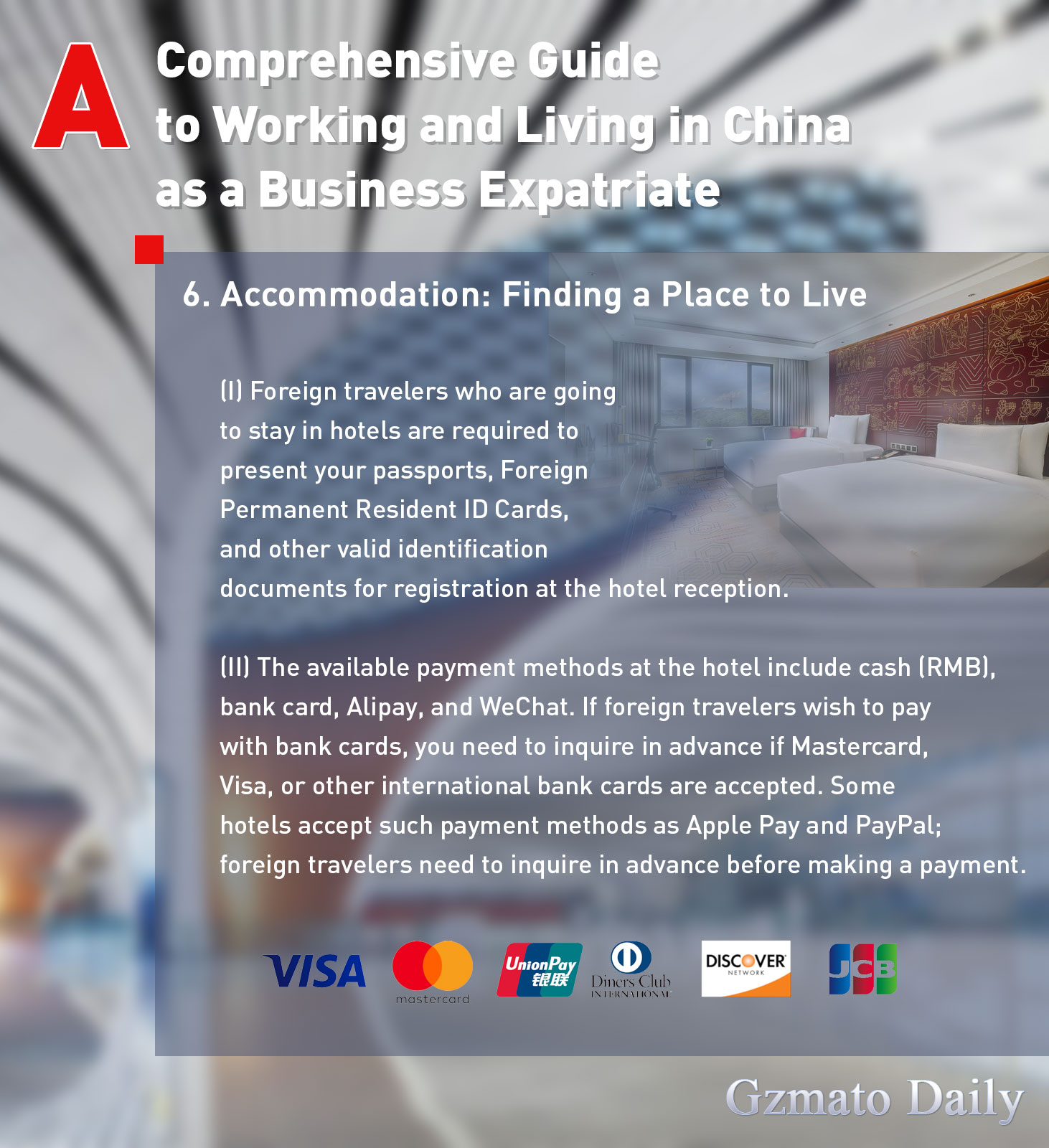
Finding the right accommodation is key to a comfortable stay.
- Short-Term: Start with serviced apartments or Airbnb while you explore neighborhoods.
- Long-Term: Use platforms like Ziroom, Lianjia, or contact a local real estate agent.
- Popular Expat Areas:
-
- Beijing: Sanlitun, Shunyi, and Chaoyang.
- Shanghai: Jing’an, Xuhui, and Pudong.
- Guangzhou: Tianhe and Yuexiu.
- Lease Terms: Typically 1 year. Negotiate rent and ensure your contract is in English and Chinese.
- Tip: Check for amenities like proximity to metro stations, international schools, and supermarkets.
Foreign travelers can make hotel reservations online through the Trip.com APP or via telephone or other means.
(I) Foreign travelers who are going to stay in hotels are required to present your passports, Foreign Permanent Resident ID Cards, and other valid identification documents for registration at the hotel reception.
(II) The available payment methods at the hotel include cash (RMB), bank card, Alipay, and WeChat. If foreign travelers wish to pay with bank cards, you need to inquire in advance if Mastercard, Visa, or other international bank cards are accepted. Some hotels accept such payment methods as Apple Pay and PayPal; foreign travelers need to inquire in advance before making a payment.
7. Cultural Tips for Business Expatriates
- Guanxi (Relationships): Building strong relationships is crucial in Chinese business culture.
- Business Etiquette: Exchange business cards with both hands, and be punctual for meetings.
- Language: Learn basic Mandarin phrases. Apps like Duolingo or HelloChinese can help.
- WeChat: This app is indispensable for both personal and professional communication.
Final Thoughts
Living and working in China as a business expatriate can be a rewarding experience with the right preparation. By setting up your essentials—like a SIM card, bank account, and mobile payment systems—and understanding the local culture, you’ll be well-equipped to thrive in this dynamic country.
If you have any questions or need further advice, feel free to reach out. Welcome to China!



- working in China
- living in China as an expat
- China business expatriate guide
- SIM card in China
- opening a bank account in China
- WeChat Pay and Alipay
- currency exchange in China
- transportation in China
- accommodation for expats in China
- China expat tips