iPhone Duo Screen Tech Explained: Why the Crease "Disappears" — And What We Still Don't Know

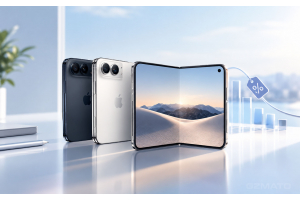
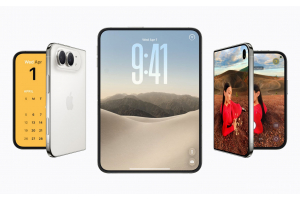
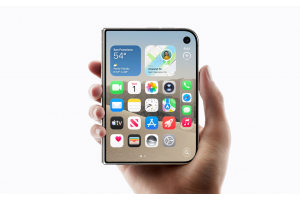
September 11, 2026 — When Apple unveiled the iPhone Duo, the most scrutinized detail wasn't the chip, the camera, or the price. It was the crease — or rather, the near-absence of one .
Early hands-on reviews have consistently reported that the iPhone Duo's foldable display looks noticeably flatter than competing foldables, particularly the Samsung Galaxy Z Fold8. But what's actually behind that? It's not magic, and it's not a single breakthrough. It's a 10-layer stack, a sliding fold mechanism, and a nano-texture surface — three engineering decisions that work together to make the crease "disappear" in everyday use .
Here's how it works — and what Apple still hasn't told us.
The 10-Layer Stack: What's Inside

The iPhone Duo's inner display uses a 10-layer stack — one of the most complex foldable screen designs ever produced.
The image above, widely circulated after the launch, shows exactly why the iPhone Duo's screen is different. It's not a single sheet of flexible glass. It's a carefully engineered stack of ten distinct layers, each with a specific job .
| Layer | Material | Function |
|---|---|---|
| Top Layer | Nano-texture polymer | Anti-glare, crease minimization |
| Adhesive | Custom optically clear adhesive | Allows layers to slide during folding |
| Display Panel | OLED | Core display function |
| Support | Titanium plate | Rigidity, prevents sagging |
| Protective Layers | Multiple polymer and glass layers | Impact resistance, durability |
The complexity here is not just for show. Each layer serves a purpose — and together, they create a screen that folds more gracefully than a simple glass-on-OLED design .
Sliding Fold: The Core Mechanism

The iPhone Duo's hinge uses over 100 parts, including titanium components and a variable-torque design.
Most foldables try to solve the crease problem by making the glass thinner. Apple took a different approach: it made the layers slide .
When you fold the iPhone Duo, the layers don't all bend at the same rate. Instead, the custom optically clear adhesive between each layer allows them to shift slightly relative to each other — like the pages of a book sliding past one another rather than bending as a single block .
This reduces the stress on any single layer. The top polymer layer bends less because the layers beneath it are absorbing some of the movement. The result is less material fatigue, less crease accumulation, and a smoother fold over time .
A traditional foldable screen is essentially a single flexible substrate with layers bonded rigidly. Every fold stresses that substrate in the same place. Over thousands of folds, the material fatigues and the crease deepens. By allowing layers to slide, Apple distributes the stress across multiple interfaces rather than concentrating it at one fold line .
Nano-Texture: Making the Crease Disappear

The nano-texture top layer scatters light instead of reflecting it — making the crease far less visible to the eye.
The second key technology is the nano-texture surface — the same finish Apple first used on its Pro Display XDR .
On a standard glossy screen, the crease catches light and reflects it back at the viewer. That's why creases look so obvious under bright lights. The nano-texture surface is matte. It scatters light in multiple directions rather than reflecting it in a single beam. The crease is still physically there, but the light doesn't highlight it the same way .
Apple says the custom polymer top layer is 40% stiffer than standard foldable display materials, which helps it resist deformation while still allowing the screen to fold .
The combination of a stiffer top layer and a light-scattering surface means that, in normal use, you simply don't see the crease. It's not gone — it's hidden.
The Crease Truth: Visual vs. Physical

Side-by-side comparison: iPhone Duo (left) vs. Galaxy Z Fold8 (right). The Duo's nano-texture surface reduces visible crease under direct light.
Here's where we need to be precise — and where many reviews have been less than fully honest.
Apple has never claimed the crease is eliminated. The official language is "minimized" — a careful word choice. In Apple's own FAQ, the company describes the display as reducing the appearance of the crease, not removing it .
What reviewers have consistently found: in normal use — browsing, watching video, reading — the crease is effectively invisible. The nano-texture scatters light, and your eye doesn't catch the subtle depression in the surface. The display looks flat.
But under certain conditions — direct sunlight at an angle, a bright overhead light, or when the screen is off — the crease becomes visible. It's a faint line, a slight change in reflection. It's there. It's just not in your face .
The Biggest Unknown: Long-Term Durability
This is the part no review can answer yet, because the phone hasn't shipped .
Apple has not published a fold-cycle rating for the iPhone Duo. Samsung rates its foldables for 200,000 folds — roughly five years of heavy use. Apple hasn't disclosed any equivalent number for the Duo .
More importantly, there is no data on whether the crease deepens over time. All the praise for the Duo's flat display comes from hands-on sessions with new units. Nobody knows how the screen will look after 10,000 folds, 50,000 folds, or two years of daily use .
The sliding-layer design is theoretically more durable than a rigidly bonded stack, because it distributes stress across multiple interfaces. But theory and practice are different things. The materials could still fatigue. The adhesive could degrade. The nano-texture surface could wear down or accumulate scratches, reducing its light-scattering effect and making the crease more visible over time .
Key Takeaways
| # | What You Need to Know About the iPhone Duo's Screen |
|---|---|
| 1 | 10-layer stack — the inner display is one of the most complex foldable screens ever made, with nano-texture polymer, OLED panel, and titanium support plate |
| 2 | Sliding fold mechanism — custom adhesive allows layers to shift during folding, distributing stress instead of concentrating it |
| 3 | Nano-texture surface — matte finish scatters light instead of reflecting it, making the crease far less visible in daily use |
| 4 | Crease is minimized, not eliminated — Apple's own language is careful; the crease is visible from certain angles under direct light |
| 5 | No fold-cycle rating disclosed — Apple hasn't published a durability rating for the Duo, unlike Samsung's 200,000-fold claim |
| 6 | Long-term data doesn't exist yet — all praise is based on new units; crease evolution over time is unknown |
Shop iPhone & Accessories at Gzmato
iPhone 18 Pro | iPhone 18 Pro Max | iPhone Duo | Cases & Chargers | In Stock Soon
Special Offer: Use code TECH2026 for a discount on your first order!
Shop Phones at GzmatoOur team can help you compare based on your needs — new vs. Brightstar, Pro vs. Duo, and whether to wait or buy now. Chat with us or open a request.
- MacRumors — 10-layer display structure, nano-texture polymer, 40% stiffness claim, hinge teardown details
- AnTuTu — Display structure analysis, layer breakdown
- PhoneArena — Nano-texture technology, crease comparison with Galaxy Z Fold8
- Apple Official FAQ — "Minimized" crease language, IP68 rating, hinge materials
- Digital Trends — Hands-on crease visibility, sliding fold mechanism explanation
- 老戴 / Tim哥 hands-on videos — Crease visibility under different lighting conditions
- Nikkei Asia — iPhone Duo production challenges, initial supply constraints

- iPhone Duo screen
- foldable display
- crease
- nano-texture
- sliding fold
- 10-layer structure
- foldable durability
- Apple
- Gzmato