Unitree IPO Approved: NVIDIA Partnership, 73-Day Record, and the Rise of Humanoid Robots
- Unitree IPO Approved: China's Humanoid Robot First Stock
- NVIDIA Partnership: H2 Plus Robot Coming Late 2026
- IPO Details: 73-Day Record, $4.2 Billion Target
- Financials: From Startup to Profitability
- The Biggest Winner: Meituan's 12x Return
- The AI Bet: Half of IPO Funds Go to Robot Brains
- Industry Outlook: 2026 as Commercialization Year Zero
- Key Takeaways
Unitree IPO Approved: China's Humanoid Robot First Stock
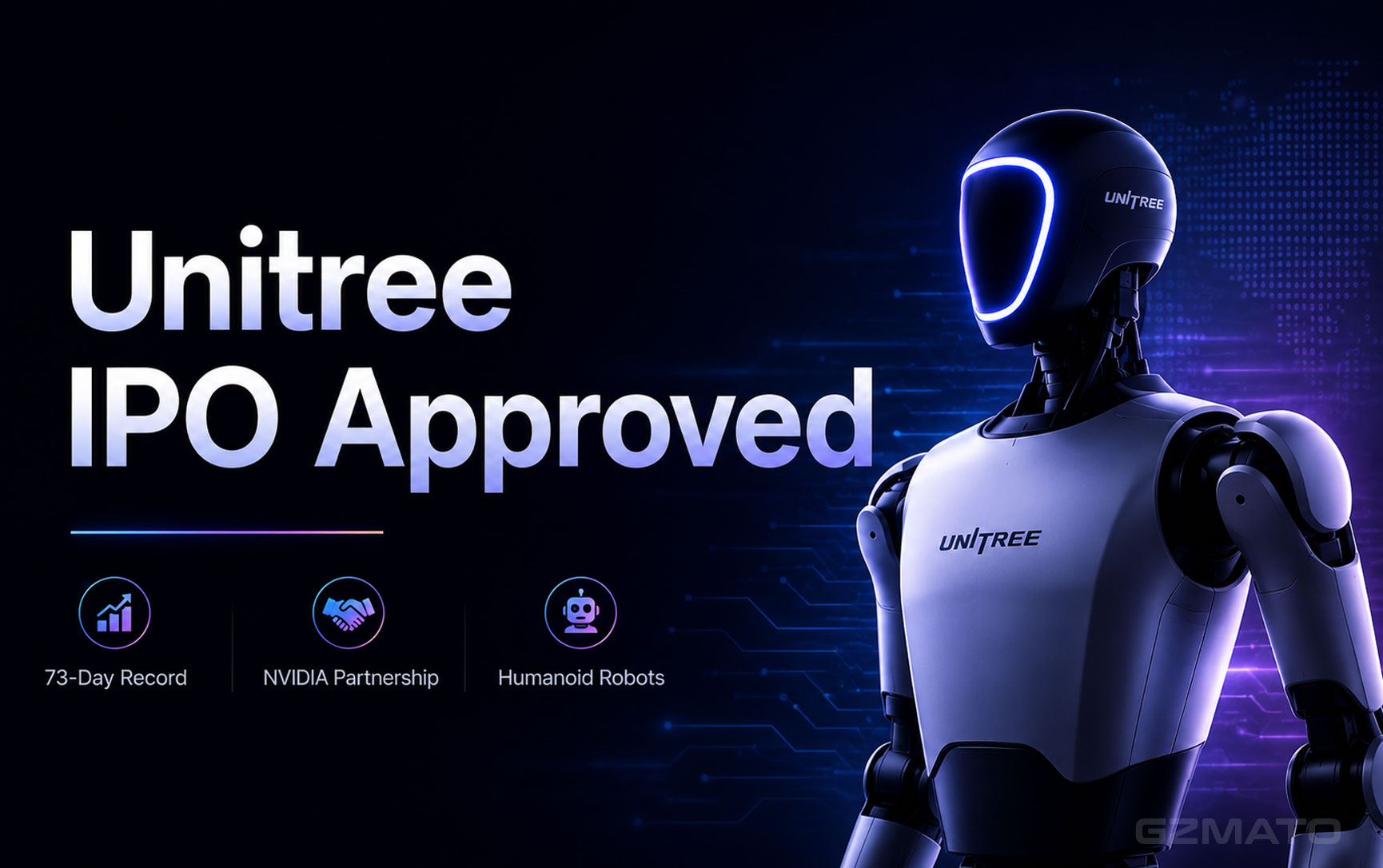
On June 1, 2026, China's STAR Market listing committee approved Unitree Technology's IPO application — clearing the path for the first "embodied AI" listing on the Chinese A-share market. The approval came just 73 days after Unitree's filing was accepted on March 20, setting a new record for the fastest review under the STAR Market's pre-review mechanism.
On the same day, NVIDIA CEO Jensen Huang announced at GTC Taipei 2026 that the company had partnered with Unitree to launch the H2 Plus humanoid robot reference design — with Unitree providing the "body" and NVIDIA providing the "brain".
This is not just an IPO story. It is the convergence of China's most advanced robotics hardware and the world's most powerful AI computing platform, timed perfectly as 2026 shapes up to be the "Year Zero" for humanoid robot commercialization.
NVIDIA Partnership: H2 Plus Robot Coming Late 2026
On June 1, NVIDIA announced at GTC Taipei 2026 that it had selected Unitree's H2 Plus humanoid robot as the reference design for the NVIDIA Isaac GR00T platform — a full-stack development system for humanoid robots.
- Height: 1.82 meters (approx. 6 feet)
- Weight: 68 kg (approx. 150 lbs)
- Degrees of Freedom: 31 total (body), 22 in each Sharpa Wave tactile five-fingered hand
- Arm Torque: Up to 120 N·m (rated), 15 kg peak load
- Leg Torque: Up to 360 N·m
- Availability: Late 2026
In this partnership, Unitree provides the "body" — the H2 Plus humanoid robot platform and Sharpa Wave tactile five-fingered hands. NVIDIA provides the "brain" — the Jetson Thor edge computing platform and the Isaac GR00T software stack, which includes simulation, training, evaluation, and deployment tools.
"Developers want a humanoid robot they can start using immediately to build applications," said Wang Xingxing, Unitree's founder and CEO. "H2 Plus combines Unitree's humanoid robot with NVIDIA Jetson Thor and Isaac GR00T, giving teams a validated starting point for developing robotic skills and applying them to real-world scenarios."
The system is initially targeted at higher education institutions and university researchers — customers already include Stanford University and ETH Zurich. Unitree's market director Huang Jiawei confirmed that H2 Plus will officially launch in the second half of 2026.
For NVIDIA, the partnership solves a critical problem: it needs a high-quality "body" to demonstrate and sell its "brain" software. For Unitree, it solves an equally critical problem: it needs world-class AI to make its hardware truly intelligent. Both companies recognised that building a complete humanoid robot test platform from scratch is too difficult for most research teams — and stepped in to fill the gap.
IPO Details: 73-Day Record, $4.2 Billion Target
Unitree's IPO approval is remarkable for its speed. The company's filing was accepted on March 20, selected for on-site inspection on April 1, and passed the review committee on June 1 — just 73 days.
To put this in perspective, memory chip company Changxin Technology took about five months from filing to review. The average STAR Market review cycle is 183 days. Unitree's approval is even faster than GPU company Moore Threads, which previously set a record of 88 days.
Unitree is the second company to use the STAR Market's "pre-review" mechanism, which allows certain tech companies to engage with regulators before filing their formal application — protecting sensitive business information and accelerating the approval process for critical core technology sectors.
| # | IPO Milestone | Date |
|---|---|---|
| 1 | Application accepted by STAR Market | March 20, 2026 |
| 2 | Selected for on-site inspection | April 1, 2026 |
| 3 | IPO review approved | June 1, 2026 |
| 4 | Expected listing | Q3 2026 (pending registration) |
The company plans to raise 4.202 billion yuan (approximately $620 million USD) by issuing no less than 10% of its shares, implying an IPO valuation of approximately 42 billion yuan (about $6.2 billion USD).
Funds will be allocated to four major projects:
- Intelligent robot model R&D — 2.022 billion yuan (nearly half of total proceeds)
- Robot hardware R&D — continued development of the physical platform
- New intelligent robot product development — next-generation models
- Smart manufacturing base construction — production capacity expansion
Once Unitree completes registration with China's securities regulator and files its issuance plan, it will officially become the "A-share humanoid robot first stock" — a category with no existing listed companies.
Financials: From Startup to Profitability
Unitree's financial trajectory shows a company in rapid transformation. From 2023 to 2025, revenue soared from 159 million yuan to 1.699 billion yuan — a compound annual growth rate of 226.78%.
| Metric | 2023 | 2024 | 2025 |
|---|---|---|---|
| Revenue | 159M yuan | 392M yuan | 1.699B yuan |
| Gross margin | 44.22% | — | 60.13% |
| Adjusted net profit | -18.0M yuan | 78M yuan | 590M yuan |
| Humanoid robot revenue share | 1.88% | — | 51.78% |
| Humanoid robot shipments | — | — | 5,500+ units |
The company turned profitable in 2024 and has maintained strong margins. In 2025, Unitree shipped over 5,500 pure humanoid robots (excluding wheeled dual-arm robots), achieving 8.68 billion yuan in revenue from that segment alone. The company claims global market share leadership in both quadruped and humanoid robot shipments.
The Biggest Winner: Meituan's 12x Return
While the public focuses on Unitree's dancing robots, the real financial winners are its early investors. The prospectus reveals an unexpected name as the largest external shareholder: Meituan, the food delivery and local services giant.
- Total stake: 9.65% (via Hanhai Information, Chengdu Longzhu, and Galaxy Z entities)
- Entry point: February 2024, Series B2 financing, valuation ~3.1 billion yuan
- IPO valuation: ~42 billion yuan
- Return multiple: Approximately 12x in less than 2 years
- Paper value at IPO: Over 4 billion yuan (~$600 million USD)
To put Meituan's stake in perspective:
- Sequoia China: 7.11%
- Shunwei Capital (Lei Jun's fund): 4.42%
- Tencent: 0.60%
- Alibaba: 0.45%
Meituan's holdings exceed the combined stakes of Sequoia China, Shunwei Capital, Tencent, and Alibaba. One investor joked, "This speed is even faster than ordering a Meituan delivery."
Other major shareholders include Tencent, Alibaba, Ant Group, China Mobile, Sequoia China, and Matrix Partners. Founder Wang Xingxing controls approximately 68.78% of voting rights through a dual-class share structure, giving him effective operational control.
Unitree's valuation has grown approximately 1,270 times since its founding, with a wide dispersion of returns depending on investment timing.
The AI Bet: Half of IPO Funds Go to Robot Brains
Perhaps the most telling detail in Unitree's prospectus is where the money is going. Of the 4.202 billion yuan being raised, 2.022 billion yuan (48.1%) is allocated to "Intelligent Robot Model R&D" — the development of AI brains for robots.
This is a dramatic shift. Unitree's total R&D spending over the past three years was approximately 265 million yuan. The company is now planning to invest nearly eight times that amount in AI models alone.
Unitree is pursuing two parallel technical paths for embodied AI:
- WMA (World Model-Action): Open-sourced as UnifoLM-WMA-0
- VLA (Vision-Language-Action): Open-sourced as UnifoLM-VLA-0
In May 2026, Unitree merged these concepts into WVLA 2.0, an embodied AI model focused on autonomous decision-making, disturbance-resistant operation, and multi-task coordination. The company demonstrated the model running on its G1 humanoid robot, which independently identified, sorted, and precisely placed meeting room objects.
This represents a fundamental strategic pivot. Unitree started as a hardware company — first quadruped robots, then humanoids. With this IPO and the NVIDIA partnership, it is transforming into an "embodied AI" company, competing on intelligence as much as on hardware.
Industry Outlook: 2026 as Commercialization Year Zero
Industry analysts view 2026 as the "Year Zero" for humanoid robot commercialization — when robots finally move from laboratory demonstrations to small-scale production and real-world testing.
- Short term (2026–2027): B2B applications — manufacturing, logistics, security patrols
- Medium term (2028–2029): Cost reduction through scaled production; unit economics begin to work
- Long term (2030+): Marginal cost per robot falls below human labor replacement threshold
Key challenges remain:
- Reliability gap: Consistency required for manufacturing environments vs. current demonstration capabilities
- Cost economics: Unit cost must continue falling for robots to replace human labor economically
- Industrial consolidation: Expect rapid consolidation around leaders with both technical capability and cost competitiveness
The competitive landscape is still forming. Tesla, Xiaomi, UBTech, and others are all developing humanoid robots. Unitree's advantages include its existing global shipment leadership, profitability, and — through the NVIDIA partnership — access to world-class AI infrastructure.
Key Takeaways
| # | Key Takeaway |
|---|---|
| 1 | Unitree IPO approved in record 73 days — Setting a new STAR Market speed record; the company will become China's "A-share humanoid robot first stock" |
| 2 | NVIDIA partnership announced same day — Jensen Huang selected Unitree H2 Plus as the reference "body" for Isaac GR00T platform; product launches late 2026 |
| 3 | H2 Plus specifications — 1.82m tall, 68kg, 31 degrees of freedom, 360 N·m leg torque, 120 N·m arm torque |
| 4 | $4.2 billion IPO target — 42 billion yuan valuation based on 10% share issuance; funds allocated primarily to AI model development |
| 5 | Revenue grew from 159M to 1.699B yuan (2023–2025) — 226.78% CAGR; turned profitable in 2024 with 590M yuan adjusted net profit in 2025 |
| 6 | Q1 2026 growth slowing — Revenue growth decelerated to 68%; adjusted net profit fell 52.55% due to heavy R&D investment |
| 7 | Meituan is the largest external shareholder — 9.65% stake worth over 4 billion yuan at IPO; approximately 12x return in under 2 years |
| 8 | Half of IPO funds go to AI "brains" — 2.022 billion yuan allocated to intelligent robot model R&D, signalling strategic pivot toward embodied AI |
| 9 | Open-source AI strategy — Unitree released WMA and VLA models open-source, similar to DeepSeek's strategy, to accelerate ecosystem development |
| 10 | 2026 as commercialization "Year Zero" — Analysts expect humanoid robots to move from labs to small-scale production and B2B testing this year |
- Unitree Technology IPO prospectus (review meeting draft)
- Shanghai Stock Exchange STAR Market listing committee announcement
- NVIDIA GTC Taipei 2026 — Jensen Huang keynote
- China Business Herald — Unitree-NVIDIA partnership report
- Phoenix Finance / 36Kr — Unitree IPO analysis and shareholder structure
- Securities Times — Unitree strategic pivot to embodied AI
- Korea Institute for Industrial Economics and Trade — Korea-China robot industry analysis
Gaming Accessories | Fast Chargers | USB-C Cables | Headphones | Speakers | Power Banks | Travel Adapters
Special Offer: Use code TECH2026 for a discount on your first order!
Shop Now at Gzmato
- Unitree IPO
- humanoid robot
- NVIDIA Isaac GR00T
- H2 Plus robot
- embodied AI
- Wang Xingxing
- Meituan investment
- STAR Market