AI Moves to the Physical World: Bosch, Alibaba, Volkswagen Find Common Ground
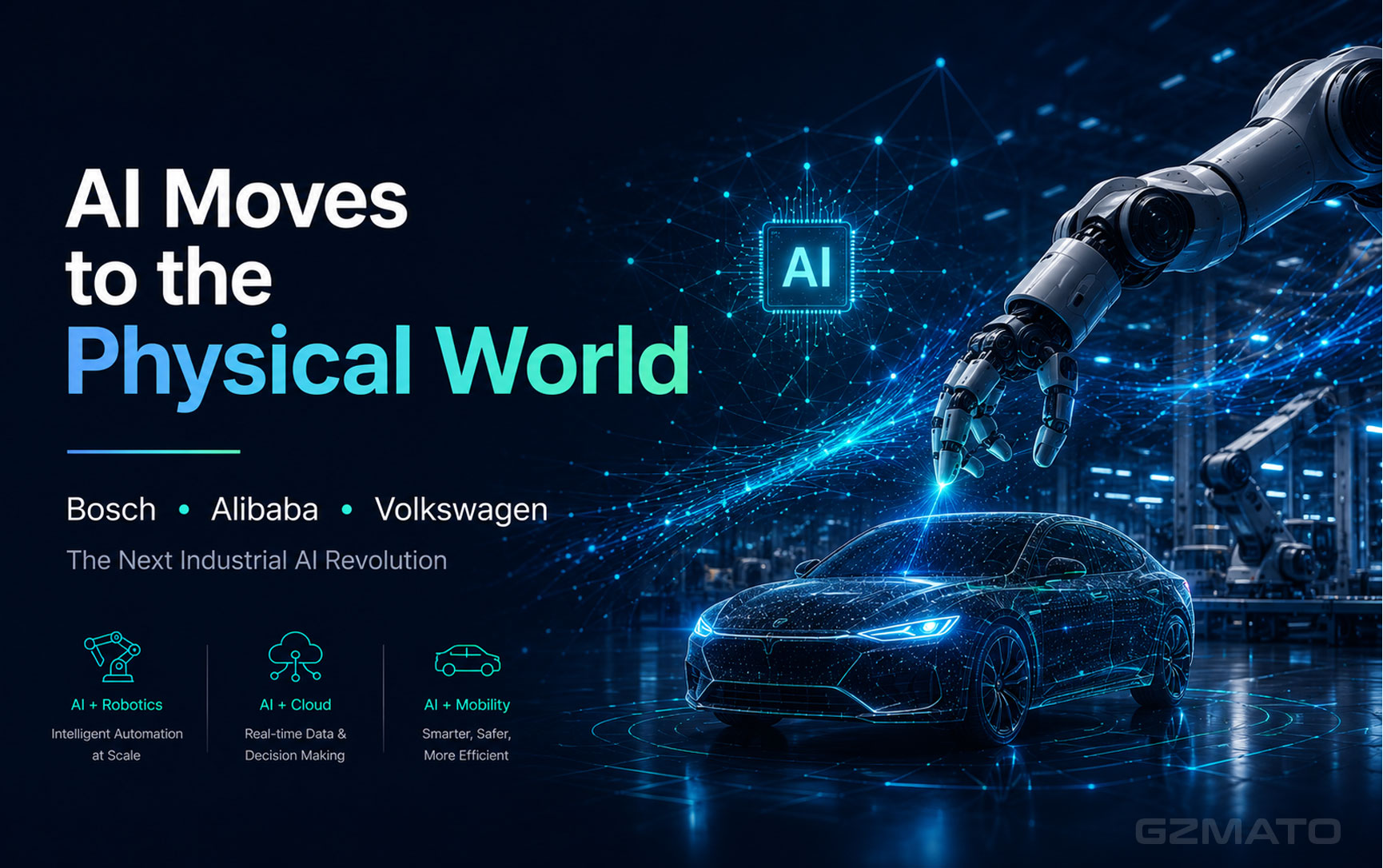
AI Moves to the Physical World: A New Consensus Emerges
From June 10-11, 2026, Bosch hosted its annual "Connected World" conference in Berlin. Over two days, leaders from manufacturing, technology, and automotive industries gathered to discuss AI's next phase — and they reached a strikingly consistent conclusion [citation:1].
The message was clear: AI is moving from generating digital content to transforming the physical world. The next frontier is not better chatbots or more creative image generators. It is robots that understand factory floors, cars that become companions, and industrial systems that optimize themselves with data [citation:1].
Three voices stood out at the conference — Bosch's CEO Hartung, Alibaba's Chairman Tsai, and Volkswagen's CEO Blume — each representing a different link in the industrial chain. Together, they painted a picture of AI's future that every technology professional should understand.
Bosch: Factories Will Be the First Key Deployment
Stefan Hartung, Chairman of Bosch's Board of Management, delivered the most concrete assessment of where humanoid robots will actually go first. His answer: factories, not homes [citation:1].
Hartung explained that while humanoid robots are entering a rapid development phase, their large-scale deployment depends entirely on scenario maturity. Industrial environments — with their higher standardization, controlled conditions, and repetitive tasks — are far better suited for robotic training and iteration than the chaotic unpredictability of home settings [citation:1].
- "The factory is not just an application scenario — it is also a training scenario." Industrial environments provide the controlled conditions necessary for robot learning.
- Robots are evolving from executing tasks to "understanding the environment." Future embodied AI robots will need to integrate vision, touch, and other perception capabilities.
- The core of intelligence is deep coupling between hardware systems and AI. "A robot is not a single technology product, but a highly integrated system."
- MEMS sensors are key to understanding the physical world. They enable robots to perceive their environment holistically [citation:1].
Hartung acknowledged that robot innovation is now driven by a global network of companies, startups, and research institutions — and he pointed specifically to China's growing role. "China has the world's largest and most complete manufacturing system, providing rich real-world application scenarios," he said, adding that a large number of Chinese startups and research institutions are rapidly driving technological iteration [citation:1].
Earlier this year, Bosch established a robotics center in China to coordinate collaborative innovation with local partners, accelerating the development, testing, and commercial deployment of robotics solutions [citation:1].
Alibaba: China's Manufacturing Data Is the Real Advantage
Joe Tsai, Chairman of Alibaba Group, took a broader view. His central argument: the ultimate value of AI lies not in developing frontier models, but in deploying AI applications that benefit society at scale [citation:2][citation:4].
Tsai revealed a staggering figure: global hyperscale cloud providers are expected to invest approximately $800 billion in capital expenditure this year alone, with continued growth ahead. Much of this spending is going toward what he called "AI factories" — the massive computing infrastructure needed to train and run AI models [citation:1].
But Tsai's most provocative point concerned data. He noted that Germany and China, as the world's two most important manufacturing nations, possess enormous quantities of factory data, production process data, and industrial scenario data. "AI cannot function without data," he said. These industrial datasets will become the foundation for the next generation of industrial AI development [citation:1].
Looking ahead, Tsai predicted that AI's next stage will move from the digital world to the physical world. The opportunities ahead are not limited to robots — they extend to every application scenario connected to the real economy. With massive industrial data, AI could play a much larger role in product R&D, manufacturing, quality inspection, and operational optimization. Manufacturing will be one of AI's most promising development directions [citation:1].
He specifically highlighted China's rapidly growing new energy vehicle industry as an engine for autonomous driving technology, and noted that manufacturing and industrial process data will become the critical foundation for the next phase of AI model training [citation:1].
Volkswagen: AI Is Reshaping the Auto Industry
Oliver Blume, CEO of Volkswagen Group, described a transformation that is already underway. The automotive industry, he said, is moving through three phases: from mechanical drive to software drive, and now to AI-powered transformation [citation:1].
AI is simultaneously changing two things: how cars are developed, and what cars themselves can do. Blume noted that AI is being deployed across smart cockpits, voice interaction systems, autonomous driving technology, and even internal R&D processes. "AI is becoming the core technical foundation connecting perception, decision-making, and execution." [citation:1]
- Launching late 2026: CEA architecture models will feature in-vehicle AI agents trained on local large language models
- Fully on-device operation: All data processing stays in the vehicle, protecting user privacy
- Capabilities beyond voice: The AI agent can proactively understand user needs, execute complex operations across vehicle systems through natural conversation, and make decisions based on context [citation:5]
- Future roadmap: CEA 2.0 architecture in 2027 will coordinate multiple AI agents across driving, cabin, and cloud services
Blume also revealed that Volkswagen is developing smart driving systems in partnership with Chinese companies and plans to launch them first in the Chinese market. He called China an "essential part" of Volkswagen's global innovation system — the company now has its largest R&D center outside Germany in China, with more than 3,000 engineers and software developers [citation:1].
"In a rapidly changing market environment, China is not only an important sales market but is also becoming a significant source of technological innovation," Blume said. "We are able to benefit from China's innovation speed and digital expertise and bring these lessons to other regions of the world" [citation:1].
China's Unique Position: The "AI+Manufacturing" Advantage
Across all three speakers, a consistent theme emerged: China's role in the physical AI revolution is not incidental — it may be decisive.
Hartung noted China's combination of the world's largest manufacturing system and a vibrant startup ecosystem. Tsai emphasized China's industrial data advantage and the country's commitment to open-source AI models. Blume pointed to China's innovation speed and digital expertise as lessons for the rest of the world.
This is not just talk. Concrete developments were announced at the conference:
- Bosch's robotics center in China is already coordinating collaborative innovation with local partners [citation:1]
- Volkswagen will launch AI agents in China later this year, with full on-device large language models [citation:5]
- Alibaba is pushing AI adoption across consumer, enterprise, healthcare, and financial sectors, using its self-developed Qwen model as the foundation [citation:2]
Key Takeaways
| # | Key Takeaway |
|---|---|
| 1 | AI is moving from digital to physical — The consensus from Bosch, Alibaba, and Volkswagen is that AI's next frontier is the real world, not better chatbots. |
| 2 | Factories, not homes, will see humanoid robots first — Industrial environments offer standardized, controllable conditions ideal for training and deployment. |
| 3 | Manufacturing data is the new oil — Tsai emphasized that Germany and China's industrial data will be the foundation for next-generation industrial AI. |
| 4 | Global AI capex is massive and growing — Hyperscale cloud providers will invest ~$800 billion this year in "AI factories." |
| 5 | Auto AI agents are arriving in 2026 — Volkswagen's CEA architecture models will feature on-device LLM-powered agents, with full vehicle control via natural conversation. |
| 6 | China's open-source strategy is paying off — Tsai argued that open-source models have broken down technology barriers, making AI a global public good. |
| 7 | Integration, not just algorithms, will separate winners from losers — Hartung's key point: intelligence requires deep coupling between hardware and AI, not just better models. |
- Xinhua Finance / China Financial Information Network — Bosch Connected World conference coverage (June 12, 2026)
- The Paper — Alibaba Joe Tsai speech at China Development Forum (March 22, 2026)
- Shanghai Securities News / Sina Finance — Tsai's four-factor analysis of China's AI success (March 22, 2026)
- International Online (CRI) — Volkswagen "Agentic AI for All" roadmap and Beijing Auto Show announcements (April 22, 2026)
- CRI (Traditional Chinese) — Same Volkswagen announcements, alternative source
- Observer.com / NetEase News — Volkswagen localization strategy and chip choices (April 22, 2026)
AI-Ready Laptops | Smart Home Devices | Fast Chargers | USB-C Cables | Power Banks | Tech Accessories
Special Offer: Use code TECH2026 for discount on your first order!
- physical AI
- embodied AI
- industrial AI
- Bosch Connected World
- Joe Tsai AI
- Volkswagen AI agent
- China manufacturing data
- humanoid robots factories