China's First Mandatory L3/L4 Autonomous Driving Standard: What It Means
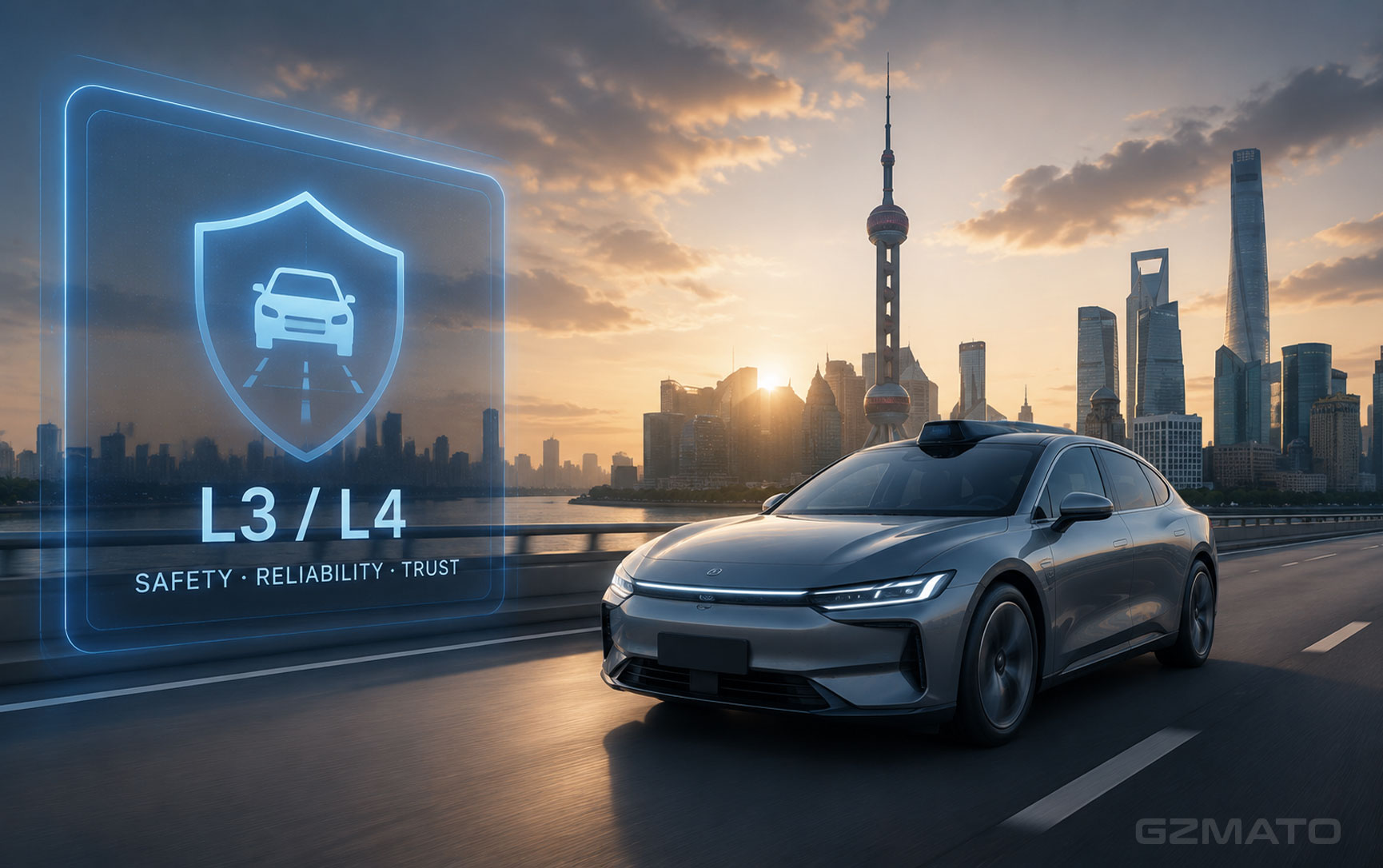
August 5, 2026 — On August 4, China's Ministry of Industry and Information Technology (MIIT) published the mandatory national standard GB 44721—2026 "Intelligent and Connected Vehicles — Safety Requirements for Automated Driving Systems" [citation:2][citation:3]. The standard, approved by the State Administration for Market Regulation and the Standardization Administration of China, will take effect on July 1, 2027 [citation:1].
This is China's first mandatory national standard for Level 3 (conditional) and Level 4 (high) autonomous driving systems [citation:2]. For an industry that has operated largely on voluntary guidelines and local pilot programs, this new regulation marks a fundamental shift—one that will reshape how automakers develop, test, and deploy autonomous vehicles [citation:4].
Scope: L3/L4 M and N Class Vehicles
The standard applies to M class (passenger) and N class (cargo) vehicles equipped with Level 3 or Level 4 automated driving systems [citation:2][citation:3]. It does not cover automated parking systems [citation:3].
This coverage is significant. M class vehicles include passenger cars, buses, and vans. N class includes commercial trucks and delivery vehicles. The standard therefore applies across both consumer vehicles and commercial fleets where L3/L4 automation is most immediately relevant.
The timeline is equally important. The July 2027 effective date gives the industry roughly 11 months to prepare [citation:1]. This is not a distant deadline—it is a concrete milestone that will dictate product development cycles for the next two years [citation:4].
The Four Pillars of the New Standard
The standard is built around four core requirements [citation:2]:
- Full Life-Cycle Safety Management: Manufacturers must establish safety capabilities across four dimensions—safety policy, risk management, safety assurance, and safety improvement. This covers the entire product life cycle from design through production and post-deployment [citation:2].
- System Safety Performance: The automated driving system must perform at a level at least equivalent to a competent and attentive human driver. The standard also specifies minimum risk maneuver requirements and the conditions for their activation [citation:1].
- Human-Machine Interaction and User Information: Activation and deactivation must be safe. For L3 systems, driver takeover capability monitoring is mandatory [citation:3]. Manufacturers must clearly communicate automation levels, system capabilities and limitations, and control strategies to users [citation:2].
- Multi-Dimensional Testing and Verification: The standard requires a three-part verification system: (1) manufacturer safety capability assessment, (2) safety file review, and (3) confirmatory testing using simulation, track, and public road methods [citation:2].
These four pillars represent a significant departure from the previous voluntary standard. Chinese Academy of Engineering academician Li Jun described the shift as a transition from a "driver is fully responsible" model to an "operational safety" era [citation:1].
Li Jun identified four core challenges that the new standard creates [citation:1]:
- How to standardize the measurement of safety over a vehicle's full life cycle
- How to make AI algorithms, perception systems, and decision logic fully verifiable and trustworthy
- How to prove that the remaining residual risk is acceptable to ordinary people
- How to continuously identify and eliminate unknown dangerous scenarios that appear on the road
Hu Chuan, associate professor at Shanghai Jiao Tong University, noted that the new standard "clarifies the safety boundaries of automated driving systems, ensures effective takeover mechanisms and risk handling procedures, and holds enterprises accountable for safety performance throughout the R&D, production, and post-deployment phases" [citation:1].
Industry Impact: From Performance Race to Safety Race
Industry analysts and executives have described the standard as a threshold event that will reshape the competitive landscape [citation:4].
Increased barriers to entry: The new compliance requirements—algorithm self-development, massive real-world scenario data, full-process simulation testing, safety system documentation, and closed-loop safety files—are beyond the reach of companies that rely on third-party algorithm integration [citation:5]. As Huazheng Securities analysts noted, "a single algorithm or hardware solution no longer meets the compliance requirement" [citation:5].
New hardware baselines: To achieve L3 compliance, vehicles will need at least 200 TOPS of computing power; for L4, 1,000 TOPS or more, with multi-sensor fusion including LiDAR, millimeter-wave radar, and cameras [citation:5]. Brake-by-wire and steer-by-wire systems face unified safety benchmarks [citation:5].
From performance to safety: Economist and MIIT expert Pan Lin predicted the industry will shift from performance-based competition to safety-based competition [citation:4]. "Companies that fail to meet standards will be eliminated, exaggerated claims will stop, and the supply chain will face a new round of consolidation," he said [citation:4].
Full life-cycle responsibility: The standard represents a permanent shift in liability [citation:1]. As Li Jun put it: "In the future, selling high-level autonomous vehicles requires automakers to continuously prove safety, monitor vehicles on the road in real time, and bear safety responsibility for the life of the vehicle" [citation:1].
| Dimension | Change |
|---|---|
| Responsibility | Driver is fully responsible → Automaker must prove safety throughout the life cycle [citation:1] |
| Certification | Single testing → Continuous evidence collection over the vehicle's life [citation:1] |
| Regulatory oversight | Pre-approval only → Continuous monitoring and evidence retention [citation:1] |
| Testing | Voluntary standards → Mandatory multi-dimensional testing [citation:2] |
| L3 requirement | No requirement → Driver takeover monitoring mandatory [citation:3] |
China's Regulatory Leadership
The new standard aligns China with global regulatory trends. In June 2026, the UN's Automated Driving Systems Global Technical Regulation (ADS GTR) was formally approved, with China as a co-sponsor [citation:5]. The Chinese standard maintains technical consistency with the UN's GTR while introducing more detailed specifications for L3/L4 systems and a standardized testing scenario system tailored to Chinese road conditions [citation:5].
2025 saw two L3-certified models receive conditional approval in China [citation:3]. Wang Ning, director of the Automotive Industry and Technology Strategy Research Center at Tongji University, stated that the new standard "supports companies going global" and "enhances China's influence over global rules" [citation:1].
For the autonomous vehicle industry, the standard is a catalyst for commercialization [citation:4]. Beijing University of Technology professor Ji Xuehong said: "Autonomous driving safety standards provide clear requirements for L3 and L4 commercialization... from the second half of this year through 2027, L3 autonomous driving will achieve scale and further realize commercial value" [citation:4].
Key Takeaways
| # | What You Need to Know About China's First Mandatory L3/L4 Autonomous Driving Standard |
|---|---|
| 1 | Published August 4, 2026, effective July 1, 2027 — China's first mandatory national standard for L3/L4 autonomous driving systems [citation:2] |
| 2 | Applies to M and N class vehicles — passenger cars, buses, vans, and commercial trucks with L3/L4 systems [citation:2] |
| 3 | Four pillar framework — full life-cycle safety management, system safety performance, human-machine interaction, and multi-dimensional testing [citation:2] |
| 4 | L3 vehicles must have driver takeover monitoring — mandatory requirement for all L3 systems [citation:3] |
| 5 | Full life-cycle responsibility — automakers must prove safety continuously, not just at launch [citation:1] |
| 6 | Industry shift from performance to safety — non-compliant companies face elimination; supply chain consolidation ahead [citation:4] |
| 7 | Hardware baselines rising — L3 requires 200+ TOPS, L4 requires 1000+ TOPS with multi-sensor fusion [citation:5] |
- 工信部 / 国家市场监管总局 — GB 44721—2026 standard publication, August 4, 2026
- 上海证券报 — Academician Li Jun and industry expert analysis, August 5, 2026 [citation:1]
- IT之家 — Standard scope and pillar breakdown, August 4, 2026 [citation:2]
- 新华社 / 四川日报 — L3 takeover monitoring requirement, August 4, 2026 [citation:3]
- 北京日报 — Industry impact and expert commentary, August 5, 2026 [citation:4]
- 浙商证券 / 华龙证券 — Hardware market and compliance analysis, August 2026 [citation:5]

- L3 autonomous driving
- L4 autonomous driving
- GB 44721
- China autonomous driving regulation
- autonomous driving safety standard
- ADAS regulation
- self-driving car China
- Gzmato