The Flying Hoverboard AI Is the Coach, Not the Autopilot
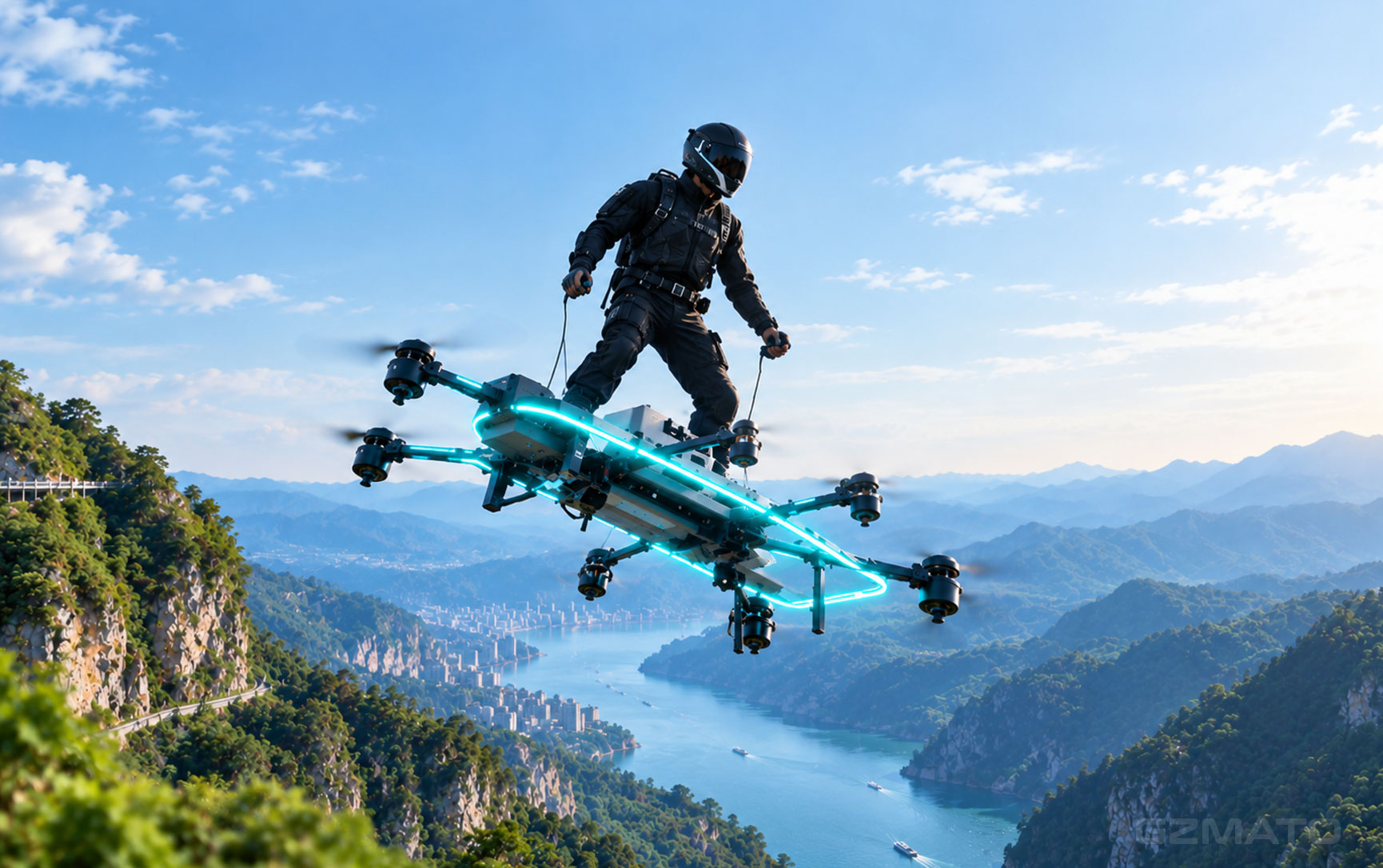
October 20, 2026 — A homemade flying hoverboard crossed the Yangtze River earlier this month. The video went viral almost instantly, and the reaction was predictable: it looked like something out of a sci-fi movie. But the story behind it is more interesting than the spectacle. It is a story about what happens when a determined builder uses AI as a tool — not to fly the board, but to learn how to fly it.
The board's creator is a 26-year-old from Hubei named Song Xingyu, known online as "Shenqi Ayu." He built the device in two months, from scratch, after an earlier jet-powered version caught fire during testing.
How It Actually Works
The hoverboard's design is brutally simple: ten electric motors, a frame, a battery pack, and a finger-mounted throttle. There is no flight controller, no gyroscope array feeding a stability algorithm, and no automatic thrust vectoring.
| Component | Detail |
|---|---|
| Propulsion | 10 high-power brushless motor sets, each producing 30+ kg of thrust |
| Power draw | Up to 2,000 amps at peak |
| Control | Finger-ring throttle — the pilot directly manages motor speed |
| Balance | Fully manual — the pilot uses body weight and core strength to stay level |
| "AI" system | Two smartphones: one on the board for attitude sensing, one on the wrist for AI voice feedback via Bluetooth |
The first version used five micro turbojet engines. During testing, it caught fire — the exhaust gases from adjacent engines were being sucked back into the intakes. Song fed the data to an AI model, which analyzed the thermal imaging and recommended abandoning the jet design in favor of electric propulsion. That advice led to the 2.0 version.
The AI's Real Job: Voice Coach, Not Flight Control
This is the part most coverage gets wrong. The AI in this project is not flying the board. It cannot adjust motor speeds or vector thrust. It cannot correct the pilot's balance.
What it does is simpler, and in its own way more clever: it acts as a real-time coach.
One phone is mounted on the board, using its sensors to measure tilt and orientation. The other is worn by the pilot. The AI analyzes the board's attitude and sends voice prompts through a Bluetooth earpiece: "lean left," "bend your right knee," "center your weight." The pilot then makes the adjustment manually.
Building a closed-loop flight controller for a 2,000-amp, 10-motor platform is an enormous engineering challenge. It requires precise sensor fusion, extremely low-latency motor control, and extensive tuning. Song had two months and a limited budget. Using AI as a coaching layer — rather than a control layer — was a pragmatic compromise. It allowed him to fly safely without building a full autopilot system from scratch.
A Reader's Perspective: The Next Step for Stabilization
One of our readers, Stephen Roach, looked at the engineering challenge from a constructive angle — not critiquing what it lacks, but pointing to where it could go next:
His suggestion points directly at the gap between this project and a commercially viable product. The hardware is already there — the motors are powerful enough, the frame holds, the battery delivers. What is missing is the software layer that turns raw power into controlled flight.
Why a Drone Hovers Itself, But This Doesn't
It is worth explaining why a DJI drone can hover perfectly in place with zero pilot input, while a 100,000-watt hoverboard requires constant human adjustment.
The difference is control loop latency and redundancy. A drone's flight controller reads sensor data thousands of times per second and adjusts motor speeds in microseconds. It is designed from the ground up for stability. The hoverboard has no such system — it relies on the pilot's nervous system and muscles to close the loop. The human reaction time (around 200 milliseconds) is far too slow for the precision required at this power level, which is why the board is so difficult to ride.
The Safety Reality
The board's creator has been transparent about the risks. The first version caught fire. The second version draws enough current to melt conventional wiring. The flight across the river was conducted after submitting a flight plan to local authorities.
Chinese state media coverage of the event included explicit warnings: this is a high-risk experimental project, and it should not be replicated. That is not a formality. The combination of 2,000 amps, 10 motors, and a human body standing on an unenclosed platform is inherently dangerous.
Key Takeaways
| # | What You Need to Know About the Flying Hoverboard |
|---|---|
| 1 | It is fully manual — no automatic balancing, no flight controller, no thrust vectoring. The pilot balances with core strength. |
| 2 | The AI is a voice coach, not an autopilot — two phones measure attitude and give verbal guidance, but the pilot makes every adjustment. |
| 3 | 10 brushless motors, 30+ kg thrust each — total thrust sufficient to lift four adults, drawing up to 2,000 amps at peak. |
| 4 | The first version was jet-powered — it caught fire during testing, and AI analysis recommended switching to electric propulsion. |
| 5 | A drone hovers itself because of its flight controller — this board has no such system, which is why it is so difficult to ride. |
| 6 | The 300-meter river crossing was a real, verified flight — conducted after submitting a flight plan to local authorities. |
| 7 | This is not a consumer product — state media explicitly warned against replication. The risks are real and the safety net is the pilot's own reflexes. |
- 长江云新闻 — Flight verification, river crossing details, safety warnings
- 极目新闻 — Creator background, 2.0 version specifications, AI coaching system
- 湖北日报 — Technical details, motor configuration, AI-assisted development process
- IT之家 — AI crash analysis leading to electric redesign, smartphone-based attitude monitoring
- 抖音 / 神奇阿宇 — Original video footage, flight demonstration, AI voice coaching implementation
- Stephen Roach — Reader contribution on future stabilization engineering and safety
Drones | PC Components | RC Accessories | Electronic Parts
Special Offer: Use code TECH2026 for a discount on your first order!
Shop Tech at GzmatoOur team can help you explore related electronics, sensors, and components. Chat with us or open a request.


- flying hoverboard
- Song Xingyu
- Shenqi Ayu
- DIY hoverboard
- AI assisted flight
- manual balance hoverboard
- 10 brushless motors
- hoverboard safety
- Gzmato