100,000 AI Cards in 2,000 Square Meters: Inside China's Fully Domestic Supercluster
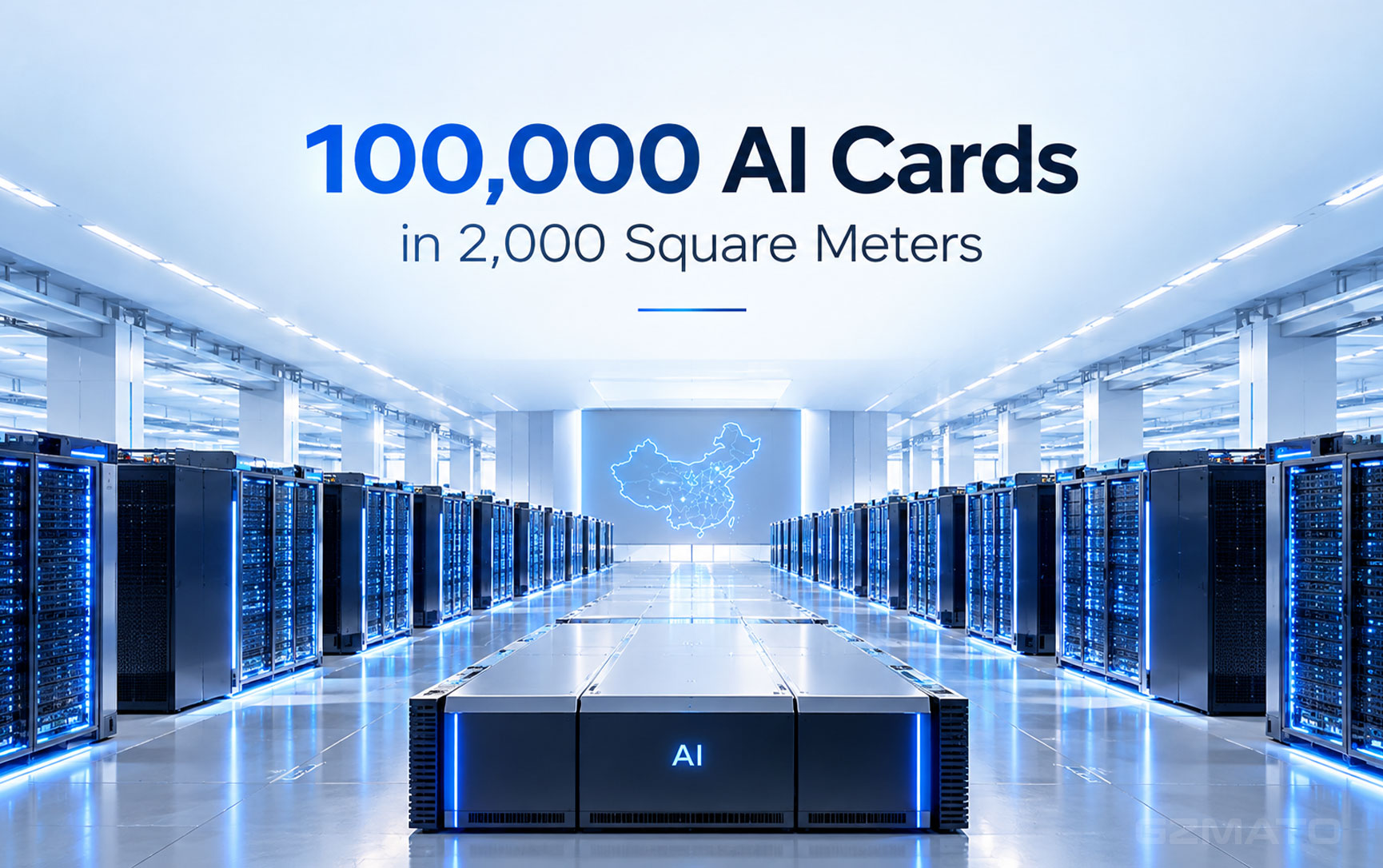
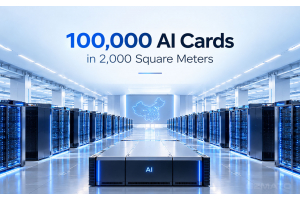
October 19, 2026 — On October 18, at the 2026 CCF National High Performance Computing Academic Conference in Shenzhen, China's first fully domestic 100,000-card AI supercluster made its public debut. The official description was striking: it can "fit a universe" inside.
But the number that matters most is not 100,000. It is 2,000 — the square meters of floor space the entire system occupies. That density is what makes this a genuine engineering milestone, not just a headline.
What "100,000 Cards" Actually Means
To understand the scale, it helps to compare against what came before. Until recently, the largest AI clusters in China were measured in thousands of cards. Moving to 100,000 is not a simple multiplication problem — it is a different class of engineering challenge.
At this scale, the bottlenecks shift entirely. A thousand cards can be connected with conventional networking. A hundred thousand cards cannot. Data has to flow between them at rates that overwhelm traditional storage architectures. Heat generation becomes a building-level problem. And managing the entire system without it collapsing under its own complexity requires a level of software orchestration that few organizations have ever attempted.
The numbers from the official disclosure give a sense of what was built: 30 billion electronic components, assembly precision held to 0.05 millimeters, and a total system weight of 1,500 tons — roughly equivalent to three fully loaded Boeing 747s [citation:11]. The 1,600 kilometers of internal cabling, if laid end to end, would stretch from Zhengzhou to Harbin [citation:11].
How They Fit It: The Engineering Problem
The most interesting part of the Sugon 8000 story is not the card count. It is how the team solved the three problems that make 100,000-card clusters so difficult: network, storage, and cooling.
Network: The "Super Tunnel"
When 100,000 cards are working on the same task, they need to exchange data constantly. Traditional storage architectures use a "shared channel" design, which means different tasks compete for the same bandwidth. At scale, this causes I/O congestion — one task's massive read/write request can stall everything else, and GPUs sit idle waiting for data [citation:3].
Sugon's solution was to build what they call a "Super Tunnel." Instead of a shared highway, each compute card is paired with its own dedicated storage CPU, creating an independent data path. The system creates billion-level tunnels, each with its own micro-controller, zero-interrupt processing, and zero-copy data transfer. The result: the storage subsystem can handle nearly 100 million read/write requests per second with sub-millisecond latency [citation:3].
Cooling: Chips in a "Bath"
The heat problem is almost absurd. When running at full load, the 100,000 cards generate heat equivalent to burning 12 tons of standard coal per hour — roughly 98 megawatts of continuous thermal load concentrated in 2,000 square meters. That is nearly 50 kilowatts per square meter, compared to 1–2 kilowatts per square meter in a traditional data center [citation:9].
Air cooling cannot handle this. The Sugon 8000 uses immersion phase-change liquid cooling: the motherboards are submerged in a fluoride liquid with a boiling point around 50°C. As the chips heat up, the liquid boils and carries heat away through phase change, which is far more efficient than pumping cold air. The result is a PUE (Power Usage Effectiveness) below 1.04, meaning almost all electricity goes to computation, not cooling [citation:11].
Why "Fully Domestic" Matters
The "全国产" (fully domestic) label is not just a patriotic flourish. In the current environment, it is the core of the story.
For the past two years, the global AI hardware supply chain has been under extreme pressure. HBM memory, advanced packaging, and high-end GPUs have been constrained by AI data center demand. The memory shortage has pushed up prices across consumer electronics. For Chinese AI infrastructure, there is an additional layer: access to the most advanced chips is restricted.
The Sugon 8000 addresses this by going fully domestic across the entire stack: Hygon chips as the compute foundation, scaleFabric RDMA networking for high-reliability connections, ParaStor distributed storage (which ranked #1 on the 2026 IO500 production cluster list), and domestic liquid cooling technology [citation:4][citation:12].
This does not mean the individual components are the fastest in the world. It means the system as a whole works — and that is a different kind of achievement.
The Real Test: Applications, Not Benchmarks
A supercluster's value is not measured by how fast it can run a benchmark. It is measured by what scientists and engineers can actually do with it.
The Sugon 8000's first batch of results is genuinely impressive:
| Application | What It Achieved |
|---|---|
| "Qianyan" Cosmological Simulation | Reproduced cosmic evolution using 4 trillion dark matter particles, described by international peers as pushing the limits of numerical cosmology [citation:9] |
| Protein Folding | Accelerated the full simulation workflow using 80,000 cards, directly serving new drug development [citation:12] |
| Turbulence Simulation | Completed 328 trillion grid direct turbulence simulation using 88,000 cards, supporting aviation and shipbuilding [citation:12] |
| DFT Precision Simulation | Simulated 31.6 trillion atoms with DFT-level precision using 90,000 cards [citation:12] |
| Digital Twin Brain | Fudan University team built the world's first 100-billion-neuron scale digital twin brain [citation:9] |
The system has already completed over 300 application optimizations across 20+ fields including materials, electromagnetics, quantum computing, biomedicine, and astronomy [citation:10]. In its first week of operation, it processed an average of 150,000 jobs per day, with a single-day peak exceeding 500,000 [citation:9].
What This Means for You
For most readers, a 100,000-card supercluster is not something you will interact with directly. But it has downstream effects that are worth understanding.
- AI training costs may eventually come down. More domestic compute capacity means less reliance on expensive, constrained imports. If the cluster is used efficiently, the cost of training large models in China could decrease over time — though that depends on many factors beyond raw hardware.
- Scientific research accelerates. The applications listed above are not consumer products, but they lead to better drugs, more efficient aircraft, and deeper understanding of physics. Those benefits take years to reach consumers, but they are real.
- The "compute as a utility" model gets closer. The Sugon 8000 is connected to the national supercomputing network and available to researchers, universities, and enterprises. The goal is to make compute accessible the way electricity is accessible — not something you build yourself, but something you plug into [citation:10].
For comparison, the Sugon 8000's 100,000 cards and 2,000 square meters represent a very different design philosophy from the "compute towns" being built in the United States, which often sprawl across millions of square meters. The compact, high-density approach is shaped by China's land and energy constraints, but it also produces a system that is easier to cool efficiently and easier to manage as a single unit.
Key Takeaways
| # | What You Need to Know About the Sugon 8000 |
|---|---|
| 1 | 100,000 domestic AI cards in 2,000 square meters — 133,340 compute nodes, 1,600 km of cabling, 1,500 tons total weight. |
| 2 | The engineering challenges were network, storage, and cooling — not just the card count. |
| 3 | "Super Tunnel" storage solves the I/O bottleneck — nearly 100 million read/write requests per second with sub-millisecond latency. |
| 4 | Immersion liquid cooling achieves PUE below 1.04 — chips are submerged in a liquid that boils at 50°C, carrying heat away through phase change. |
| 5 | Fully domestic stack — Hygon chips, self-developed RDMA networking, ParaStor storage (IO500 #1), domestic cooling. |
| 6 | Real applications, not just benchmarks — 4 trillion particle cosmology simulation, 31.6 trillion atom DFT simulation, 100-billion-neuron digital brain. |
| 7 | Connected to the national supercomputing network — available to researchers and enterprises, with 150,000 jobs processed per day in its first week. |
- CCTV — 100,000-card supercluster debut, application results, 2,000 sqm density [citation:1][citation:7][citation:8]
- Tianji Net — "Super Tunnel" storage architecture, I/O performance details [citation:3]
- Qianjia Net — Physical scale, cooling load, PUE, application results [citation:9]
- Global Times / NetEase — Immersion cooling details, physical dimensions, total weight [citation:11]
- IT168 — Full domestic stack, Hygon chips, IO500 ranking, application results [citation:12]
- Oriental Securities — System architecture, "super-intelligence fusion" technical route [citation:4]
- CCTV News — National supercomputing network connection, open access model [citation:10]
PC Components | Storage | Networking | Accessories
Special Offer: Use code TECH2026 for a discount on your first order!
Shop Tech at GzmatoOur team can help you explore related tech products and understand the hardware ecosystem. Chat with us or open a request.
- Sugon 8000
- 100
- 000 card AI cluster
- domestic AI supercluster China
- immersion liquid cooling
- super tunnel storage
- Hygon AI chip
- national supercomputing network
- Gzmato