IFA 2026: Chinese Robot Army Takes Over Berlin, Physical AI Ignites Europe
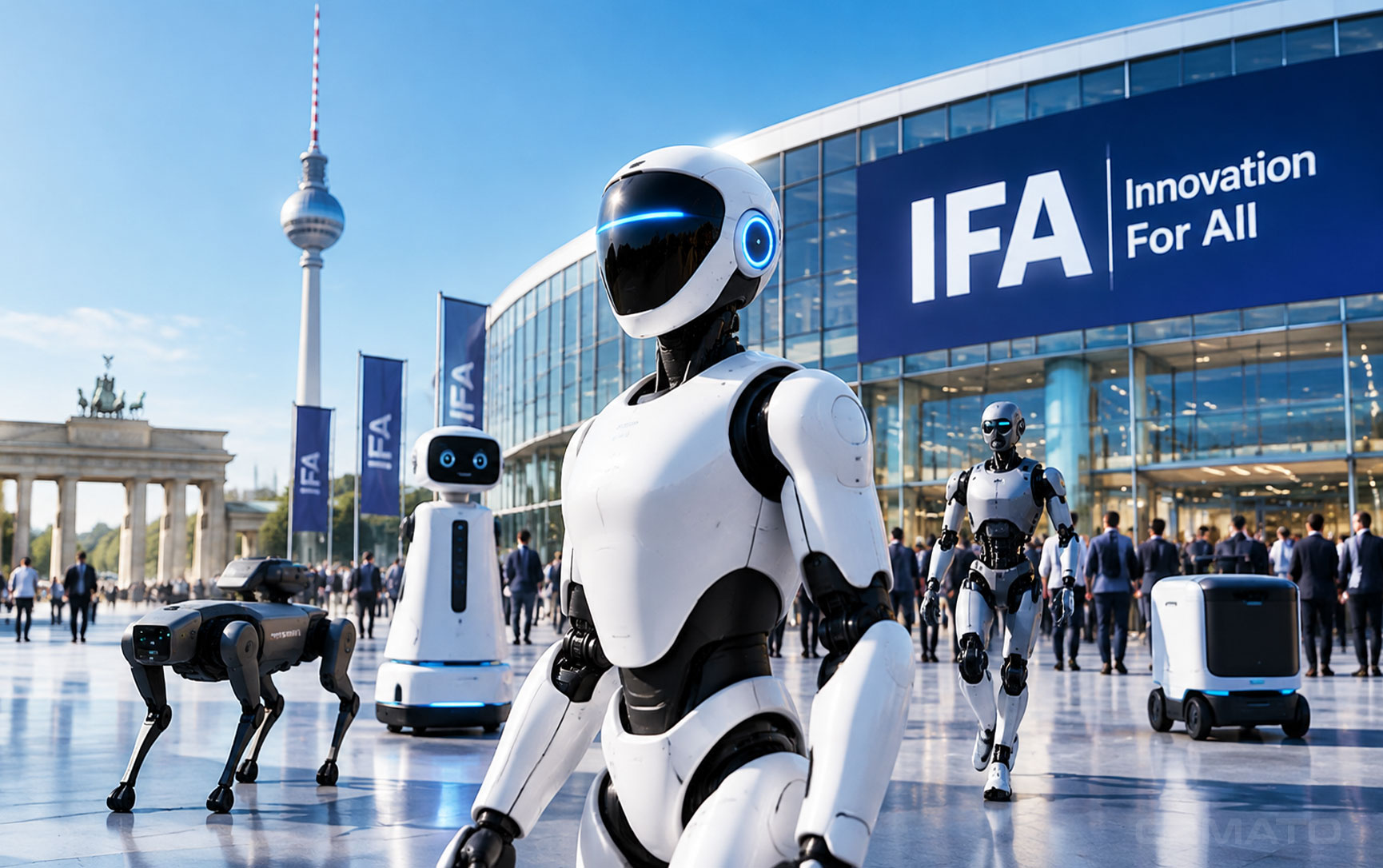
BERLIN — September 4, 2026. The doors to the Berlin Exhibition Center opened for IFA 2026, and something had changed [citation:3].
Walking through the halls, you'd see humanoid robots kicking, dancing, and waving. AI refrigerators, washing machines, and ovens that talk back. AI glasses, AI pets, AI exoskeletons. A century-old radio and consumer electronics show had become a physical AI exhibition [citation:3].
And standing at the front of this transformation, once again, were Chinese companies [citation:3].
IFA CEO Leif Lindner put it simply: "AI is increasingly entering the physical world." [citation:3]
By the Numbers: 1,000+ Chinese Companies, Half the Show
According to on-site statistics, 932 companies from Chinese mainland exhibited at IFA 2026. Together with Hong Kong, Macao, and Taiwan exhibitors, the number exceeded 1,000 companies — more than half of all exhibitors, setting an all-time record [citation:3].
Walk through any hall, and Chinese conversations were everywhere. The scale was unlike anything IFA had seen before [citation:3].
Companies like TCL, Hisense, Changhong, Haier, and Midea all launched full-scenario AI solutions, with pavilions covering thousands of square meters [citation:3]. Xiaomi made its IFA debut — its Mijia brand officially announcing its large-scale entry into the European market [citation:3][citation:12].
And then there were the robots.
Berlin Robot Parade: China's Humanoid Army
IFA's "Next" pavilion, historically a space for emerging tech, was effectively taken over by Chinese robotics companies [citation:3].
Unitree — one of China's best-known robotics brands — positioned its booth prominently at the entrance of IFA Next, with a fighting ring in the center and dexterous-hand robots demonstrating fine tasks beside it. The robots were "capable of both martial arts and fine work," drawing crowds of overseas attendees [citation:3].
Nearby, ExRobotics (众擎) made its IFA debut with a 1.73-meter humanoid robot named T800. It demonstrated "dragon punches," "spinning kicks," and rapid recovery from falls. With 450N·m of torque output, the robot's physical capability is reportedly equal to or greater than that of an adult male of the same size. Some attendees were reportedly tempted to jump over the guardrail to "spar" with it [citation:3].
Agibot (智元) drew crowds with its A3 robot demonstrating Taijiquan, the A2 writing traditional Chinese calligraphy, and the G2 performing industrial material handling and dexterous manipulation [citation:3].
Qiyuan (启元), a consumer-grade embodied intelligence brand under Shangwei New Materials, made its first appearance at IFA with two "personal robot" models, the Q1 and T1 [citation:2][citation:7]. The company's booth featured a PrimeGallery design concept, with a multilingual "personal robot" photo wall that explained the category in a global visual language [citation:7].
But what really drew crowds were the three IFA custom edition robots on Qiyuan's Q1 chassis [citation:7]:
- A Mini-Linus theme robot created with tech influencer Linus Sebastian, using his personal IP image [citation:7].
- An artistic custom edition created by contemporary artist 00Zhan, featuring a liquid-cooling aesthetic [citation:7].
- A sci-fi custom robot from 3D printing studio Orange Bean Workshop, inspired by lunar explorers [citation:7].
The three robots were so distinct in style that the booth became a popular photo spot. It marked a shift: robots were no longer standardized "one-size-fits-all" products, but platforms for personalization and creative expression [citation:7].
Qiyuan's first IFA appearance earned it two official IFA awards: the IFA Innovation Achievement Award for the T1, and the IFA Innovation Honor Award for the Q1 [citation:2][citation:7][citation:11].
Yuan Dian (元点), under Lexiang Technology, brought its Bridge "Little Bridge" geek edition — a robot that can backflip, dance, and jump, with a pre-sale price of 8,888 RMB [citation:3].
Pudu debuted its PUDU D7 intelligent companion robot in Europe, winning an IFA Innovation Award for its ability to interact, fetch items, and even take photos with attendees [citation:3].
MagicAtom (魔法原子), a Jiangsu-based embodied intelligence company, brought industrial-grade physical AI solutions to IFA for the first time, with two high-value scenarios: flexible material handling and logistics sorting [citation:1][citation:5].
Its flagship products — the MagicBot X1 full-size humanoid, MagicBot D1 industrial wheeled humanoid, and MagicDog T1 lightweight quadruped — cover everything from technical exploration to factory-floor operations [citation:5]. The company's proprietary Magic-VLA K02 large model made its European debut at IFA [citation:1].
Importantly, MagicAtom's solutions are already entering European factories. The company has signed a deal with Slovenian Post to build a flexible automated sorting system for a distribution center. The MagicDog T1 will also enter European hospitals to transport lab specimens and emergency medicines [citation:5].
Dobot drew attention with its panda robot — a robot designed to look like a real panda, priced at 2,999 euros (~4.7 million Korean won). Visitors gathered around to take pictures [citation:12].
At Xiaomi's IFA debut booth — covering roughly 3,300 square meters — the humanoid robot CyberOne made finger hearts and gave thumbs-up gestures to visitors [citation:12]. But the real story is in the factory: Xiaomi applied CyberOne to nut-tightening tasks at its electric vehicle plant, and the success rate rose from approximately 90% to 98% in just four months [citation:12]. The robot is being tested in real manufacturing operations — not just on display [citation:12].
Physical AI: What It Is and Why It Matters
The term "physical AI" appeared repeatedly at IFA 2026. It means AI that doesn't just generate text or images — it acts in the physical world [citation:3].
At the same time, MagicAtom showcased an end-to-end physical AI solution in live demonstrations: clothing folding and box taping, where the robot could be interrupted, objects moved, and the system would re-perceive the environment, re-plan, and continue the task autonomously [citation:5].
What changed was that physical AI was no longer a PowerPoint concept. It was running on real hardware, in real scenarios, in front of real customers.
MagicAtom's technical lead explained: "The biggest change is that robots no longer rely entirely on preset scripts." In live demos, spectators could interrupt the robot mid-task, move objects around, and the system would re-plan, continue, and deliver the output [citation:5].
Beyond Robots: AI Refrigerators, AI Pets, and the AI Home
Robots dominated IFA's headlines, but they were just one part of the story. Across the exhibition floor, AI was being integrated into everything — and Chinese companies were leading the charge.
Dreame (追觅), a Chinese smart home and robotics company, unveiled its "physical AI" platform at IFA 2026, built on three technology pillars: perception, decision-making, and action [citation:1][citation:4].
Dreame's product lineup at IFA spanned four main categories: smart home, outdoor/yard, smart mobility, and embodied intelligence [citation:1][citation:4].
Highlights included:
- DREAME TriForm: A three-in-one cleaning robot that switches between automatic cleaning, handheld mopping, and vacuuming modes [citation:1][citation:4].
- Aqua20 Pro Ultra: A robot vacuum with 180°C high-temperature steam cleaning for removing stubborn stains and disinfecting surfaces [citation:1][citation:4].
- ECHO S1 and ECHO P1: Two in-development service robots for home care — one focused on laundry, the other on sorting, organizing, and object handling [citation:1][citation:10].
- MOVA AstraX: A robotic lawnmower with a mechanical arm for 0cm edge trimming and 90-degree vertical cuts [citation:1][citation:4].
- NAVEE exoskeleton robot: Capable of sensing human movements in milliseconds and adapting motion rhythm in real-time [citation:1].
Dreame's approach — a single technical platform spanning home cleaning, outdoor maintenance, and industrial robotics — is emblematic of how Chinese companies are building platform-level AI capabilities, not just individual products [citation:1].
IFA 2026 showed something more profound than just the numbers. As 36Kr noted: "Chinese manufacturers are transforming from product sellers to category definers." [citation:3]
Key Takeaways
| # | What You Need to Know About IFA 2026 and Physical AI |
|---|---|
| 1 | IFA 2026: The Physical AI Show — AI is no longer just about conversation; it's entering the physical world through robots, appliances, and everyday devices [citation:3] |
| 2 | 1,000+ Chinese companies exhibited — over half of all exhibitors, setting an all-time record [citation:3] |
| 3 | Humanoid robots dominated IFA Next — Unitree, Agibot, ExRobotics, Qiyuan, and others showcased the largest humanoid robot collection in IFA history [citation:3] |
| 4 | Qiyuan wins two IFA awards on first outing — with "personal robots" that emphasize co-creation, personalization, and the "first robot in your home" concept [citation:2][citation:7] |
| 5 | Dreame's physical AI platform — one unified architecture across home, outdoor, mobility, and industrial robotics [citation:1][citation:4] |
| 6 | Physical AI is landing in European factories — MagicAtom has signed deals with Slovenian Post for automated sorting centers, and robots are entering European hospitals, energy plants, and postal facilities [citation:5] |
- 36Kr / 智东西 — On-site IFA 2026 coverage: 932 mainland Chinese exhibitors, 1,000+ with HK/MO/TW, physical AI [citation:3]
- 雷科技 — Qiyuan robot IFA debut and two awards, customized robots [citation:7]
- 科技日报 — Qiyuan Innovation Award confirmation, IFA 2026 award details [citation:11]
- 大武汉客户端 / 中時新聞網 — Dreame physical AI technology platform, ECHO service robots, MagicAtom [citation:1][citation:4]
- 交汇点新闻 / 金山网 — MagicAtom industrial-grade physical AI solutions, European deals, live task completion [citation:5]
- 搜狐 / 扬子晚报 — Qiyuan IFA awards, customization partnerships, themed robots [citation:2]
- Financial News — Xiaomi IFA debut, CyberOne robot, Chinese robot presence across the exhibition [citation:12]

- IFA 2026
- Berlin
- physical AI
- Chinese robots
- humanoid robots
- Unitree
- Agibot
- Qiyuan
- Dreame
- MagicAtom
- embodied intelligence
- Gzmato