The Week AI Left the Chat Window: GPT-6 Astra, NVIDIA's $12.9B Bet, and the Physical World
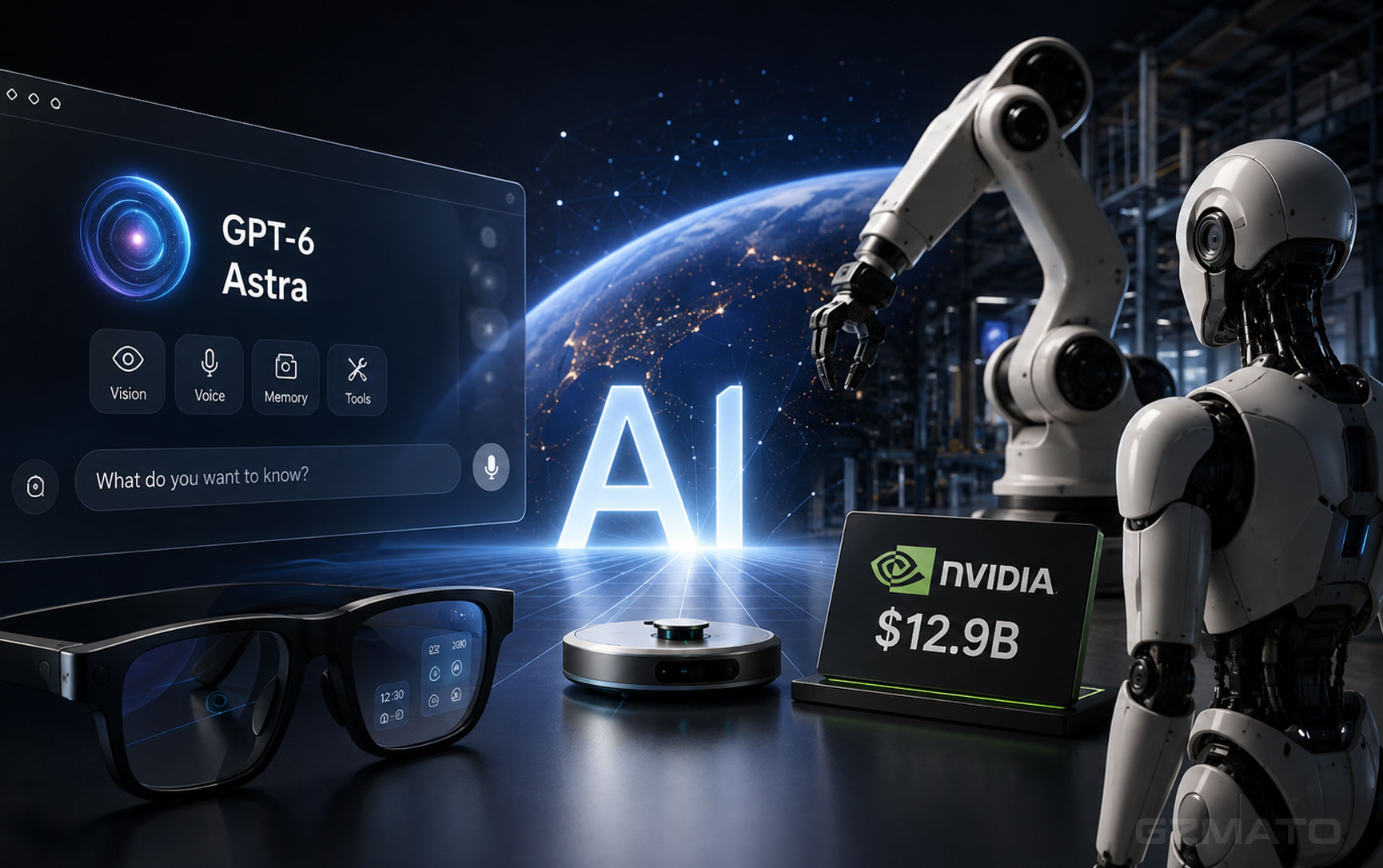
Something happened in the first week of September 2026. Not one thing — a cascade. By the time the dust settles, it might be remembered as the week AI stopped being a chat window and started becoming infrastructure [citation:2].
On September 3, OpenAI released GPT-6 Astra. On the same day, NVIDIA agreed to buy Hugging Face for $12.9 billion. In Berlin, IFA 2026 opened with the official declaration that AI is "entering the physical world." And in Shanghai, preparations for the Bund Summit were underway — an event that would ask not what AI can do, but how it creates new forms of growth [citation:8][citation:3].
This is the story of that week — and why it matters.
IFA 2026: AI Enters the Physical World
On September 4, IFA Berlin 2026 opened its doors to the public. The numbers: 1,900+ brands, 49 countries represented, and a clear message from the organizers [citation:8].
Leif Lindner, CEO of IFA Management, put it directly: "AI is moving beyond content generation and complex tasks and increasingly entering the physical world." [citation:2]
Smaller and more energy-efficient AI models are being integrated into smartphones, vehicles, home appliances and other everyday products [citation:2]. The shift is from "AI in the screen" to "AI in the room."
Two figures capture the moment: ~900 Chinese companies are exhibiting, nearly half of the total 1,900 brands [citation:8]. TCL, Hisense, Haier, DJI and Xiaomi are all present [citation:2]. TCL's CTO Daniel Sun described the theme as "AI Inspired Life" — not just products, but a way of living in the AI era [citation:2].
And robots? They're no longer confined to the robotics hall. IFA Next is being called the "largest humanoid robot showcase to date" [citation:8]. Unitree, AGIBOT, DEEP Robotics, Dobot are among the exhibitors. They're not just walking — they're cleaning, fetching, collaborating.
On September 9, the same day Apple holds its "Surprise and Shine" event, the Bund Summit opens in Shanghai. The convergence is fitting: the week that began with GPT-6 Astra ends with a global conversation about how AI creates economic value. The message is consistent: AI is no longer experimental.
GPT-6 Astra: 99.9% on ARC-AGI-3
Early on September 3, OpenAI released GPT-6 Astra. It was a model designed to operate computers, not just answer questions [citation:10].
Astra can fill out web forms, update CRM records, manage calendars, write code, install and test software, and respond to problems that appear on the screen [citation:15]. It can analyze scientific data, generate charts, create websites, and run front-end quality tests [citation:15].
The benchmark results are striking [citation:4][citation:10]:
| Benchmark | GPT-6 Astra | GPT-5.6 Sol |
|---|---|---|
| ARC-AGI-3 | 99.9% | 7.8% |
| FrontierMath Tier 4 | 97.6% | — |
| ExploitBench | 100% | 78.5% |
| OSWorld 2.0 | 72.6% | 65.7% |
| Automation Bench | 41.4% | 18.1% |
ARC-AGI-3 tests whether a model can figure out rules in unfamiliar environments and apply them to harder scenarios. The leap from 7.8% to 99.9% is one of the largest single-generation improvements in benchmark history [citation:4].
OpenAI President Greg Brockman made the declaration: "Welcome to the AGI era." He said that years from now, people may look back at this moment as the point when AGI began [citation:4][citation:15].
But Astra isn't available to everyone yet. It's being released through a Trusted Access program first, with a phased rollout to ChatGPT Plus, Pro, Business, and Enterprise users over the following days [citation:4]. The API pricing is $10 per million input tokens and $50 per million output tokens — about 2.5x the cost of its predecessor, putting it on par with Anthropic's Claude Fable 5.1 [citation:4][citation:7].
NVIDIA's $12.9B Hugging Face Acquisition
On the same day, NVIDIA announced it had agreed to acquire Hugging Face for $12.93 billion — its second-largest acquisition ever [citation:5][citation:11].
Hugging Face is the "AI GitHub": 18 million developers, 3 million models, 500,000 datasets, 1 million apps, and 200,000+ enterprises using the platform [citation:5].
But the acquisition is unusual. Hugging Face's annualized revenue is around $150 million — making this an ~80x revenue multiple [citation:5][citation:11]. NVIDIA isn't buying revenue. It's buying the distribution layer of the AI ecosystem.
NVIDIA CEO Jensen Huang made the commitment explicit: Hugging Face will continue to operate as an open platform. Developers can choose their own models, frameworks, cloud providers, and compute platforms. They are not required to use NVIDIA hardware [citation:5].
This is the paradox: NVIDIA just spent $12.9 billion to buy a platform that doesn't have to use its chips. But the logic is strategic: the more open-source models are distributed and used, the more compute is needed — and NVIDIA is the default provider of that compute [citation:5].
1,200 Billion Parameters in a Laptop
At IFA, Lenovo unveiled the Yoga Pro 9n, a laptop that localizes a 120-billion-parameter large language model [citation:6].
It achieves this using NVIDIA's RTX Spark chip — a 20-core Grace CPU paired with a Blackwell RTX GPU with 6,144 CUDA cores, connected via NVLink-C2C. The system provides 1 PFLOPS of AI performance [citation:6].
But the real breakthrough is memory: 128GB of unified memory at 9,400 MT/s, shared between CPU and GPU. Traditional PC architectures keep CPU memory and GPU memory separate, forcing data to be moved back and forth. Unified memory removes that bottleneck — allowing the entire model to stay in memory [citation:6].
The Yoga Pro 9n is 15.3 inches and 16.7 mm thick, with an 80W TDP kept in check by Lenovo's X Power thermal system [citation:6]. It's also a 165Hz 2.5K PureSight Pro OLED display and an NVIDIA RTX gaming platform — meaning it's not just an AI workstation, it's a fully functional laptop [citation:6].
As PChome put it: "120-billion-parameter models and a full industrial-grade AI workflow are now in a backpack — not a concept, but a shipable product." [citation:6]
Bund Summit: What Comes Next
On September 9, the Bund Summit opens in Shanghai with the theme "Co-creating the AI New Economy" [citation:3][citation:9].
The Summit has already attracted 50,000+ registrants from 50+ countries. It will feature 1 main forum, 40+ insight forums, and 600+ speakers including two Nobel laureates: Thomas Sargent and Philippe Aghion [citation:3][citation:14].
The exhibition hall spans 15,000 square meters with 300+ tech companies [citation:9]. 30+ agent applications will be displayed across work and entertainment scenarios, showing how AI has moved from the "dialog box" to real life [citation:3].
The physical world presence is represented by 40+ embodied intelligence companies — Unitree, Zhiyuan, SuDu Technology, Lingbo Technology — showing robots doing real work: in pharmacies, on factory floors, in logistics [citation:3].
A parallel story is unfolding at the Summit: the next generation of AI creators. The Hackathon has attracted 10,000+ participants, nearly 70% under 18, with the youngest just 6 years old [citation:3][citation:9].
Key Takeaways
| # | What You Need to Know About the Week AI Left the Chat Window |
|---|---|
| 1 | GPT-6 Astra: ARC-AGI-3 from 7.8% to 99.9% — a single-generation leap in reasoning that OpenAI's president called the start of the "AGI era" [citation:4][citation:10] |
| 2 | NVIDIA's $12.9B Hugging Face acquisition — buying the distribution layer of open-source AI to keep the ecosystem in its orbit [citation:5][citation:11] |
| 3 | IFA 2026: AI enters the physical world — smaller models, integrated into phones, cars, appliances and robots, not just generating text [citation:2][citation:8] |
| 4 | Yoga Pro 9n: 120B parameters in a laptop — local AI deployment is no longer theoretical; it's shipping [citation:6] |
| 5 | Bund Summit: 50,000+ registrants, 50+ countries — the conversation has shifted from "what can AI do?" to "how does AI create economic value?" [citation:3] |
| 6 | ~900 Chinese companies at IFA — nearly half of all exhibitors, showing the depth of China's hardware and AI integration [citation:8] |
- QQ News / 21世纪经济报道 — GPT-6 Astra release, benchmark scores (ARC-AGI-3 99.9%, FrontierMath 97.6%, ExploitBench 100%) [citation:1]
- China.org.cn — IFA 2026 official coverage: 1,900+ brands, AI entering physical world [citation:2]
- QQ News / 外滩大会 — Bund Summit details: 50,000+ registrants, 50+ countries, 300+ exhibitors [citation:3]
- 36Kr — GPT-6 Astra deep analysis, ARC-AGI-3 from 7.8% to 99.9%, pricing details [citation:4]
- BT财经 — NVIDIA $12.9B Hugging Face acquisition, platform metrics [citation:5]
- PChome — Lenovo Yoga Pro 9n, RTX Spark, 128GB unified memory, 120B parameter models [citation:6]
- 爱范儿 — IFA 2026 coverage, Hugging Face acquisition, GPT-6 Astra timeline [citation:7]
- 天极网 — IFA 2026 official opening, ~900 Chinese exhibitors, robots at IFA Next [citation:8]
- 人民网-上海频道 — Bund Summit, 40+ forums, 300+ exhibitors, hackathon [citation:9]
- 星島頭條 — OpenAI release, ARC-AGI-3 99.9%, pricing $10/$50 per 1M tokens [citation:10]
- BT财经 — NVIDIA acquisition, 18M developers, 3M models, 500k datasets [citation:11]
- GPT-6 Astra
- NVIDIA
- Hugging Face
- IFA 2026
- Bund Summit
- AGI
- AI physical world
- Lenovo Yoga Pro 9n
- ARC-AGI-3
- Gzmato