$442 Billion in One Day: NVIDIA's AI-Driven Record Surge
- $442 Billion in One Day: NVIDIA's AI-Driven Record Surge
- By the Numbers: A $5.49 Trillion Market Cap
- "AI Has Reached an Inflection Point" — Jensen Huang's Message
- The Real Story: The Chinese AI Chip Capacity Crunch
- Global AI Infrastructure Build-Out: "Computing Power is Income"
- Shop Tech & Electronics at Gzmato
- Key Takeaways
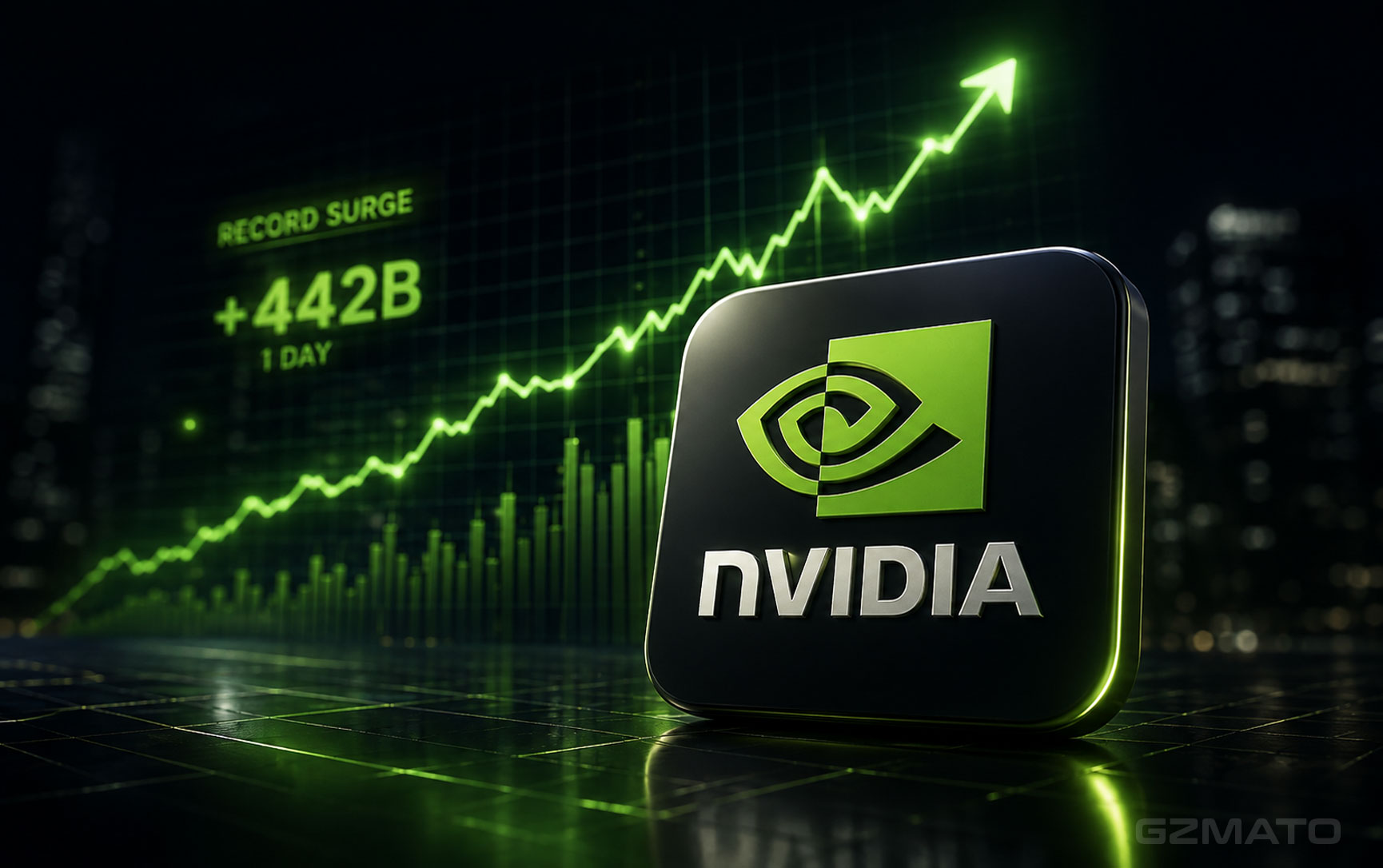
August 27, 2026 — NVIDIA added roughly $442 billion in market value in a single trading session on Thursday, marking the second-largest one-day market-cap gain ever recorded for a US company . The $5.49 trillion valuation puts NVIDIA firmly in the No. 1 position among the world's publicly traded companies .
Shares of the chipmaker surged 8.74% to $227.98, the stock's best single-day performance since April 2025 . The gain was fueled by a fiscal second-quarter earnings report that outpaced even the most bullish expectations — and a growth outlook that effectively answered Wall Street's most pressing question: Is AI demand slowing down?
By the Numbers: A $5.49 Trillion Market Cap
The magnitude of NVIDIA's single-day move is difficult to overstate. The $442 billion gained in a single session is larger than the entire market capitalization of most S&P 500 constituents .
The rally followed a period of investor anxiety. NVIDIA's stock had declined in six of the previous eight quarters amid recurring fears that AI spending could cool and that hyperscalers might eventually slow GPU purchases . The Q2 report, however, delivered a decisive answer to those concerns — a sentiment echoed across the semiconductor sector .
Raymond James analyst Simon Leopold called the results "outstanding," noting that what investors truly applauded was the 70% growth outlook for the next fiscal year . J.P. Morgan went further, suggesting the guidance "could still prove conservative" given that NVIDIA's forecast is supply-constrained while underlying demand growth is even stronger .
"AI Has Reached an Inflection Point" — Jensen Huang's Message
In the company's quarterly earnings call, NVIDIA CEO Jensen Huang delivered a statement that reframed the AI narrative:
"AI is now doing real useful work, and its generated tokens are creating productivity and profit. Today, computing power is income, and demand is still growing rapidly. At this time last year, infrastructure development was mainly driven by a single AI lab. Now, we are entering a golden age of new AI labs and startups."
Huang identified three structural shifts driving the AI infrastructure build-out:
- Multiple frontier AI labs expanding simultaneously: No longer a single-player market, but a diverse ecosystem of leading-edge research organizations
- Open model ecosystems thriving: Open-source AI models are accelerating adoption and creating new demand for compute
- Physical AI beginning to be applied: AI for robotics, autonomous driving, and factory automation — a $50 trillion addressable market that has "almost no tech penetration" to date
Huang also revealed that NVIDIA's Physical AI business (robotics, autonomous driving, and factory automation) has nearly reached $10 billion in annual revenue and is still "growing exponentially" . In digital biology, he predicted a "ChatGPT-like inflection point" within 2-5 years, at which point AI will be able to represent and understand genes, proteins, and cellular dynamics .
The Real Story: The Chinese AI Chip Capacity Crunch
While NVIDIA's stock surge dominated headlines, a parallel story unfolded in China's semiconductor industry — one that underscores the depth of global AI demand and the structural constraints on supply.
According to data from TMTPost, total domestic demand for advanced AI chips in China reached approximately 4.2 million units in 2026, but SMIC's N+2 process (equivalent to 7nm technology) — the country's only viable foundry for advanced AI processors — can supply just 2.6 million units .
This represents a 1.6 million-unit supply deficit — nearly 40% of demand cannot be met .
- Equipment: No EUV lithography — DUV multi-patterning takes 2-3x longer per wafer than leading-edge foundries
- Cost: Wafer costs 40-50% higher than historical industry standards, with limited revenue for expansion
- Yield: Only recently crossed 50% break-even threshold — rapid expansion is financially unsustainable
This capacity crunch has created a non-market allocation hierarchy, where strategic alignment and sovereign supply chain security override commercial terms . Huawei commands the largest share at 43% through a locked five-year master supply agreement, with its HiSilicon engineers embedded in SMIC's production facilities and driving over 60% of advanced process yield improvements . Cambricon holds approximately 9-11% .
The parallel between NVIDIA's supply-constrained guidance and China's domestic capacity crunch highlights a global theme: AI demand isn't slowing — supply simply can't keep up.
Global AI Infrastructure Build-Out: "Computing Power is Income"
NVIDIA's Q2 report and the Chinese capacity data both point to the same conclusion: the AI infrastructure build-out is accelerating, not decelerating .
Huang noted that "at this time last year, infrastructure development was mainly driven by a single AI lab." Today, "multiple cutting-edge AI labs are expanding simultaneously," while "open model ecosystems are thriving" and "physical AI is beginning to be applied" .
This shift is reflected in NVIDIA's data center revenue ($89 billion in Q2 alone) and its 70% growth guidance — numbers that would be impossible if AI demand were contracting .
J.P. Morgan's analysis suggests NVIDIA's 70% guidance may still be conservative because the company's forecasts are "capped by supply constraints while underlying demand growth remains even stronger" .
For businesses building on AI, the message is clear: computing power is the new bottleneck. For hardware manufacturers and electronics retailers like Gzmato, the trend points to sustained demand for AI-capable devices — from data center equipment to consumer products powered by AI chips.
Shop Tech & Electronics at Gzmato
AI-Powered Devices | Laptops & Workstations | Smart Home | In Stock Now
Special Offer: Use code TECH2026 for a discount on your first order!
Shop Now at GzmatoWe're actively expanding our catalog and can often source specific models on request. Chat with our team or open a request.
Key Takeaways
- BingX Flash News — $442B single-day market cap gain, $96.2B Q2 revenue, 70% growth guidance, $5.49T market cap, J.P. Morgan analysis
- 富聯網 / 財訊快報 — 8.74% stock surge, $227.98 closing price, second-highest ever
- BlockBeats — Jensen Huang "AI inflection point" and "computing power is income" remarks, Physical AI details
- 钛媒体 / TMTPost — China AI chip capacity analysis: 4.2M demand vs. 2.6M supply, SMIC N+2 constraints, Huawei 43% share
- El Economista — Jensen Huang net worth $196.8B, $14.5B single-day increase
- NVIDIA
- NVDA stock
- AI chip demand
- $442 billion market cap
- Jensen Huang
- AI inflection point
- computing power is income
- China AI chip
- SMIC capacity
- semiconductor supply
- Gzmato
- 2026 tech