Apple's Return to Servers: M8 Ultra AI Inference Server May Use Nvidia Technology
- Apple's Return to Servers: A Different Kind of Comeback
- The Product: M8 Ultra AI Inference Server
- The Nvidia Question: A 20-Year Relationship Reconsidered
- The UALink Paradox: Apple Sits on Both Sides
- John Ternus and the Strategic Bet
- The Catalyst: Mac's Unexpected AI Success
- Timeline and Uncertainty: 2029, Maybe
- Shop at Gzmato
- Key Takeaways
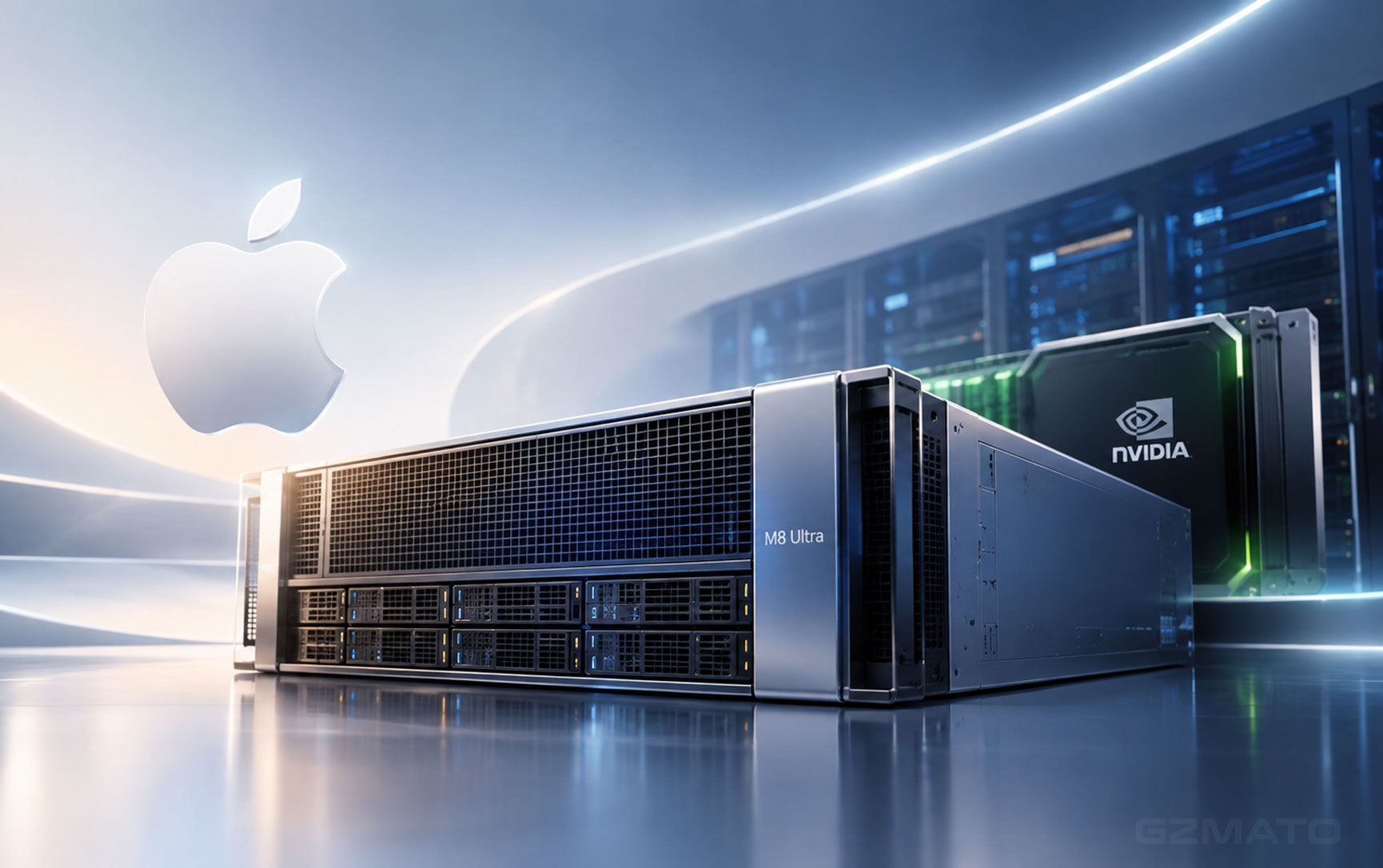
September 17, 2026 — Apple is developing an enterprise AI inference server powered by its own silicon, according to a report from The Information on September 16. The project, if it ships, would mark Apple's first return to selling server hardware since the Xserve line was discontinued in 2011.
But this is not a conventional comeback. The server is designed for AI inference — running trained models, not training them. And it may rely on a technology from a company Apple has had a strained relationship with for nearly two decades: Nvidia.
The Product: M8 Ultra AI Inference Server
According to The Information's report, Apple's server is designed specifically for AI inference — the process of running trained models to generate responses, rather than training them from scratch. This is a deliberate positioning that separates Apple from the training-focused GPU servers that dominate the market today.
The server is expected to come in two configurations: one with two M8 Ultra chips, and one with four. The M8 Ultra is described as Apple's most powerful planned chip, though it has not yet been announced and remains in development.
To connect multiple M8 Ultra chips within a single server, Apple has discussed using Nvidia's NVLink Fusion interconnect technology. The chips need high-speed, low-latency connections to collaboratively process large language model inference tasks — precisely the capability NVLink Fusion provides.
| Specification | Reported Details |
|---|---|
| Purpose | Enterprise AI inference (not training) |
| Chip | M8 Ultra (in development, not announced) |
| Configurations | Two-chip and four-chip versions |
| Target Customers | AI developers, enterprises, government |
| Interconnect (Under Consideration) | Nvidia NVLink Fusion |
| Launch Window | Not before 2029; project may be cancelled |
| Key Advocate | John Ternus (now CEO) |
This is not Apple's first attempt at server hardware. The Xserve product line was discontinued in 2011 as the company shifted focus entirely to consumer devices. Since then, Apple's server-side presence has been limited to software and services rather than physical infrastructure.
The Nvidia Question: A 20-Year Relationship Reconsidered
The most striking element of the report is the potential use of Nvidia technology. Apple and Nvidia have had a strained relationship since around 2008, when defective Nvidia graphics chips led to widespread failures in MacBook laptops. Cooperation between the two companies has been minimal ever since.
If Apple ultimately adopts NVLink Fusion, it would represent a significant shift in that relationship — a pragmatic decision to use the best available technology rather than maintain a long-standing corporate distance.
NVLink Fusion was announced in May 2025 at Computex in Taipei. It opens Nvidia's NVLink interconnect — previously restricted to Nvidia's own GPUs — to third-party chip makers. This allows customers' custom chips to interconnect with each other at high speed, form large-scale AI computing systems, and also work alongside Nvidia GPUs.
Running large AI models requires more than just fast individual chips. Multiple processors must communicate with each other continuously — sharing data, splitting workloads, and synchronizing results. The speed and latency of those connections often determine whether a multi-chip system performs well or becomes bottlenecked.
For Apple, connecting two or four M8 Ultra chips into a coherent system is not a simple matter of placing them on the same board. It requires a proven high-bandwidth interconnect fabric. Nvidia's NVLink Fusion is one of the few technologies that can provide this at the scale required.
The UALink Paradox: Apple Sits on Both Sides
There's a complication. Apple is a board member of the UALink Consortium — an open AI chip interconnect standard established in 2024 by AMD, Intel, Google, Microsoft, and other technology companies.
UALink serves the same purpose as NVLink: high-speed connections between multiple chips in AI servers. But it is designed as an open standard not controlled by any single vendor, and it is positioned as the primary competitor to Nvidia's proprietary technology.
| Standard | Backers | Positioning |
|---|---|---|
| NVLink Fusion | Nvidia, MediaTek, Marvell, Fujitsu, Qualcomm | Proprietary, but open to third-party chip makers |
| UALink | AMD, Intel, Google, Microsoft, Apple (board member) | Open standard, vendor-neutral |
If Apple ultimately selects NVLink Fusion, it would mean the company — a board member of the open-standard consortium — chose a proprietary Nvidia solution over the open alternative it helped create.
But this is not necessarily a contradiction. For a shipping product that must work reliably at scale, Apple may prioritize maturity and proven performance over idealistic alignment with open standards. The UALink ecosystem is still developing; NVLink Fusion has a head start.
John Ternus and the Strategic Bet
The project was reportedly initiated about a year ago, with John Ternus as a key advocate. At the time, Ternus was Apple's Senior Vice President of Hardware Engineering. He became CEO on September 1, 2026.
This matters for two reasons. First, it shows that the project has top-level backing — it was not a skunkworks experiment buried in a research division. Second, it connects to Ternus's broader strategy: the Mac's transition to Apple Silicon demonstrated what Apple can achieve when it controls both chip design and system integration. An AI inference server would extend that same philosophy to the data center.
Ternus has also been a public advocate for Apple's approach to AI, emphasizing on-device processing and privacy. A server that runs AI inference locally — for enterprises and governments that want to keep data on-premises — aligns with that position.
The Catalyst: Mac's Unexpected AI Success
The report points to a surprising factor behind Apple's server ambitions: the Mac has become a favorite AI development platform.
OpenAI and other AI labs have reportedly purchased tens of thousands of Mac minis and Mac Studios for AI development work. Apple's latest quarterly earnings showed Mac revenue up nearly 29% year-over-year — the fastest-growing hardware category in the company's lineup.
The reason is Apple Silicon's unified memory architecture. A Mac Studio with 512GB of unified memory can run large language models that would otherwise require multiple expensive GPUs. For developers working with models that don't require distributed training, a Mac provides a simpler, more cost-effective solution.
Macs are excellent for individual developers. But they lack the remote management, orchestration, and rack-mount form factor that enterprise and government deployments require. A Mac Studio is not designed to be managed at scale in a data center.
Apple's inference server would fill exactly that gap: the same unified memory advantage, packaged in a form factor that enterprises can actually deploy.
Timeline and Uncertainty: 2029, Maybe
The report is clear that this is a long-term project with significant uncertainty. The server is not expected before 2029, and the project could still be cancelled entirely. It could also ship without Nvidia technology, using UALink or an Apple-designed interconnect instead.
This ambiguity is itself informative. Apple is exploring the enterprise server market seriously enough to have developed configurations and discussed partnerships — but not so seriously that the project is guaranteed. In a rapidly evolving AI infrastructure landscape, three years is a very long time.
Between now and 2029, several things could change the calculus: Nvidia's roadmap, the maturity of UALink, the trajectory of AI model sizes, and whether Apple's Mac-based AI development ecosystem continues to grow. Any of these factors could accelerate, delay, or kill the project.
Shop Macs & AI Hardware at Gzmato
Mac mini | Mac Studio | MacBook Pro | Accessories & Storage
Special Offer: Use code TECH2026 for a discount on your first order!
Shop Macs at GzmatoOur team can help you compare Mac mini, Mac Studio, and MacBook Pro configurations based on your workload and budget. Chat with us or open a request.
Key Takeaways
| # | What You Need to Know About Apple's Server Project |
|---|---|
| 1 | Apple is developing an AI inference server — not a training machine, but a system for running trained models locally |
| 2 | Powered by M8 Ultra — Apple's most powerful planned chip, in two-chip and four-chip configurations |
| 3 | May use Nvidia's NVLink Fusion — a significant potential shift in a relationship that has been strained for nearly 20 years |
| 4 | Apple is also a UALink board member — the open-standard alternative to NVLink, creating a strategic tension |
| 5 | John Ternus was a key advocate — the project connects to his broader Apple Silicon integration philosophy |
| 6 | Mac's AI success is the catalyst — OpenAI and others have bought tens of thousands of Macs for AI development |
| 7 | Not before 2029, and may be cancelled — this is a long-term bet, not a near-term product |
- The Information — Original report on Apple's AI inference server project
- 财联社 — Summary and Chinese-language coverage of The Information report, NVLink Fusion background, UALink context
- Nvidia Official — NVLink Fusion announcement and partner list
- Apple Newsroom — Xserve discontinuation context, Apple Silicon history
- MacRumors — Mac AI development adoption, Mac revenue growth
- Bloomberg — OpenAI Mac procurement reporting

- Apple server
- Apple AI inference server
- M8 Ultra
- Nvidia NVLink Fusion
- UALink
- John Ternus
- Apple enterprise AI
- Apple Xserve return
- Gzmato