RCEP 2.0: How Smart Sellers Cut Costs Without Cutting Quality
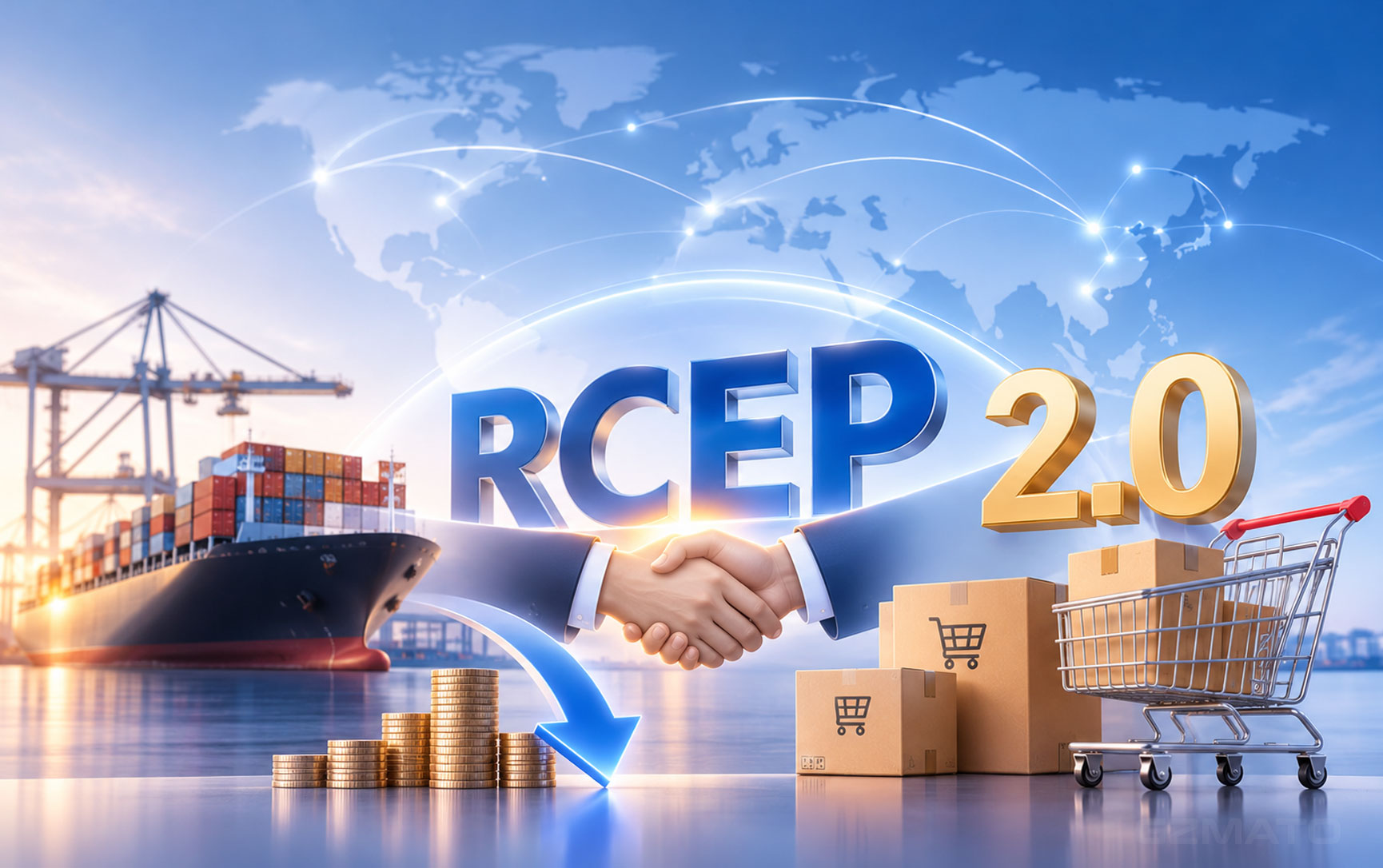
RCEP 2.0: How Smart Sellers Cut Costs Without Cutting Quality
November 4, 2026 — While everyone is focused on the EU’s new parcel fees and the US tariff situation, a massive trade advantage is quietly expanding right next door. The Regional Comprehensive Economic Partnership (RCEP) is moving into its next phase: expanding membership and upgrading rules.
For cross-border sellers, the core value of RCEP is not just "selling more goods." It is the Regional Accumulation Rule. In an era where "cheap and cheerful" is dying, RCEP allows you to source high-quality components from across 15 Asian countries, assemble them, and still enjoy zero tariffs. It is the ultimate tool for maintaining product quality while cutting costs.
What's New: Expansion and Upgrade
RCEP, which covers 15 economies including China, Japan, South Korea, ASEAN, Australia, and New Zealand, is no longer just a static agreement. It is evolving.
- Expansion: Working groups have been established to consider the accession of Bangladesh, Chile, Hong Kong, and Sri Lanka. This will further expand the "tariff-free zone" for sellers.
- Upgrade: In 2027, RCEP members will launch a comprehensive review to upgrade the agreement, likely focusing on digital trade, green economy standards, and deeper supply chain integration.
The 40% Rule: How Regional Accumulation Works
Under traditional FTAs, a product usually has to be entirely made in one country to get tariff benefits. RCEP changes the math. It allows for Regional Accumulation—meaning materials and processing from any of the 15 member countries can be combined to calculate the origin.
| Supply Chain Scenario | Without RCEP | With RCEP Accumulation |
|---|---|---|
| Design & Tech | China | China |
| Precision Parts | Japan (Subject to tariffs) | Japan (Counts toward the 40%) |
| Assembly | Vietnam | Vietnam |
| Export to Japan | High Tariffs (Origin is Vietnam) | 0% Tariff (Regional value > 40%) |
In the past, to avoid tariffs and qualify for local origin in a Southeast Asian country, sellers were forced to use cheap local parts to meet the local content threshold, often degrading the product quality. With RCEP's accumulation rule, you can use the best Japanese parts, Chinese tech, and Vietnamese labor, and still get zero tariffs because the total regional value meets the 40% threshold. It allows you to build a premium product while staying highly competitive on price.
Action Plan for Gzmato Sellers
If you want to leverage RCEP to build a better product without losing your margin, here is what you need to do:
1. Audit Your BOM (Bill of Materials)
Look at your raw materials and components. Are you buying heavily from Europe or the US? If so, consider shifting your sourcing for those specific parts to RCEP countries (like Japan, South Korea, or ASEAN). If you can shift enough sourcing to RCEP nations to hit the 40% threshold, your end product enters Japan or ASEAN markets at 0% tariff.
2. Recalculate Your Pricing Power
If you save 5-10% on tariffs, do not just drop your price and start a price war. Use that saved margin to upgrade your packaging, increase your marketing budget, or absorb the new EU compliance costs. Protect your "high-quality" positioning.
The Hidden Trap: Origin Certificates
The 40% rule is powerful, but it is not automatic. To claim the tariff benefit, you must have a Certificate of Origin (CO).
RCEP allows for "back-to-back" proof of origin. For example, if a Chinese company exports parts to a Vietnamese factory, and the Vietnamese factory then exports the final product to Japan, the Vietnamese factory can issue a "back-to-back" certificate to the Japanese buyer using the original Chinese certificate. But if the paperwork is incorrect or the data is inconsistent, customs will reject the claim.
Key Takeaways
| # | What You Need to Know About RCEP |
|---|---|
| 1 | RCEP is expanding and upgrading — new members and a 2027 review will further open up the Asian market. |
| 2 | The 40% Regional Value Content (RVC) rule is the crown jewel — it allows you to source and process across 15 countries and still get zero tariffs. |
| 3 | You can maintain high quality — use the best parts from Japan, Korea, or ASEAN, combine them, and avoid the previous trap of using cheap local materials just to meet origin rules. |
| 4 | Audit your BOM now — look for opportunities to shift sourcing from Europe/US to RCEP countries to hit the 40% threshold. |
| 5 | Don't start a price war — use the saved tariff costs to improve your brand, packaging, or absorb other regulatory costs. |
| 6 | Origin certificates are mandatory — if you can't prove the regional value, you pay full tariffs. Keep your supply chain data clean. |
Tell us your supply chain layout and product category, and we can help you understand the new origin rules. Chat with us or open a request.


- RCEP trade rules
- RCEP regional accumulation
- 40% regional value content
- RCEP expansion
- cross-border supply chain
- origin certificate
- Gzmato