9.39 Seconds: When Machines Outran the Fastest Human at Beijing 2026
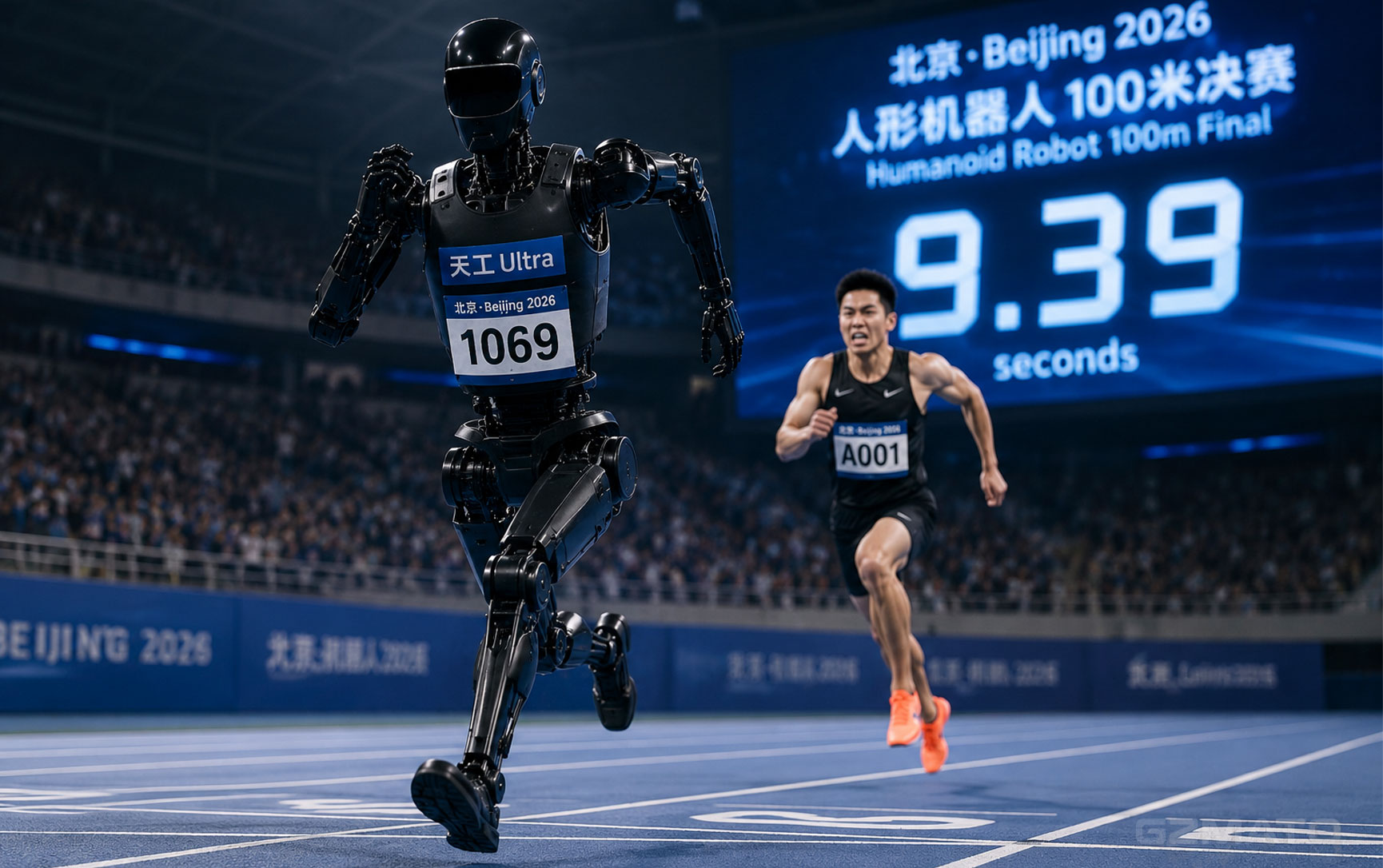
- 9.39 Seconds: When Machines Outran the Fastest Human
- From 21.50 to 9.39: One Year of Leapfrog Progress
- The Real Breakthrough: From Remote-Controlled to Autonomous
- Beyond the Track: Robots That Can Actually "Work"
- From Stadium to Factory: How Close Are Robots to Daily Life?
- Event Schedule: What's Coming Next
Core facts: On August 22, the second edition of the World Humanoid Robot Games opened at Beijing's National Speed Skating Oval "Ice Ribbon." 666 teams from 16 countries across six continents brought 2,056 humanoid robots to compete [citation:1]. The Tianzhuo team's humanoid robot ran the 100 meters in 9.39 seconds — surpassing Usain Bolt's 9.58-second human world record [citation:9]. Honor's "Lightning" robot had previously clocked 9.32 seconds in a test run, reaching a peak speed of 14.5 meters per second (approximately 52.2 km/h) [citation:2]. Tiangong Ultra cleared 2.8843 meters in the standing high jump, exceeding the human record of 2.45 meters, and ran 400 meters in 39.70 seconds, beating the human record of 43.03 seconds [citation:5]. The competition eliminated manual remote control in multiple events, operating entirely autonomously [citation:3]. From the inaugural edition's best 100m time of 21.50 seconds to 9.39 seconds — a leapfrog breakthrough achieved in just one year [citation:1].
From 21.50 to 9.39: One Year of Leapfrog Progress
Last year's inaugural World Humanoid Robot Games saw a best 100m time of just 21.50 seconds [citation:1]. This year, 9.39 seconds and 9.32 seconds have both surpassed Usain Bolt's 9.58-second human world record [citation:5]. In one year, robot sprinting performance has undergone a qualitative leap from "human jogging pace" to "surpassing the world's fastest human."
Honor Robotics Chief Technology Architect Yan Bin disclosed that "Lightning's" top speed comes from four core technologies:
- Self-developed high-torque joint modules — resolving conflicts between chassis layout and power delivery
- High-dynamic motion control system — balancing power consumption with joint performance
- Autonomous perception and navigation algorithms — ensuring stable environmental awareness at high speeds
- Liquid cooling thermal solution — preventing joint modules from exceeding 100°C during sustained high-speed operation
The Real Breakthrough: From Remote-Controlled to Autonomous
The most significant change in this year's Games isn't the numbers on the scoreboard — it's the rule change behind them. With the exception of 100m and 400m obstacle events, track events are operating entirely autonomously [citation:3], putting humanoid robots' AI models to the test on environmental perception and independent decision-making.
From remote-controlled "marionettes" to autonomous "steel athletes," humanoid robots have completed a critical leap in just one year.
The scale of participation confirms this trend: 666 teams and 2,056 robots, with team count up 138% and robot count quadrupled compared to last year's 280 teams and approximately 500 robots [citation:6]. Chinese teams from 27 "Double First-Class" universities competed alongside robotics powerhouses like the United States, Germany, and Japan [citation:13].
Beyond the Track: Robots That Can Actually "Work"
The opening ceremony showcased robots demonstrating capabilities far beyond racing:
- 80 Acceler Evolution Booster T2 robots performed autonomous formation changes, spelling out "BEIJING"
- 50 Tiangong embodied-intelligence 3.0 robots autonomously executed "Thomas flairs"
- Galbot G1 completed fully autonomous long-horizon complex tasks across home, retail, and food-service scenarios
- 36 dexterous-hand robots performed musical instrument duets with human artists
- Robots engaged in tennis rallies with Grand Slam champion Zheng Jie and table tennis exchanges with Olympic champion Ding Ning
This year's Games expanded events from 26 to 51, adding high-intensity competitions like long jump, weightlifting, tug-of-war, and table tennis [citation:13]. Twenty-one scenario-based events covered logistics, hospitality, household services, fire rescue, and industrial manufacturing — including dexterous-hand tasks like powder weighing, tweezer handling, and bottle-opening [citation:13].
From Stadium to Factory: How Close Are Robots to Daily Life?
The deeper significance of this year's Games lies in building a global platform for embodied-intelligence technology exchange and industrial collaboration, accelerating robots' transition from competition scenarios to real-world applications.
A concrete example: Star Chart's fully autonomous robot micro-fulfillment center in partnership with JD.com covers the entire workflow — picking, grasping, placing, and packing. At their exhibition booth, a single robot completed over 100 orders per day with zero human intervention.
After the Games, the "Ice Ribbon" will become a permanent training base for participating teams.
Industry consensus is that robots are moving from "muscle-showing" to a "productivity validation" phase. Leading robotics companies agree that the next real threshold is whether robots can enter unfamiliar environments, rapidly learn new tasks, and work at close to or above human efficiency.
Star Chart founder Gao Jiyang proposed three metrics: speed, precision, and generalization. Currently, robot execution efficiency is about 70-80% of human labor. Centimeter-level operations are stable, but millimeter-level precision still needs improvement.
Event Schedule
The Games run through August 26, featuring 51 events and 1,301 competitions [citation:8].
On August 23, events include 400m finals (large and small categories), 1500m finals, long jump finals, football 3v3/5v5 quarterfinals, Wushu Taijiquan finals, freestyle boxing, table tennis, and scenario-based events (food service, emergency response, smart charging, etc.).
Shop Smart Tech at Gzmato
Robot Vacuums | Smart Home Devices | Electronics & Accessories | In Stock Now
Special Offer: Use code TECH2026 for a discount on your first order!
Shop Smart Tech at GzmatoWe're actively expanding our catalog and can often source specific models on request. Chat with our team or open a request.
- People's Daily / pdnews.cn — 9.39-second 100m record, Tianzhuo team details, 21.50 to 9.39 progress [citation:1]
- Yahoo Sports / The Guardian — Honor "Lightning" 9.32-second test run, 14.5 m/s peak speed, half-marathon record [citation:2]
- AP News — 2,884.3mm high jump record, 2,000+ robots, Tianzhuo vs X-Humanoid details [citation:5]
- Danish Broadcasting Corporation (DR) — 51 events, 2,056 robots, Tiangong Ultra 9.39 details [citation:4]
- Chosun (South Korea) — 666 teams, 51 events, 1,301 competitions, autonomy rules [citation:8]
- CCTV+ / China.org.cn — Opening ceremony coverage [citation:6][citation:14]
- AFPBB News (Japan) — 16 countries, 51 events, scenario categories, dexterous-hand events [citation:13]
- humanoid robot games 2026
- Beijing humanoid robot games
- robot 100m 9.39 seconds
- Tianzhuo robot
- Usain Bolt robot record
- Honor Lightning robot
- China humanoid robot
- World Humanoid Robot Games
- embodied intelligence
- Gzmato
- humanoid robot industry 2026
- robot Olympics