Yobotics: The 48-Day Humanoid Robot That Climbed Mount Tai
Yobotics (优宝特): The 48-Day Humanoid Robot That Climbed Mount Tai
When we talk about Chinese humanoid robots, names like Unitree, UBTech, and Xiaopeng usually dominate the conversation. But there is another company — one that has quietly built a 12-year foundation in legged robotics and is now making its move onto the national stage.
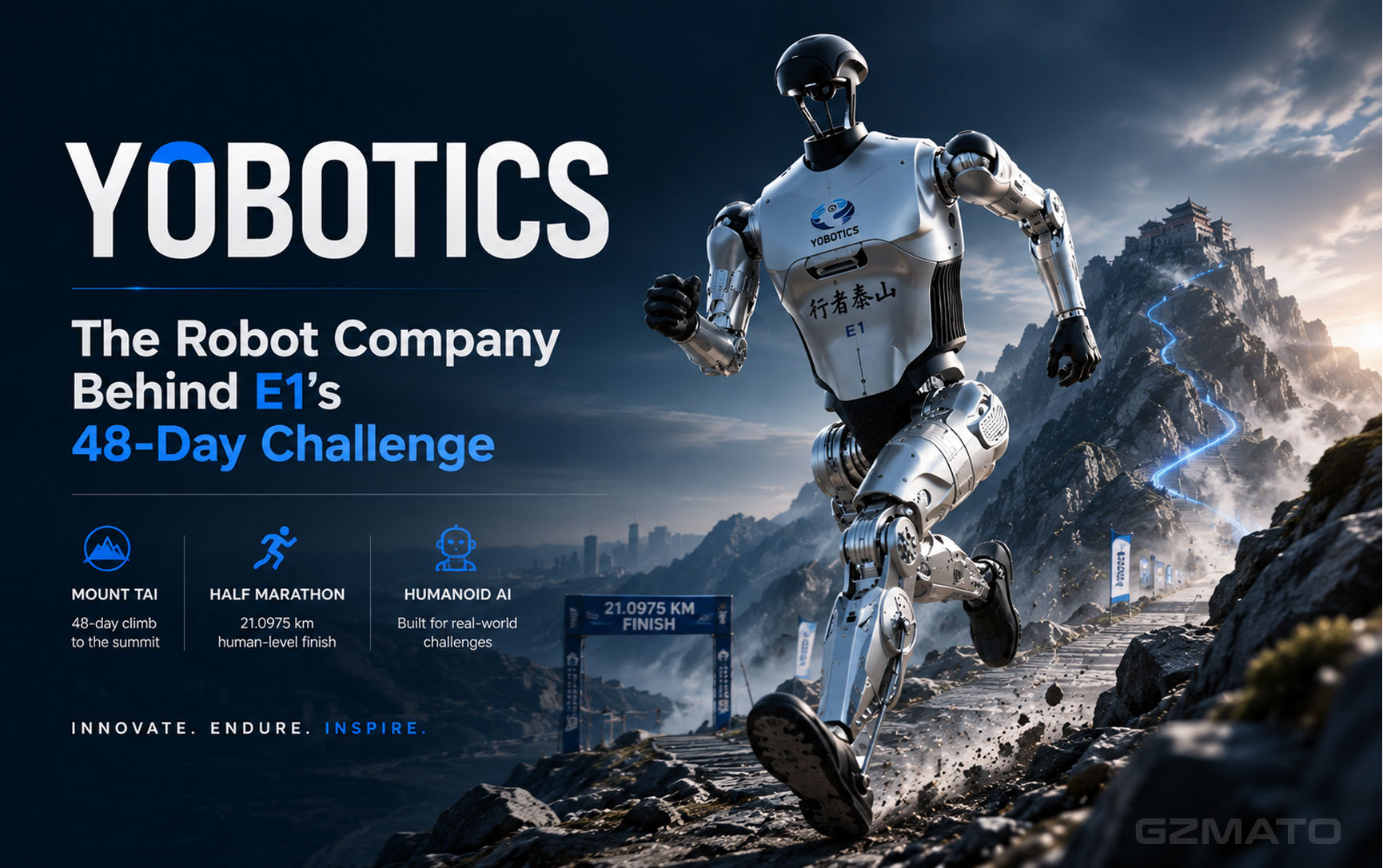
Yobotics (优宝特) is a Shandong-based robotics company that built the first humanoid robot to successfully climb Mount Tai — one of China's most challenging mountain trails. Its robot completed a half marathon, won a 100-meter sprint at the 2025 World Humanoid Robot Games, and was developed in just 48 days.
On June 15, 2026, Yobotics opened its first subsidiary outside Shandong — in Shenzhen. The move signals the company's ambition to go national, and to compete in the increasingly crowded humanoid robot space not with flash, but with proven reliability in the toughest real-world conditions.
12 Years of Legged Robot Expertise: Why 48 Days Was Possible
Yobotics was founded in 2014, two years before Unitree and long before the humanoid robot hype cycle began. The company has spent over a decade perfecting legged robot technology across three technical routes: electric drive, hydraulic drive, and electro-hydraulic drive.
- Joint modules: Proprietary motor and actuator design
- Robot body: Complete mechanical and structural engineering
- Motion control (cerebellum): Proprietary algorithms for walking, running, and balancing
- AI brain: Perception, navigation, and decision-making
The company holds over 50 core patents, and its R&D team is predominantly composed of graduates from prestigious institutions like Shandong University and the Chinese Academy of Sciences, with over 75% holding master's or doctoral degrees.
This technical depth allowed Yobotics to achieve what seemed improbable: the company's first humanoid robot, "Xingzhe Taishan," was developed in just 48 days — a record that stunned the industry. The achievement was not luck but a direct result of technical reuse from the company's extensive experience in quadruped and wheeled robots.
'Xingzhe Taishan': Proven on the Race Track and the Mountain
Yobotics' humanoid robot "Xingzhe Taishan" is not a laboratory showpiece. It has been tested under the most demanding conditions the industry can offer.
Key Specifications
| # | Parameter | Specification |
|---|---|---|
| 1 | Height | 1.38 meters |
| 2 | Weight | 38 kg |
| 3 | Degrees of Freedom | 21 DOF |
| 4 | Max Speed | 4.5 m/s (16.2 km/h) |
Competition Record
- 2025 World Humanoid Robot Games: First place in the 100-meter sprint (performance category); third place in the 4×100-meter relay
- 2026 Beijing Yizhuang Humanoid Robot Half Marathon: Top 8 finish among industry brands, validating long-distance running stability
- Mount Tai Ascent: First humanoid robot to successfully climb Mount Tai, navigating thousands of stone steps and varying terrain conditions
Commercialization: A B2B-Focused Strategy
Yobotics' go-to-market strategy differs sharply from the consumer-focused approaches of companies like Unitree. The company targets industrial, special operations, and government use cases where reliability is more important than price.
Key Application Scenarios
- Power industry: Inspection and maintenance in dangerous environments
- Emergency response: Firefighting, disaster relief, and search operations
- Mining and ports: Heavy-duty inspection and operation in challenging conditions
- Police and security: Patrol and reconnaissance
- Rail transportation: Infrastructure inspection
Commercial Milestones
- 2025 shipments: Nearly 100 humanoid robot units, primarily deployed in education, tourism, and exhibition scenarios
- 2026 target: 1,000 units (across quadruped, wheeled, and humanoid robots)
- Partnerships: Collaborations with Inspur, China Telecom, Shandong Expressway Group, and the Hong Kong AI Factory ecosystem
Financial Status
- Six funding rounds completed since founding
- Series A+ (December 2025): Approximately 100 million yuan, with Jinan municipal government participation
- Next round planned: 100 million yuan (via 10% equity stake increase or transfer)
Shenzhen Expansion: From Shandong to National Player
On June 15, 2026, Yobotics' Shenzhen subsidiary — Shenzhen Yobotics Intelligent Robot Co., Ltd. — officially began operations. This marks the company's first out-of-province subsidiary in its 12-year history.
- Regional R&D hub: Focused on frontier technologies and customized solutions for southern China's industrial clusters (power, mining, ports, emergency response)
- Regional sales and marketing center: Covering Guangdong, Guangxi, Fujian, Hainan, and other southern provinces
- Integration into the Greater Bay Area: Access to supply chain, talent, and capital networks
The subsidiary is located in the Nanshan District of Shenzhen — the heart of China's technology ecosystem. Yobotics has described the move as "a key step in the company's national expansion strategy," with the goal of accelerating the mass production and commercialization of its robot products.
Why Shenzhen matters: The city is home to some of the world's most advanced robotics supply chains, from sensors to actuators to AI chips. By establishing a presence there, Yobotics gains proximity to partners and customers that were previously distant from its Shandong headquarters.
Key Takeaways
| # | Key Takeaway |
|---|---|
| 1 | 12 years of legged robot expertise — Yobotics' 48-day humanoid robot development was built on over a decade of quadruped and bipedal robot experience, not on a fresh start. |
| 2 | Full product spectrum — Yobotics is the only Chinese company covering electric/hydraulic bipedal, quadruped, wheeled, and humanoid robots. |
| 3 | Proven through extreme testing — Mount Tai climb, half-marathon finish, and world competition medals validate real-world reliability beyond lab conditions. |
| 4 | B2B focus — Unlike Unitree's consumer push, Yobotics targets industrial, emergency, and government customers where reliability and durability command premium pricing. |
| 5 | Shenzhen expansion — The June 15, 2026 opening of the Shenzhen subsidiary signals Yobotics' shift from regional to national player. |
| 6 | Government backing — As a Shandong "chain master" enterprise with state investment and multiple government recognitions, Yobotics has institutional support that many competitors lack. |
| 7 | Scalability challenge — The company's 2026 target of 1,000 units (vs. Unitree's 5,500 humanoid units in 2025) shows the scale gap that needs to be closed. |
| 8 | Funding trajectory — Six funding rounds completed, with an additional 100 million yuan round planned. The company is positioning for accelerated growth. |
- Yobotics official — Shenzhen subsidiary launch announcement (June 15, 2026)
- Event reports — "Xingzhe Taishan" robot performance and competition records
- Industry publications — Yobotics funding history and shipment targets
- Company press releases — Hong Kong AI Factory ecosystem partnership
- Local media — Shandong "chain master" enterprise designation
Robot Accessories | Sensors | Cables | Power Supplies | Development Kits | Tech Gear
Special Offer: Use code TECH2026 for discount on your first order!
- Yobotics
- 优宝特
- humanoid robot
- Xingzhe Taishan
- legged robot
- Shandong robotics
- Shenzhen subsidiary
- embodied AI