AI Is a Lever, Not a Replacement: Why Knowledge × Creativity × Judgment Matters More Than Ever
- AI Is Not a Replacement — It's an Amplifier
- The AI Bubble Isn't About Technology — It's About Business Models
- The Amplifier Effect: AI Is a Lever, Not a Substitute
- From Selling Tokens to Selling Results
- The Human Factor: Knowledge × Creativity × Judgment
- The New Cognitive Divide: Who Thrives, Who Survives
- Key Takeaways
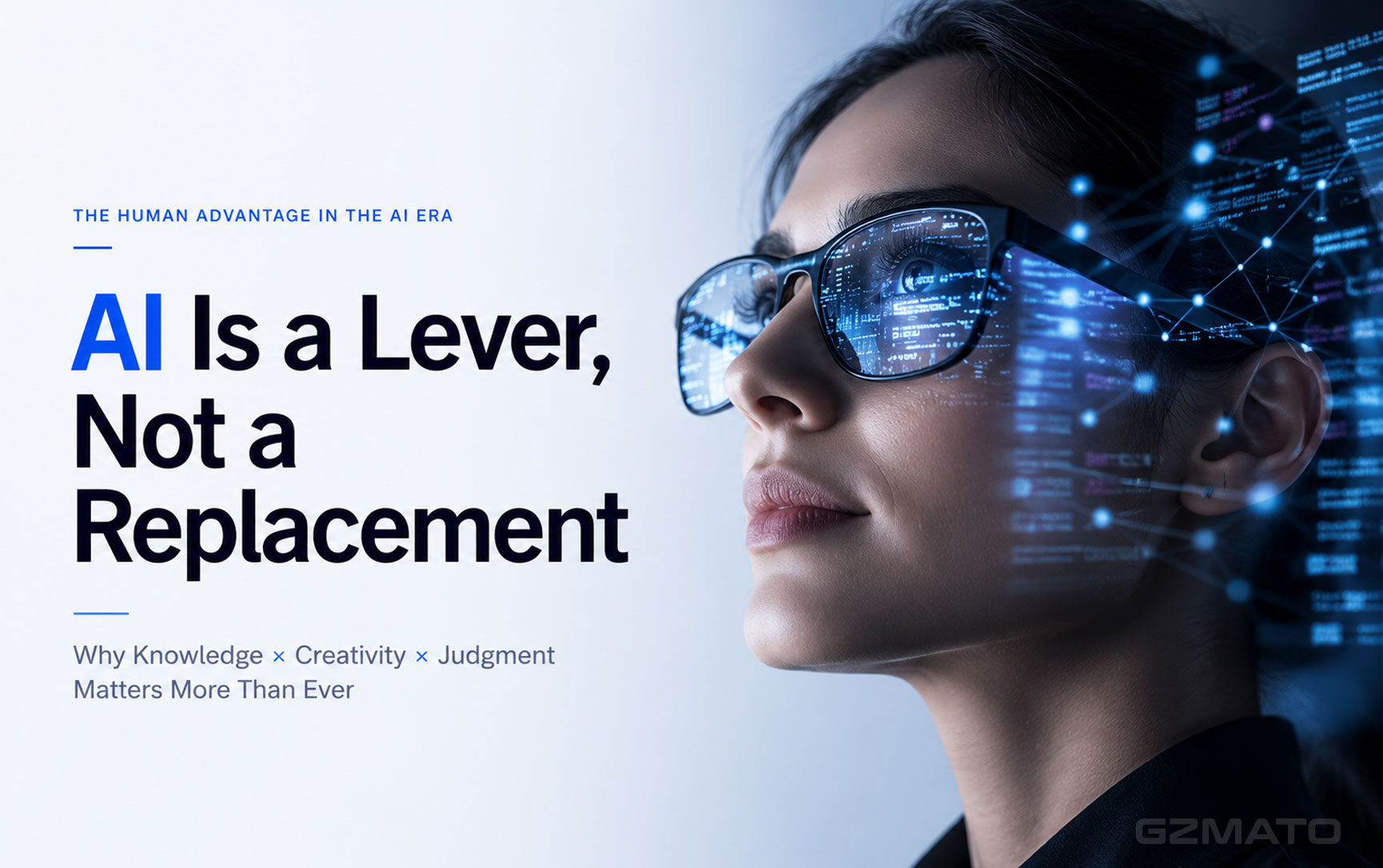
AI Is Not a Replacement — It's an Amplifier
There is a growing anxiety in the tech industry right now. AI stocks are tumbling, investors are nervous, and the headlines scream "bubble." But if you look closely, the problem is not that AI is useless — it's that the business model to monetize it hasn't caught up with the technology.
Uber burned through its entire $3.4 billion AI budget in four months. Microsoft killed its Claude Code license because token costs spiraled out of control. ByteDance's Doubao serves over 200 million daily users but generates less than $1 million in daily revenue — while burning millions in compute costs .
Yet in the same environment, Anthropic's annual revenue has grown from $90 billion in late 2025 to nearly $450 billion . The difference? Anthropic sells to businesses. It sells results, not just tokens.
This is the real story of the AI era: AI is not a replacement for human intelligence — it's an amplifier. And like any amplifier, its output depends entirely on the quality of the input.
The AI Bubble Isn't About Technology — It's About Business Models
When investors talk about an AI bubble, they are not doubting that AI works. They are doubting whether the billions of dollars being poured into infrastructure will ever generate matching returns.
| Company | What Happened | The Lesson |
|---|---|---|
| Uber | $3.4B AI budget exhausted in 4 months — $500-2000 per engineer per month on API calls | Token costs are real, and they scale with usage — not with revenue |
| Microsoft | Killed Claude Code license after 6 months — token bills exceeded value delivered | Even the most AI-committed companies have a limit |
| ByteDance (Doubao) | 200M+ daily users, daily revenue $10M | Consumer AI is not a "free" business — traffic doesn't equal profit |
These stories share a common thread: selling tokens is not the same as selling value. If all you offer is access to an API, you are in a commodity business — and commodities compete on price, not quality.
Investor anxiety reflects a brutal math problem: how many $200/month ChatGPT subscriptions does it take to justify a $50 billion data center? The answer, so far, is "not enough."
The Amplifier Effect: AI Is a Lever, Not a Substitute
Here is the most important thing to understand about AI: it is not a replacement for human intelligence — it is a multiplier.
Think of AI like a lever. A lever does not create force — it amplifies the force you already apply. The same is true of AI. It amplifies your knowledge, your creativity, and your judgment.
AI Output = Human Knowledge × Human Creativity × Human Judgment × AI Capability
If any of the human factors is zero, the output is zero. AI cannot compensate for a lack of domain expertise, creative vision, or good judgment.
Consider a concrete example: before AI, a team of dozens might spend months creating a 3D animated short. Today, a single person with deep knowledge of filmmaking, storytelling, and visual design can use AI to produce something comparable in days.
But note what that person still needs:
- Knowledge: They must understand what makes a good story, what shots work, what pacing feels right
- Creativity: They must have a vision — an idea worth executing
- Judgment: They must know when the AI's output is good enough, and when it needs to be rejected or refined
AI is not doing the creative work. It is executing the creative vision. The difference is everything.
From Selling Tokens to Selling Results
The most successful AI companies are not selling tokens — they are selling outcomes.
Look at the leaders in enterprise AI:
- Anthropic sells to businesses that need reliable, secure AI for real work. Annual revenue: nearly $450 billion .
- Cursor sells to software engineers who want to ship code faster. The value is not "AI writes code" — it's "teams deliver software faster."
- Vanta, Veritone, Cresta — all are AI companies with real revenue, because they solve specific problems and deliver measurable ROI .
Meanwhile, OpenAI's consumer revenue, while large, faces structural pressure because businesses make decisions based on ROI, not curiosity.
| Approach | What It Sells | Sustainable? |
|---|---|---|
| Token seller | Access to AI capability | ❌ Low — commodity pricing pressure |
| Result seller | Faster software delivery, lower marketing costs, better hiring | ✅ High — demonstrable ROI |
The Human Factor: Knowledge × Creativity × Judgment
If AI is an amplifier, then the input matters as much as the output. The three human factors that determine AI's value are:
1. Knowledge
AI can generate text, images, and code. But it cannot tell you what is worth generating.
A lawyer using AI to draft contracts must understand contract law. A marketer using AI to write copy must understand what persuades customers. A game developer using AI to build levels must understand what makes a game fun.
AI does not replace expertise. It accelerates it.
2. Creativity
AI is not creative — it is combinatorial. It remixes what it has seen. The ability to generate something truly novel comes from the person directing it.
AI can produce 10,000 variations of an image. Only a human can decide which one is "better" — because "better" depends on intention, taste, and context.
3. Judgment
AI can generate proposals, designs, and code. But judgment — the ability to decide what is good enough, what is right, and what should be rejected — remains human.
This is why AI tools are increasingly being designed to "seek approval" rather than "execute autonomously." The human is not being removed from the loop — they are being moved to the decision point.
The New Cognitive Divide: Who Thrives, Who Survives
AI is not making everyone equally productive. It is widening the gap between those who can leverage it effectively and those who cannot.
- Thrivers: Deep industry knowledge + creative vision + judgment + AI fluency. These people will achieve 10x to 100x productivity gains.
- Survivors: Basic AI skills + general knowledge. They will keep up but not break ahead. AI will automate parts of their work, but they will adapt.
- Strugglers: No domain expertise + no creative vision + no judgment. For them, AI is not a tool — it is a replacement.
The thrivers are not just "good at using AI." They are good at their craft. AI is a force multiplier, not a substitute for craft.
Consider the film industry analogy: a junior concept artist who can generate 100 images an hour with AI may be faster. But a senior art director who can look at those 100 images and identify the one that captures the right emotional tone, then refine it to perfection — that person is irreplaceable.
Key Takeaways
| # | Key Takeaway |
|---|---|
| 1 | AI is an amplifier, not a replacement — It multiplies human capability but does not substitute for human knowledge, creativity, or judgment. |
| 2 | The bubble is about business models, not technology — AI works. But selling tokens alone is not a sustainable business. |
| 3 | Results matter more than tokens — The most successful AI companies sell outcomes, not access. Businesses pay for ROI, not curiosity. |
| 4 | AI requires human expertise — A lawyer, marketer, or artist using AI must still understand their craft. AI accelerates expertise — it does not create it. |
| 5 | Creativity is still human — AI is combinatorial. Novelty, intention, and taste are human domains. |
| 6 | Judgment is the new currency — The ability to evaluate, select, and refine AI output is the most valuable human skill in the AI era. |
| 7 | AI is creating a new divide — Those with deep expertise and creative vision will achieve 10x productivity. Those without will struggle. |
| 8 | AI is not a substitute for human excellence — The best AI users are not the best prompt engineers. They are the best craftspeople who also use AI. |
Sources & Methodology (as of June 24, 2026):
- 富国银行 / 中证网 — AI token price increases and enterprise budget impact
- 36氪 — Uber's $3.4B AI budget and token cost analysis
- 英为财情 / 新浪财经 — Doubao revenue and cost data, AI bubble analysis
- 有基基金 — Li Bei's investor letter and AI bubble trigger conditions
- 格隆汇 — Anthropic vs OpenAI revenue comparison
- 中信建投 / 华尔街见闻 — Chinese internet companies' AI monetization
- TOP创新区 — AI industry revenue, token economy, and the "pay for results" model
AI-Ready Laptops | Fast Chargers | USB-C Cables | Power Banks | Development Kits | Tech Accessories
Special Offer: Use code TECH2026 for a discount on your first order!
Shop Now at Gzmato →
- AI amplifier
- AI bubble
- token economy
- AI business model
- human creativity
- AI judgment
- cognitive divide