Big Tech's Hidden $1.65 Trillion AI Debt: The Risk No One's Talking About
- Big Tech's Hidden $1.65 Trillion AI Debt Bomb
- The Numbers: $1.65 Trillion and Counting
- How the Debt Is Hidden: SPVs, Leases & Shadow Borrowing
- Meta & Oracle: The Most Exposed Giants
- BIS Sounds the Alarm: "This Has Happened Before"
- Michael Burry Rings the Bell
- What Happens If AI Doesn't Pay Off?
- Key Takeaways
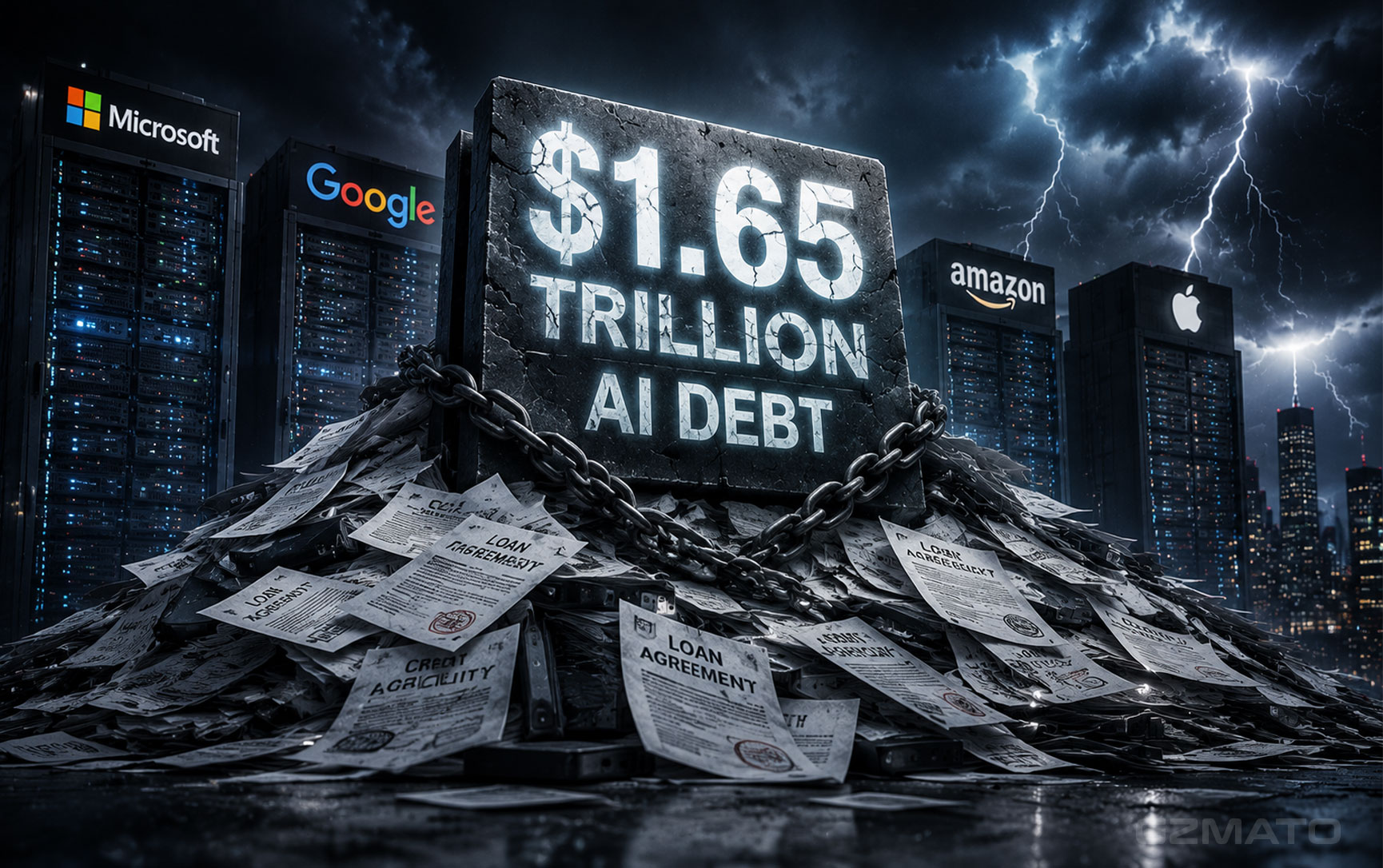
July 22, 2026 — A bombshell study from Nikkei Research has revealed that America's five largest technology companies are sitting on a hidden debt pile of $1.65 trillion — debt that doesn't appear on their balance sheets but behaves exactly like it. The figure has grown roughly eightfold in just four years, driven entirely by the AI infrastructure arms race [citation:1][citation:4].
Even more alarming: this hidden debt now exceeds the companies' actual reported debt. If you thought Alphabet, Microsoft, Amazon, Meta, and Oracle were fortress-balance-sheet tech giants, you were only seeing half the picture.
The Numbers: $1.65 Trillion and Counting
According to the Nikkei study, the five companies' combined visible and hidden obligations total roughly $3 trillion — nearly double what appears in standard credit models [citation:1][citation:4].
To put that in perspective, $1.65 trillion is larger than the GDP of all but about a dozen countries on Earth. It's more than the entire market capitalization of most national stock exchanges. And it's all tied to one thing: building AI data centers, buying GPUs, and securing the computing power needed to train and run the next generation of artificial intelligence models [citation:1].
The growth trajectory is staggering. In 2022, this hidden debt stood in the low hundreds of billions. By 2025, it had already doubled. The 2026 figure is anticipated to be roughly twice as high as 2025 [citation:4].
| Metric | Figure | Context |
|---|---|---|
| Hidden debt (5 companies) | $1.65 trillion | 8x growth in ~4 years [citation:1] |
| Total obligations (visible + hidden) | ~$3 trillion | Nearly 2x standard credit models [citation:4] |
| Meta off-balance-sheet | ~$420 billion | Nearly 3x its reported debt [citation:1] |
| Oracle hidden debt growth | ~$273.3 billion | 30x increase over 4 years [citation:4] |
| Hyperscaler CapEx 2026 | $660–$700 billion | Up from ~$410 billion in 2025 [citation:5] |
| AI-related bond issuance 2025 | $100+ billion | 3x the prior 5-year average [citation:6] |
How the Debt Is Hidden: SPVs, Leases & Shadow Borrowing
The key mechanism is off-balance-sheet financing — structures that allow tech giants to fund massive capital expenditures without the debt appearing as a straightforward liability on their corporate balance sheets [citation:6][citation:7].
The specific instruments identified by Nikkei are:
- Data center leases — long-term operating leases for massive AI facilities
- GPU supply contracts — multi-billion-dollar commitments to secure Nvidia and other accelerator chips
- Special Purpose Vehicles (SPVs) — separate legal entities that own the physical assets while the tech company leases them back
- Private credit joint ventures — partnerships with firms like Blue Owl Capital to fund infrastructure
Here's how it works in practice: Meta's $30 billion Hyperion data center in Louisiana was funded through an SPV called Beignet Investor. Meta owns just 20% of the joint venture. Blue Owl-managed funds own 80%. The project issued $27 billion in debt anchored by PIMCO and BlackRock. Meta keeps operational control but not the debt on its books. It simply leases back the finished campus under a long-term operating lease [citation:7].
The Bank for International Settlements (BIS) — the central bank for the world's central banks — has labeled this phenomenon "shadow borrowing" and warned that it creates "a complex web of private arrangements" with risks that are "typically poorly disclosed" [citation:3][citation:8].
Meta & Oracle: The Most Exposed Giants
Not all five companies carry the burden equally. The Nikkei study singles out two firms as particularly exposed:
Meta: $420 Billion Off-Balance-Sheet
Meta's off-balance-sheet liabilities come in around $420 billion — nearly triple its reported debt of approximately $151.6 billion (as of Q1 2026) [citation:1][citation:9]. Most investors would still describe Meta as effectively net-cash, given its $81.2 billion in cash and marketable securities. But in reality, the obligation stack sits roughly on the order of the infrastructure it has committed to build [citation:1].
Meta's 2026 capital expenditure guidance has already been raised to $125–$145 billion, up from a prior range of $115–$135 billion, reflecting higher component pricing and additional data center costs [citation:9].
Oracle: 30x Debt Growth in 4 Years
Oracle's hidden debt has soared roughly 30-fold over four years, reaching $273.3 billion by the end of May 2026 [citation:4]. This is particularly concerning because Oracle's ability to pay back this debt is largely dependent on the future profitability and success of OpenAI — its single largest customer [citation:4].
Oracle carries a Baa2 credit rating, just two rungs above junk bond territory. It has disclosed more than $248 billion of not-yet-commenced data center lease commitments and borrowings of about $124 billion. The company recently pledged to raise $45–$50 billion more this year, split between debt and equity, and has reportedly planned layoffs of thousands of employees to finance its data center buildout [citation:10].
BIS Sounds the Alarm: "This Has Happened Before"
The Bank for International Settlements didn't mince words in its Annual Economic Report 2026, released June 28. It drew direct parallels between the current AI investment boom and historical episodes that ended in economic catastrophe:
- The canal mania of the 1830s
- The British railway bubble of the 1840s
- The dot-com crash of 2000
"The scale and pace of the current AI investment boom, accompanied by expectations of large productivity payoffs, bear resemblance to these precedents," the BIS wrote. "These episodes ended with an eventual reversal in investment, inducing economy-wide recessions" [citation:8].
The BIS's core concern isn't that AI is a fraud — the technology is real, and task-level studies show productivity gains of 20% to 50%. The concern is that every major hyperscaler is making the same massive bet simultaneously, driven by the perception that only a handful of players will ultimately dominate. That logic, the BIS warns, is a recipe for collective overcommitment [citation:8].
Using contest-theory modeling, BIS economists found that as competitive pressure drives capital expenditure higher, the net economic surplus for the sector as a whole declines and could turn negative in adverse scenarios. A disappointment in returns, the report warns, "could trigger a sudden pullback in financing and turn the capex boom into a protracted investment bust" [citation:8].
Michael Burry Rings the Bell
On July 21, 2026, Michael Burry — the legendary investor who famously predicted the 2008 subprime mortgage crisis, immortalized in "The Big Short" — took to X (formerly Twitter) to amplify the Nikkei findings [citation:4].
"Hidden debt at U.S. tech giants swelled eightfold in roughly four years to an estimated $1.65 trillion as artificial intelligence investments ballooned, a Nikkei study shows, exceeding actual debt and making it tougher for investors to assess risk," Burry posted, quoting the Nikkei report directly [citation:4].
Burry's endorsement of the study carries weight. He has built a career on spotting systemic risks that the market misses. When the man who saw the 2008 crash coming starts waving red flags about tech debt, investors listen.
What Happens If AI Doesn't Pay Off?
The critical question is what happens if AI revenues fail to materialize at the scale needed to service this debt. Several scenarios are in play:
| # | Scenario | Likelihood | Impact |
|---|---|---|---|
| 1 | AI revenue shortfall — AI adoption slows, ROI doesn't match capex | Moderate | Credit downgrades, stock corrections, forced asset sales |
| 2 | Refinancing cliff — AI servers refresh every 18-36 months; bonds mature in 5-20 years | High | Asset-duration mismatch forces fire sales |
| 3 | Private credit squeeze — lenders pull back when conditions deteriorate | Moderate | Cascade of defaults through SPVs |
| 4 | Wealth effect crash — US stocks = 64% of MSCI Global; household equity exposure doubled since 2010 | Low-Moderate | Global consumption pullback, recession |
| 5 | Rate shock — Hormuz oil crisis + sticky inflation forces Fed to hike | Uncertain | AI debt bubble pops under higher rates |
The BIS was careful to note that immediate risks to financial stability appear modest — but with a significant asterisk: the situation stays contained only if the AI sector actually delivers strong financial outcomes [citation:3].
As one analyst put it: "In 2008, the 'trash' was hidden in housing debt. In 2026, the 'trash' is unproductive AI infrastructure debt" [citation:11].
Key Takeaways
| # | What You Need to Know About Big Tech's Hidden AI Debt |
|---|---|
| 1 | $1.65 trillion in hidden debt across Alphabet, Microsoft, Amazon, Meta, and Oracle — 8x growth in 4 years, now exceeding reported debt [citation:1][citation:4] |
| 2 | Off-balance-sheet financing via SPVs, operating leases, and private credit joint ventures obscures true leverage from standard credit models [citation:6][citation:7] |
| 3 | Meta is the most exposed with ~$420 billion off-balance-sheet liabilities, nearly 3x its reported debt [citation:1] |
| 4 | Oracle's debt grew 30x in 4 years to $273 billion, with repayment heavily dependent on OpenAI's success [citation:4] |
| 5 | BIS compares AI boom to canal mania, railway bubble, and dot-com crash — all ended in recession [citation:8] |
| 6 | Michael Burry has sounded the alarm, drawing attention to the Nikkei study and the systemic risk it represents [citation:4] |
| 7 | AI server refresh cycles (18-36 months) vs bond maturities (5-20 years) create a dangerous asset-duration mismatch [citation:4] |
| 8 | Circular financing risk — hyperscalers fund AI startups who buy cloud services back, inflating revenue without real customers [citation:8] |
- Nikkei Research — Hidden debt study: $1.65 trillion across five US tech giants [citation:1]
- AI Weekly — Analysis of Nikkei findings and per-company breakdowns [citation:4]
- Bank for International Settlements (BIS) — Annual Economic Report 2026, shadow borrowing warnings [citation:3][citation:8]
- IESE Business School — "An AI debt wave meets uneven balance-sheet risk" [citation:6]
- Techerati — "AI's Hidden Price Tag: Record Debt and Off-Balance-Sheet Financing" [citation:7]
- S&P Global — 2026 outlook on AI debt and private credit risks [citation:5]
- Fortune — "Google, Meta, and Oracle are on a $1 trillion borrowing spree" [citation:10]
- Meta Platforms, Inc. — Q1 2026 Earnings Report [citation:9]
- Bank Info Book — "The 2026 AI Debt Trap" analysis [citation:11]
Get the latest tech news, product reviews, and industry analysis delivered to your inbox.
Special Offer: Use code TECHDEBT2026 for a discount on your first order!
Explore Gzmato BlogFrom AI chips to smart home gadgets — we've got you covered.
Our team can help you navigate the latest tech developments and find the right products for your needs. Chat with us or open a request for personalized recommendations.



- big tech hidden debt
- AI infrastructure debt
- off-balance-sheet debt
- tech giants debt 2026
- Meta Oracle debt
- BIS AI warning
- Michael Burry tech debt
- shadow borrowing AI
- data center financing
- SPV tech debt