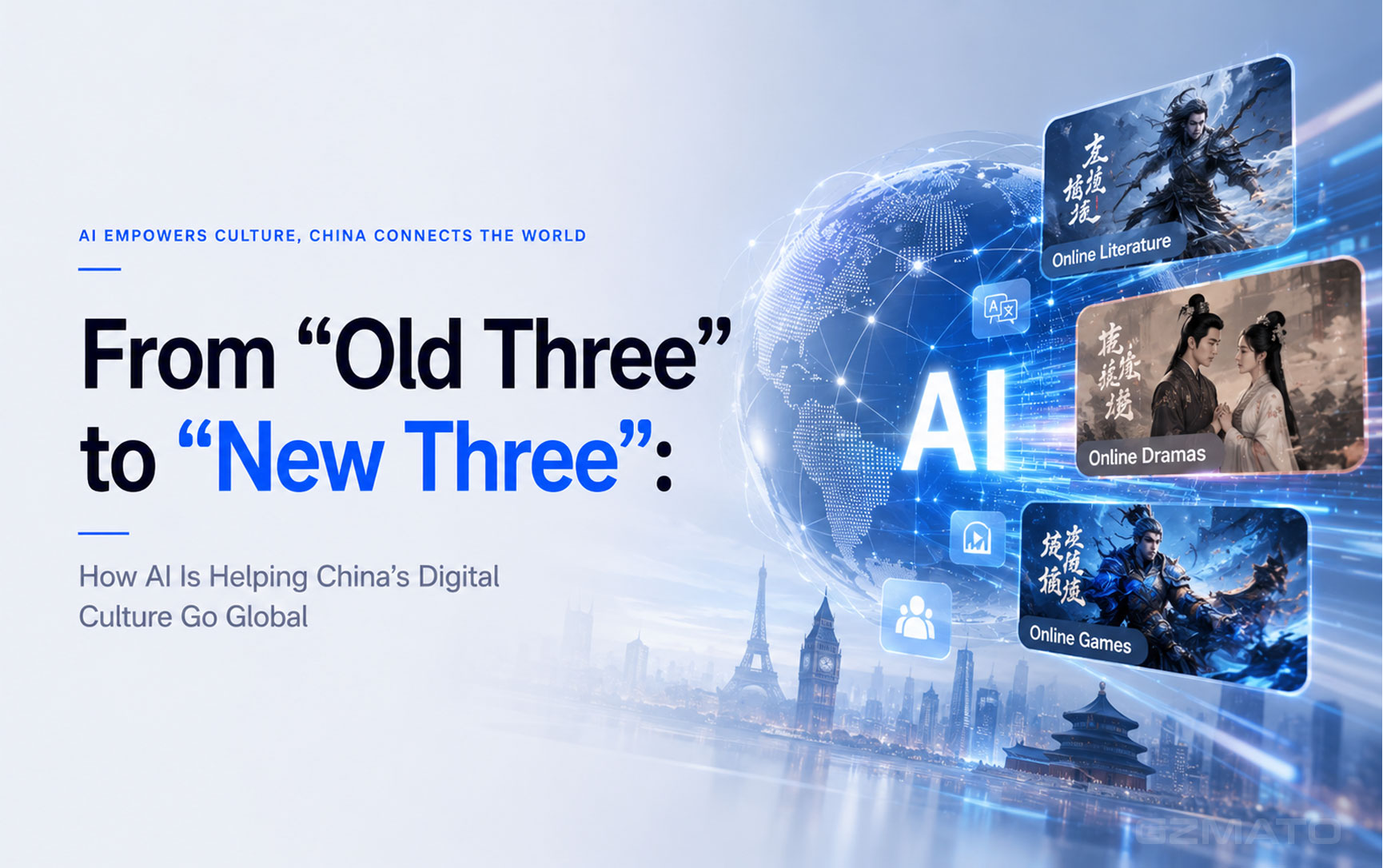
From "Old Three" to "New Three": How AI Is Helping China's Digital Culture Go Global
From "Old Three" to "New Three"
For decades, the world knew China's cultural exports through the "old three": kung fu, Chinese cuisine, and pandas. Today, a new set of cultural exports is making its way across the globe — and they are reaching audiences far beyond what the old guard ever could.
Network literature (web novels), online games, and micro-dramas have become China's cultural "new three." Unlike their predecessors, these digital-native formats are not tied to physical goods or face-to-face encounters. They travel through fiber optic cables, social media feeds, and app stores. They are consumed on phones, tablets, and laptops. And they are increasingly powered by artificial intelligence.
According to a recent survey covering 20 countries, China's web novels, online games, and micro-dramas have reached global user bases of 10.7 billion, 12 billion, and 18 billion respectively (including domestic users) — making them one of the most significant digital cultural exports of the past decade [citation:5].
Web Novels: AI Translation Opens New Markets
Network literature was the first of the "new three" to go global. Today, Chinese web novels have reached over 200 countries and territories, with nearly 200 million active overseas readers [citation:6].
What made this possible? AI translation.
Web novels—particularly fantasy and sci-fi genres—are complex to translate. They contain invented terminology, culturally specific idioms, and long-running serialized plots. Traditional translation was slow and expensive. Now, AI-powered translation systems handle the heavy lifting.
Yuewen Group, a leading digital reading platform, uses AI translation to produce content in more than 10 languages. As of late 2025, the company's overseas platform had released over 17,000 AI-translated works [citation:2]. AI-translated content revenue grew 39% year-over-year, with notable growth in emerging markets like Latin America [citation:2].
The impact goes beyond China. Yuewen has also enabled overseas writers to create their own stories within its ecosystem. The global network of web novel creators has grown to over a million writers outside China, creating a "Chinese original + global co-creation" model [citation:8].
Chinese web novels can be challenging to translate due to their use of ancient Chinese idioms, invented fantasy terminology, and serialized storytelling. AI translation systems have brought down translation costs by an estimated 90% and increased daily output to tens of millions of characters [citation:4][citation:6]. This allows web novels to be released in multiple languages simultaneously, rather than weeks or months after the original Chinese publication.
Micro-Dramas: The Fast-Growing Format
If web novels are the steady foundation, micro-dramas are the explosive growth story.
Micro-dramas are short-form video series with episodes lasting 1-2 minutes each. They are fast-paced, high-impact, and designed to be consumed on social media and streaming platforms. In 2025, China's overseas micro-drama market generated $2.38 billion in revenue, up more than 260% year-over-year [citation:8]. The market is expected to reach $6.5 billion in 2026 and is projected to exceed $40 billion globally by 2030 [citation:3][citation:11].
The segment is growing especially rapidly in Southeast Asia and Africa, where micro-dramas have already reached penetration rates of 67%, approaching China's domestic level of 70.2% [citation:5].
AI is central to this expansion. AI-powered platforms can now translate and dub a micro-drama in as little as 6 hours, with multi-language localization that allows playback to reach 3-5 times the viewership of non-localized content [citation:8].
AI also lowers production costs dramatically. A typical micro-drama filmed with real actors costs about $150,000 to produce for the U.S. market. With AI, that cost drops to $30,000 — 20% of the original — and can go as low as 10% [citation:3]. This has made it possible for smaller studios and individual creators to compete on the global stage.
Online Games: A Platform for Cultural Exchange
Online games represent the largest revenue stream among the "new three." In 2025, China's self-developed games generated $20.4 billion in overseas revenue, up 10.23% year-over-year [citation:8].
Games are a uniquely effective medium for cultural exchange. They combine visual design, narrative, and interactive engagement in ways that static media cannot. Players don't just observe — they participate.
Games like Black Myth: Wukong have gained global attention by combining Eastern aesthetics with world-class production values [citation:6]. Others have embedded Chinese cultural elements more subtly. One game publisher explained that by incorporating "Chinese kung fu" and traditional craftsmanship into its game mechanics, it has reached players in over 200 countries and regions [citation:3].
The game industry's approach to localization is also evolving. Rather than simple translation, companies are adapting content to local preferences in terms of art style, narrative, and gameplay. The goal is not to export a Chinese product but to create a product that resonates with global players — with Chinese cultural elements as part of the experience, not the entire experience [citation:3].
AI as the Engine: How Technology Powers Cultural Export
Across all three categories, AI serves as the enabling technology. It does not replace human creativity — it amplifies it.
The AI Translation and Culture "New Three" Export Report notes that AI is shifting the cultural export industry from labor-intensive localization to intelligent, technology-driven globalization [citation:4]. In web novels, AI translation powers daily output of millions of words. In micro-dramas, AI handles subtitling, dubbing, and lip-sync matching. In games, AI supports terminology management, quality assurance, and marketing asset generation [citation:4].
AI also enables entirely new production workflows. Yuewen Group developed an AI assistant that handles everything from text analysis to scene rendering — turning novels directly into animated episodes [citation:10]. The company has released nearly 1,000 AI-generated comic dramas since 2025, with more than 100 exceeding 10 million views [citation:10].
The shift from "shipping out" to "building our own ships" is another notable trend. Chinese cultural companies are increasingly building their own platforms and distribution channels rather than relying on overseas partners [citation:7]. They are moving from one-off product exports to full ecosystem development, with infrastructure ranging from AI content creation tools to global distribution networks.
In China's Zhejiang province, a new AI Cultural Innovation Center is now operational, designed to build a "full-chain closed loop" from AI creation to production to global distribution [citation:1]. The center is part of a broader effort to support cultural "new three" exports with computing power, funding, and industry resources.
Key Takeaways
| # | Key Takeaway |
|---|---|
| 1 | Web novels reach 200+ countries — Nearly 200 million overseas readers, with AI translation making multi-language releases possible at scale [citation:5][citation:6]. |
| 2 | Micro-dramas are the fastest-growing segment — $2.38 billion in overseas revenue in 2025, up 260% year-over-year [citation:8]. |
| 3 | Games generate the largest revenue — $20.4 billion in overseas revenue in 2025, with games reaching 200+ countries [citation:8]. |
| 4 | AI reduces translation costs by 90% — AI-powered translation has dramatically reduced the cost and time required to reach global audiences [citation:4][citation:6]. |
| 5 | AI production lowers costs significantly — Micro-drama production costs drop from $150K to $30K with AI tools [citation:3]. |
| 6 | Users are young and engaged — "New three" users are predominantly aged 18-34, with high engagement and willingness to pay [citation:5]. |
| 7 | The shift is from "ship out" to "build our own" — Chinese companies are building their own platforms and distribution networks rather than relying on overseas partners [citation:7]. |
| 8 | AI is an amplifier, not a replacement — Human creativity remains central; AI handles the heavy lifting of translation, localization, and production [citation:4]. |
Sources & Methodology (as of June 28, 2026):
- Xinhua / 新华社 — AI-driven changes in China's cultural industry [citation:10]
- China Daily — Cultural "new three" global user survey [citation:5]
- 21st Century Business Herald / 21世纪经济报道 — AI short drama, cultural export trends [citation:3]
- China Translation Association / 中国翻译协会 — AI translation and cultural "new three" export report [citation:4]
- Guangming Daily / 光明日报 — New quality productivity and cultural export [citation:8]
- People's Daily Overseas Edition / 人民日报海外版 — Cultural "new three" commentary [citation:6]
- Shanghai Securities News / 上海证券报 — AI short drama and IP export [citation:11]
AI-Ready Laptops | Fast Chargers | USB-C Cables | Power Banks | Development Kits | Tech Accessories
Special Offer: Use code TECH2026 for a discount on your first order!
Shop Now at Gzmato →

- Chinese culture export
- web novels
- online games
- micro-dramas
- AI translation
- digital culture
- cultural industry