China's "Artificial Sun" Breakthrough: The World's Largest Fusion Magnet Is Ready
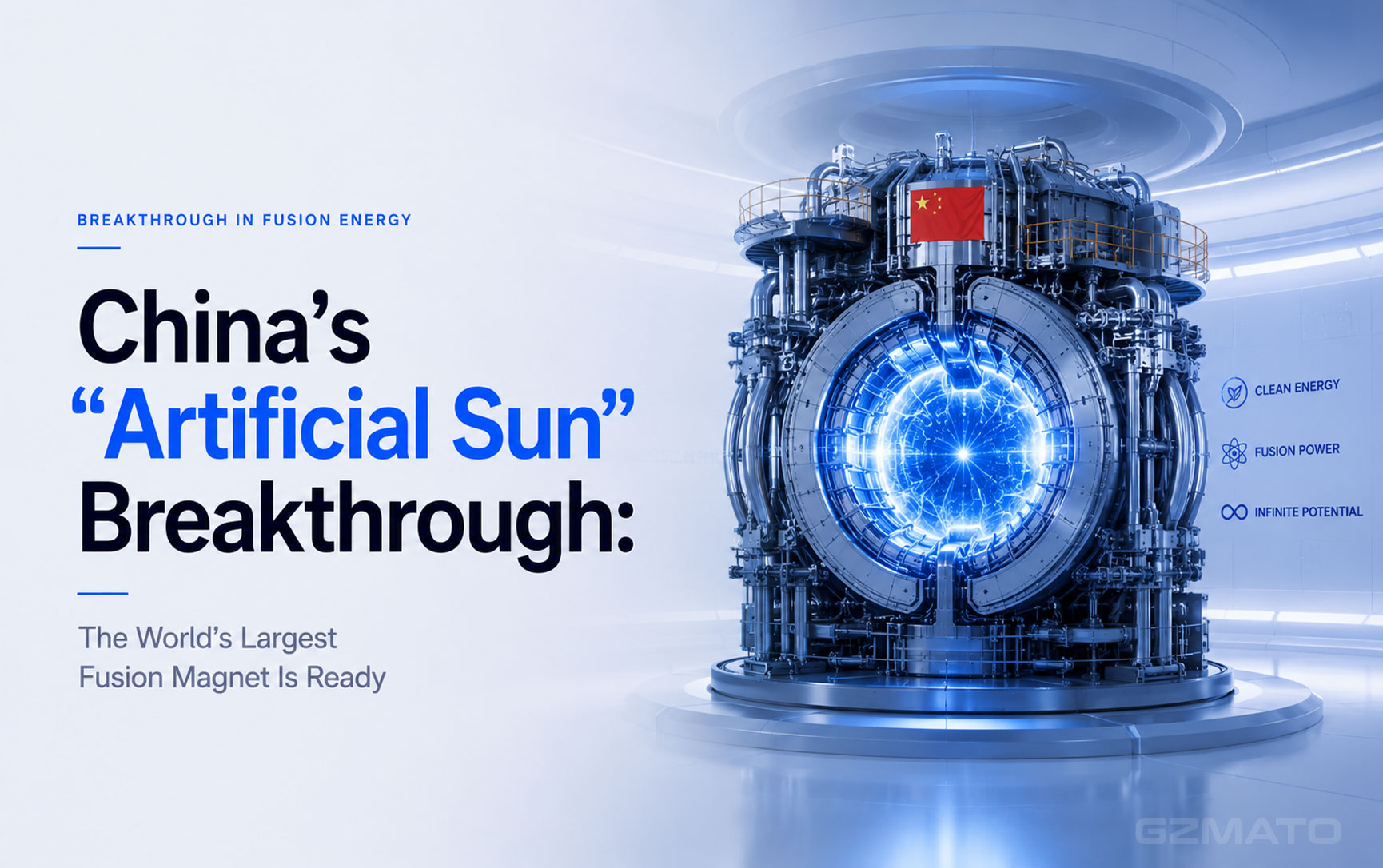
The World's Largest Fusion Magnet Is Ready
On June 27, 2026, China's "Artificial Sun" project achieved a milestone that brings humanity one step closer to unlocking the ultimate energy source.
At the Institute of Plasma Physics, Chinese Academy of Sciences (ASIPP) in Hefei, two critical superconducting magnets for fusion reactors passed final acceptance testing. The toroidal field magnet — the largest fusion magnet ever built — completed its final fabrication and passed expert review. Simultaneously, a high-temperature superconducting central solenoid coil completed full-load parameter testing, with core performance reaching internationally leading levels [citation:1][citation:5].
Both systems achieved 100% domestic technology — from materials to design to manufacturing [citation:5]. This is not just a scientific breakthrough. It is a signal that fusion energy, long dismissed as "always 50 years away," is entering a new phase.
The Magnet: 582 Tons, 1.3x ITER's Size, 3x Its Energy
The toroidal field magnet is a engineering marvel by any measure [citation:5][citation:6].
| Specification | Value |
|---|---|
| Dimensions | 21m long × 12m wide × 3.3m high |
| Weight | 582 tons |
| Size vs. ITER | 1.3× the volume of ITER's TF magnet |
| Energy Storage | 3× ITER's TF magnet |
| Operating Current | 98 kA |
| Total Stored Energy | 120 GJ |
| Peak Magnetic Field | 14.5 T |
| Design Lifespan | 60 years in extreme conditions (cryogenic temperature, high current, intense radiation, high stress) |
For context, the magnet is larger and more powerful than the comparable component of ITER — the international fusion experiment under construction in France. China is not just participating in ITER; it is building components that exceed ITER's specifications [citation:5].
The magnet's function is to generate the magnetic field that confines plasma at temperatures exceeding 100 million degrees Celsius — hotter than the core of the Sun [citation:1][citation:6].
Alongside the toroidal magnet, the high-temperature superconducting central solenoid coil also passed testing with impressive results [citation:6][citation:9]:
- Stable current: 60 kA
- Stored energy: 6.03 MJ
- Magnetic field change rate: 5.1 T/s
- Joint resistance: 0.87 nΩ — all reaching internationally leading levels
100% Domestic: 47 Patents, 14 Standards
Perhaps more significant than the magnet itself is how it was built. The entire system — from superconducting materials to structural design to manufacturing processes — is 100% domestically developed [citation:5][citation:7].
The project team spent six years on the magnet, completing full-chain development including design, pre-research, fabrication, and testing [citation:6][citation:7]. Their achievements include:
- 47 authorized patents
- 14 technical standards established
- Over a dozen key technical breakthroughs, including high-stability magnet design, high-current superconducting conductor development, low-resistance joint fabrication, and quench protection systems [citation:7][citation:9]
Fusion technology has long been subject to export controls and technology restrictions. By achieving full domestic capability — from raw superconducting materials to finished magnet assembly — China has secured a critical path to building fusion reactors without relying on foreign suppliers. The implications extend beyond energy: the same superconducting and precision manufacturing capabilities can be applied to other strategic technologies.
Why Now? Fusion Is Entering the "Industrial Dawn"
This breakthrough is not happening in a vacuum. Fusion energy is moving from laboratory experiment to industrial project at an accelerating pace [citation:13][citation:14].
Policy Support
Fusion energy is explicitly listed as a future industry priority in China's "15th Five-Year Plan." The 2026 Fusion Energy Technology and Industry Conference in Hefei saw the launch of a 1 billion yuan fusion venture fund with a 15-year horizon, alongside a Fusion Financial Institution Alliance of 130+ members [citation:13][citation:15].
Parallel Projects
China now has a tiered fusion research infrastructure [citation:15]:
- EAST: The experimental advanced superconducting tokamak — already operating
- BEST (Burning-plasma Experimental Superconducting Tokamak): Under construction, aiming to achieve fusion "first light" by 2030
- CRAFT: The comprehensive research facility for fusion reactor components — where this magnet was developed
The "Five-Year Acceleration"
According to a Fusion Energy Base survey, 78% of fusion companies expect their pilot plants to begin operations between 2030 and 2035 [citation:14]. The industry has moved from "perpetually 50 years away" to discussing "this decade" timelines.
Key Takeaways
| # | Key Takeaway |
|---|---|
| 1 | World's largest fusion magnet completed — 582 tons, 1.3× ITER's size, 3× its energy storage, passing expert acceptance on June 27 [citation:5]. |
| 2 | 100% domestic technology — Materials, design, and manufacturing all developed in China, with 47 patents and 14 standards [citation:6][citation:7]. |
| 3 | High-temperature superconducting coil breakthrough — 60 kA stable current, 6.03 MJ stored energy, 5.1 T/s field change rate, reaching internationally leading levels [citation:6][citation:9]. |
| 4 | Fusion is entering industrial acceleration — 78% of fusion companies expect pilot plants by 2030-2035 [citation:14]. |
| 5 | From "50 years away" to "this decade" — The BEST project targets 2030 for "first light," with EDR by 2035 and demonstration reactors by 2045 [citation:15]. |
| 6 | $1 billion+ fusion investment — New venture funds and financial alliances are providing long-term capital for fusion industrialization [citation:13][citation:15]. |
| 7 | AI energy demand accelerates fusion — The explosion in AI compute power is creating unprecedented demand for clean, reliable baseload electricity, adding urgency to fusion development [citation:14]. |
Sources & Methodology (as of June 28, 2026):
- Xinhua / 新华社 — China's fusion magnet breakthrough, 100% domestic tech [citation:5]
- China Energy News / 中国能源报 — CRAFT magnet acceptance details [citation:3]
- CCTV / 央视 — "Artificial Sun" project coverage [citation:1][citation:4]
- Anhui Provincial Government / 安徽省人民政府 — Official achievement announcement [citation:7]
- Institute of Plasma Physics, CAS / 中国科学院等离子体物理研究所 — Technical details of the central solenoid coil [citation:6][citation:9]
- China Daily — Fusion energy breakthrough coverage [citation:5]
- Securities Times / 证券时报 — Fusion industry and capital landscape [citation:15]
- Guosheng Securities / 国盛证券 — Fusion market analysis [citation:14]
AI-Ready Laptops | Fast Chargers | USB-C Cables | Power Banks | Development Kits | Tech Accessories
Special Offer: Use code TECH2026 for a discount on your first order!
Shop Now at Gzmato →
- fusion reactor
- artificial sun
- superconducting magnet
- nuclear fusion
- ITER
- tokamak
- clean energy