The Quiet Evolution: Why We Don't See 'Einsteins' Anymore, And Why That's A Sign of Progress
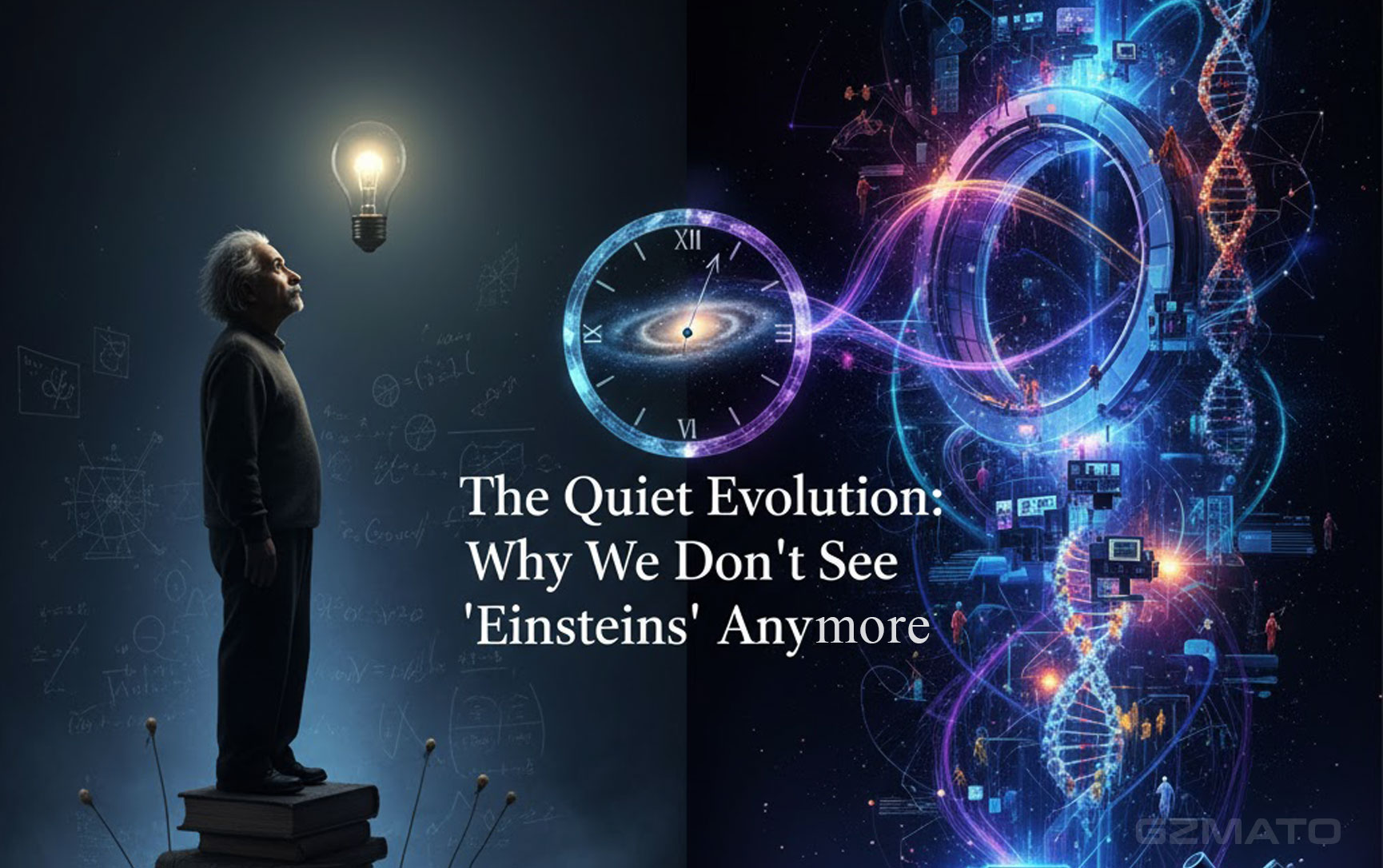
The timeless poetry of William Blake offers a profound perspective on human scale and perception: "To see a World in a Grain of Sand, / And a Heaven in a Wild Flower, / Hold Infinity in the palm of your hand, / And Eternity in an hour."
In the history of science, the great minds—Newton, Leibniz, Einstein, and Marie Curie—were those who seemed to hold this "Infinity" almost single-handedly. They were the iconic figures who, with a theory or an invention, fundamentally reshaped the world's understanding of itself.
Yet, a puzzling question arises today: Why, over the last two centuries, have we seemingly stopped producing these larger-than-life "Science Superstars"?
The answer is not a decline in human genius. Instead, the very mechanism of scientific discovery has undergone a profound structural and cultural evolution. The hero hasn't disappeared; they have been decentralized and woven into the fabric of a much larger, more resilient network.
Chapter 1: The End of Solo Genius – The Rise of "Big Science"
The most significant shift lies in the methodology of research. The great breakthroughs of the past were often achieved through individual contemplation and relatively small-scale experimentation.
- Classical Example: Albert Einstein conceived his theories of relativity largely alone, using thought experiments and mathematics—a low-cost, high-leverage intellectual endeavor.
Modern science, however, operates under the "Big Science" paradigm. Today’s major questions require resources and scales unimaginable to past generations.
The discovery of the Higgs boson—an achievement on par with Newton's laws in importance—serves as the ultimate counter-example to the solo genius myth. It required:
- Colossal Investment: Billions of dollars for the Large Hadron Collider (LHC).
- Massive Collaboration: Two primary experimental groups (ATLAS and CMS) involving over 6,000 scientists and engineers from over 100 countries.
The credit for such a breakthrough is inherently diffuse. The heroes are no longer singular figures, but the architects of the collaborative infrastructure and the leaders of massive, specialized teams.
Chapter 2: The Abstraction Barrier: When Breakthroughs Go Invisible
In the past, major scientific milestones were often physically and conceptually visible: the lightbulb, the steam engine, or the simple elegance of E = mc². Their impact was immediate and easily grasped by the public.
Today’s most important discoveries are harder for the average person to visualize, leading to a "de-dramatization" of genius:
- The Hyper-Abstract Theory: Modern theoretical physics—such as Yang-Mills Gauge Theory (pioneered by Chen-Ning Yang) or advanced quantum field theory—is foundational but relies on complex mathematical structures that defy popular simplification. The groundbreaking nature of these works is often appreciated only within the narrow confines of their specialized fields.
- The Microscopic Revolution: Conversely, some of the most impactful breakthroughs are microscopically focused. The development of the CRISPR gene-editing technology, for example, is a revolution in molecular biology. While its influence on human health is enormous, the achievement itself—modifying a specific DNA sequence—lacks the visual drama of landing on the moon or harnessing electricity.
The public remembers what they can easily see and understand; modern scientific progress often hides in the complex mathematics or the sub-cellular world.
Chapter 3: The Diffusion of Authority and Commercialization
Beyond the structure of science itself, societal and economic shifts have fragmented the role of the "Superstar Scientist."
A. The Shift from Inventor to Integrator
Historically, figures like Nikola Tesla served as both brilliant inventors and figures of industry. Today, basic science (like the invention of the laser or the internet protocol) originates in universities and state-funded labs, but is quickly translated and commercialized by massive corporations.
The modern "Tesla" is not the person who develops the fundamental theory, but the entrepreneur and integrator (like Elon Musk, Jeff Bezos, or Steve Jobs) who scales the application of the technology. The public celebrates the product and the CEO, not the obscure scientist whose decades-old work made the iPhone's screen or the Mars rocket's navigation possible.
B. The Erosion of Knowledge Authority
In the age of information saturation, the intellectual authority once held by a handful of distinguished scientists has dissolved.
The modern landscape features:
- Idol Diversification: The cultural "hero" slot is split between politicians, celebrities, entrepreneurs, and media influencers.
- Professional Silos: Due to hyper-specialization, a leading cosmologist may not hold significant authority in the field of virology, preventing the emergence of a single, universally revered scientific figure.
Conclusion: The Collaborative Constellation
Scientific progress is not dying; it has matured into a collective endeavor. We should stop waiting for a singular, dramatic figure to step forward and embrace the new reality: our greatest leaps are now forged through the synergistic efforts of specialized, global teams.
The modern "Einstein" is not one person, but the collective human network—the brilliant theoretical architect (like the late Stephen Hawking), the ingenious engineering leader, and the thousands of peer reviewers who ensure rigor. This collaborative constellation is far more robust and efficient than any solitary genius could ever be.
Perhaps this is the ultimate fulfillment of Blake’s vision. By letting go of the need for one hand to hold "Infinity," we empower the many hands of humanity to collaboratively explore the vast world hidden within the smallest grain of sand.


- Science Superstars
- Albert Einstein
- Big Science
- Collaborative Science
- Higgs Boson
- Technological Commercialization
- William Blake