WAIC 2026 Opens Today: 29 Nations Sign AI Pact, Robots Already on the Job
- WAIC 2026 Opens Today: 29 Nations Sign AI Pact, Robots Already on the Job
- World AI Cooperation Organization: 29 Nations Sign Founding Agreement
- The Robots Are Already on the Job
- On the Factory Floor: Cars Built Without Humans
- In Daily Life: Tea, Coffee, and Fashion Authentication
- Play and Interaction: Ping-Pong and Photo Printing
- The Hardware Behind the Hype: Atals 950 and DF1000
- The Bigger Shift: From "Can It Move?" to "Can It Work?"
- Key Takeaways
WAIC 2026 Opens Today: 29 Nations Sign AI Pact, Robots Already on the Job
July 17, 2026 — The 2026 World Artificial Intelligence Conference (WAIC) opens its doors in Shanghai today, and the robots have already reported for duty.
Just one day before the official opening, reporters walking through the Shanghai World Expo Exhibition and Convention Center found a fully functioning "Partnership City" — not a concept, but a working demonstration of humanoid robots seamlessly integrated into production lines, daily life, and entertainment [citation:2].
This year's WAIC is the largest in its nine-year history: 100,000+ square meters of exhibition space, 1,100+ exhibitors, 3,000+ products on display, and over 300 global product debuts [citation:4]. The event runs July 17-20 across four venues in Shanghai's Pudong, Zhangjiang, and Xuhui districts [citation:1].
But the biggest headline came just before the doors opened.
World AI Cooperation Organization: 29 Nations Sign Founding Agreement
On Thursday, July 16, Chinese Foreign Minister Wang Yi and representatives from 29 countries signed the agreement establishing the World Artificial Intelligence Cooperation Organization (WAICO) in Shanghai [citation:3][citation:8].
The founding members include Kazakhstan, Laos, Pakistan, Russia, and Indonesia, among others [citation:3][citation:8]. United Nations Secretary-General António Guterres attended the signing ceremony [citation:1][citation:8].
According to the agreement, WAICO will be an independent intergovernmental international organization headquartered in Shanghai [citation:8]. It will "uphold the purposes of the UN Charter, be committed to extensive consultation and joint contribution for shared benefit, and adhere to a people-centered approach" [citation:3][citation:8].
WAICO's mission has three pillars:
- Deepening innovation cooperation — creating a supply-demand matching platform for AI technology transfer
- Promoting inclusive development — helping developing countries access AI capabilities and close the technology gap
- Strengthening collaborative governance — establishing global norms and standards for safe, fair AI development
The organization was first proposed by China in July 2025 and has since garnered broad international support [citation:1][citation:3].
Why this matters: WAICO represents a significant shift in global AI governance. For the first time, a multilateral AI framework is headquartered outside the US and Europe, with a focus on balancing innovation with equitable access and safety [citation:1][citation:5].
The Robots Are Already on the Job
Inside the "Partnership City" at the Shanghai Expo Center, WAIC organizers have built something remarkable: a complete, functioning ecosystem where humanoid robots work alongside humans, performing real tasks across manufacturing, service, and entertainment [citation:2][citation:6].
These aren't concept demos. They are working systems, running live, producing real outputs [citation:2][citation:6].
On the Factory Floor: Cars Built Without Humans
The "Intelligence Workshop" is perhaps the most jaw-dropping installation at WAIC this year. A complete electric vehicle production line has been recreated inside the expo hall — and it runs without human intervention [citation:2].
Four humanoid robots collaborate across the line, executing five core stages of automotive production from battery assembly to final packaging [citation:2]:
- Battery module production: Four humanoid robots work in synchronized coordination to stack, assemble, and warehouse battery cells with precision [citation:2]
- Wiring harness integration: Robots perform high-precision wire routing, placement, and plugging — a task traditionally difficult to automate — with positioning accuracy reaching sub-millimeter levels [citation:2]
- Motor housing assembly: Two humanoid robots work in perfectly synchronized motion to assemble electric motor housings, moving like "old partners who have worked together for years" [citation:2]
- Headlight assembly and testing: Robots autonomously pick, screw, plug, and perform complete lighting tests [citation:2]
- Interior speaker assembly and packaging: Multiple robots collaborate on speaker installation, calibration, and final packaging — from raw components to finished product in a complete automation loop [citation:2]
This is a live, full-scale demonstration of truly autonomous manufacturing — not a robotic arm performing a single repetitive task, but a complete production system that builds a complex product from start to finish [citation:2][citation:6].
In Daily Life: Tea, Coffee, and Fashion Authentication
Beyond the factory floor, AI-powered robots are showing how they can integrate into everyday life:
- Tea ceremony robot: Performs a six-minute traditional tea ceremony with steady, precise hand movements comparable to a seasoned master [citation:2][citation:6]
- AI kitchen robot: Independently handles ingredient prep, seasoning, and serving — a complete cooking workflow from start to finish [citation:2]
- Luxury goods authentication: A dual-modality system using visual and tactile sensors identifies counterfeit designer handbags with high accuracy [citation:2]
These demonstrations show AI moving beyond industrial contexts into roles that require dexterity, precision, and adaptability — qualities that have traditionally been difficult for robots to master [citation:2][citation:6].
Play and Interaction: Ping-Pong and Photo Printing
WAIC also highlights the entertainment potential of humanoid robotics:
- Table tennis robot: Uses real-time visual prediction to anticipate ball trajectories and engage in extended rallies with human players [citation:2]
- Polaroid companion robot: Autonomously composes shots, positions itself, and prints photos for visitors [citation:2]
These interactions demonstrate real-time environmental awareness and adaptation — skills essential for robots to operate safely and intuitively alongside humans in unstructured environments [citation:2][citation:6].
The Hardware Behind the Hype: Atlas 950 and DF1000
Underpinning all these robot demonstrations is a massive leap in computing infrastructure, and WAIC 2026 is showcasing China's latest advances in AI hardware [citation:4][citation:7][citation:9].
Huawei Atlas 950 SuperPoD
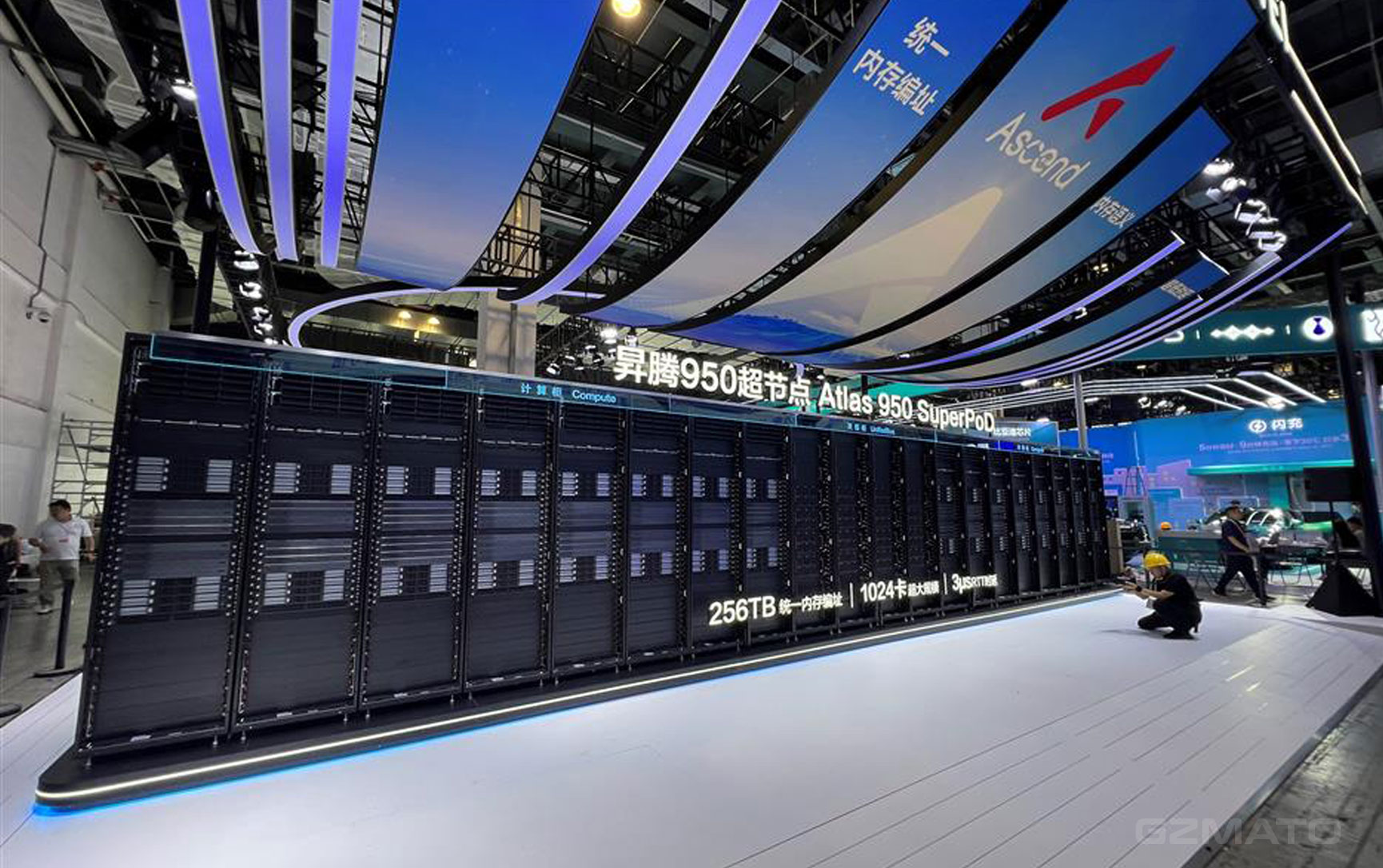
Making its public debut, the Atlas 950 SuperPoD is a next-generation AI supernode built on Huawei's "Lingqu" interconnect architecture. A single cabinet supports 64 Ascend NPU cards, scaling up to 8,192 cards — 56.8 times the scale of Nvidia's NVL144 architecture [citation:4].
At the cluster level, the Atlas 950 SuperCluster scales to 50,000 cards, making it the world's most powerful AI compute cluster by raw scale [citation:4][citation:7]. The system addresses the bottlenecks that have historically prevented large GPU clusters from achieving linear performance scaling [citation:7][citation:9].
DF1000: The World's First Software-Defined 3D Near-Memory Computing Chip
Perhaps the most technically significant debut at WAIC, Shanghai-based Orient Silicon's DF1000 is the world's first software-defined 3D near-memory computing chip [citation:4][citation:7][citation:9].
Built on a 14nm+ process with an entirely domestic supply chain, DF1000 achieves 520 TFLOPS of BF16 compute, 6.4 TB/s memory bandwidth, and 900 GB/s scale-up interconnect [citation:4][citation:9].
How does it achieve this? Two core innovations [citation:4][citation:9]:
- Software-defined chip architecture: The chip is programmable at the architectural level, allowing algorithms to map directly to hardware for significantly higher utilization. Traditional chips typically operate at 50-60% utilization — DF1000 is designed to close that gap [citation:9].
- 3D near-memory computing: Instead of planar 2.5D packaging, DF1000 stacks compute and memory vertically using 3D hybrid bonding, compressing interconnect distances from tens of microns to sub-micron levels. This dramatically increases bandwidth and reduces latency [citation:9].
The result: performance comparable to chips built on far more advanced nodes, without HBM, without TSMC, and without any single point of foreign dependency [citation:4][citation:7][citation:9]. The chip is now taking orders and is expected to enter mass production in the second half of 2026 [citation:7].
The Bigger Shift: From "Can It Move?" to "Can It Work?"
WAIC 2026 reflects a fundamental shift in the AI industry. As one industry observer put it, the question is no longer "can it move?" but "can it work?" [citation:2][citation:6].
Key industry metrics cited at WAIC:
- China's AI core industry exceeded 1.2 trillion yuan in 2025 [citation:2][citation:6]
- AI application penetration among China's large-scale industrial enterprises now exceeds 30% [citation:2][citation:6]
- Over 200 embodied AI companies are exhibiting at this year's WAIC, many with real commercial deployments rather than lab prototypes [citation:9]
- Humanoid robots are genuinely "entering factories and workshops" rather than just performing on trade show floors [citation:2][citation:6]
This shift is reflected in the conference's theme: "AI Partnership for a Brighter Future" [citation:1]. The emphasis is now on how AI can work alongside humans, not just how it can replace or outperform them.
Industry leaders at WAIC noted that the competitive landscape has moved from "pushing hardware" to "optimizing systems." As one executive put it, the future of AI infrastructure depends not just on the number of chips, but on "integrating chips, interconnect, memory, cooling, scheduling, and software into a stable, large-scale system" [citation:7].
Key Takeaways
| # | What You Need to Know About WAIC 2026 Opening Day |
|---|---|
| 1 | 29 nations signed WAICO agreement — World Artificial Intelligence Cooperation Organization established, headquartered in Shanghai, with founding members including Kazakhstan, Pakistan, Russia, and Indonesia [citation:3][citation:8] |
| 2 | Complete EV production line running autonomously — humanoid robots performing battery assembly, wiring, motor housing, headlight, and interior assembly with sub-millimeter precision [citation:2] |
| 3 | Huawei Atlas 950 SuperPoD debuts — 8,192-card supernode, 50,000-card cluster, the world's most powerful AI compute infrastructure by raw scale [citation:4][citation:7] |
| 4 | DF1000 3D chip — 14nm+ chip achieving 520 TFLOPS via software-defined + 3D near-memory architecture, entirely domestic supply chain, now taking orders for mass production [citation:4][citation:7][citation:9] |
| 5 | AI has moved from "showable" to "scalable" — 200+ embodied AI companies exhibiting, humanoid robots working real jobs, and AI penetration in China's industrial sector exceeding 30% [citation:2][citation:9] |
| 6 | WAIC 2026 runs July 17-20 — 100,000+ sqm, 1,100+ exhibitors, 300+ global product debuts, 140+ forums, 9 Nobel/Turing laureates speaking [citation:1][citation:4] |
- Anadolu Agency — WAIC 2026 preview and WAICO signing, July 2026 [citation:1][citation:3]
- The Paper — WAIC 2026 site visit report and robot demonstrations, July 2026 [citation:2][citation:6]
- Feng News — WAIC product debuts and hardware highlights, July 2026 [citation:4]
- Shanghai Securities News — DF1000 and Atlas 950 coverage, July 2026 [citation:7]
- Jiemian News — WAIC 2026 "must-see" list and industry analysis, July 2026 [citation:9]
- Xinhua — WAICO agreement signing, July 2026 [citation:8]
- Vietnam.vn — WAICO agreement coverage, July 2026 [citation:5]
- Ukrinform — WAICO agreement coverage, July 2026 [citation:10]



- WAIC 2026
- World Artificial Intelligence Conference
- WAICO
- 29 nations
- humanoid robots
- Atlas 950
- DF1000 3D chip
- embodied AI
- Shanghai AI conference
- Gzmato