WAIC 2026 Kicks Off Tomorrow: What to Expect from China's Biggest AI Event
WAIC 2026 Kicks Off Tomorrow: What to Expect from China's Biggest AI Event
Updated July 16, 2026 — Tomorrow morning, Shanghai will open its doors to the 2026 World Artificial Intelligence Conference (WAIC), and this year's edition is shaping up to be the largest and most consequential in the event's nine-year history. From a 50,000-card domestic AI supercluster and a 3D chip that rewrites the rules of semiconductor manufacturing to humanoid robots that can actually work and an AI phone that completes tasks across 200 apps, WAIC 2026 has moved beyond "showable" AI to genuinely deployable AI .
Here's what you need to know before the doors open.
By the Numbers: WAIC 2026 in Scale
This year's conference marks several firsts that reflect how quickly China's AI industry has matured :
| Metric | 2026 WAIC |
|---|---|
| Exhibition area | 100,000+ sqm (first time exceeding 100k) |
| Exhibitors | 1,100+ enterprises |
| Products on display | 3,000+ items |
| Global product debuts | 300+ |
| Forums | 140+ |
| Speakers | 1,400+ domestic and international |
| Nobel/Turing laureates | 9 confirmed |
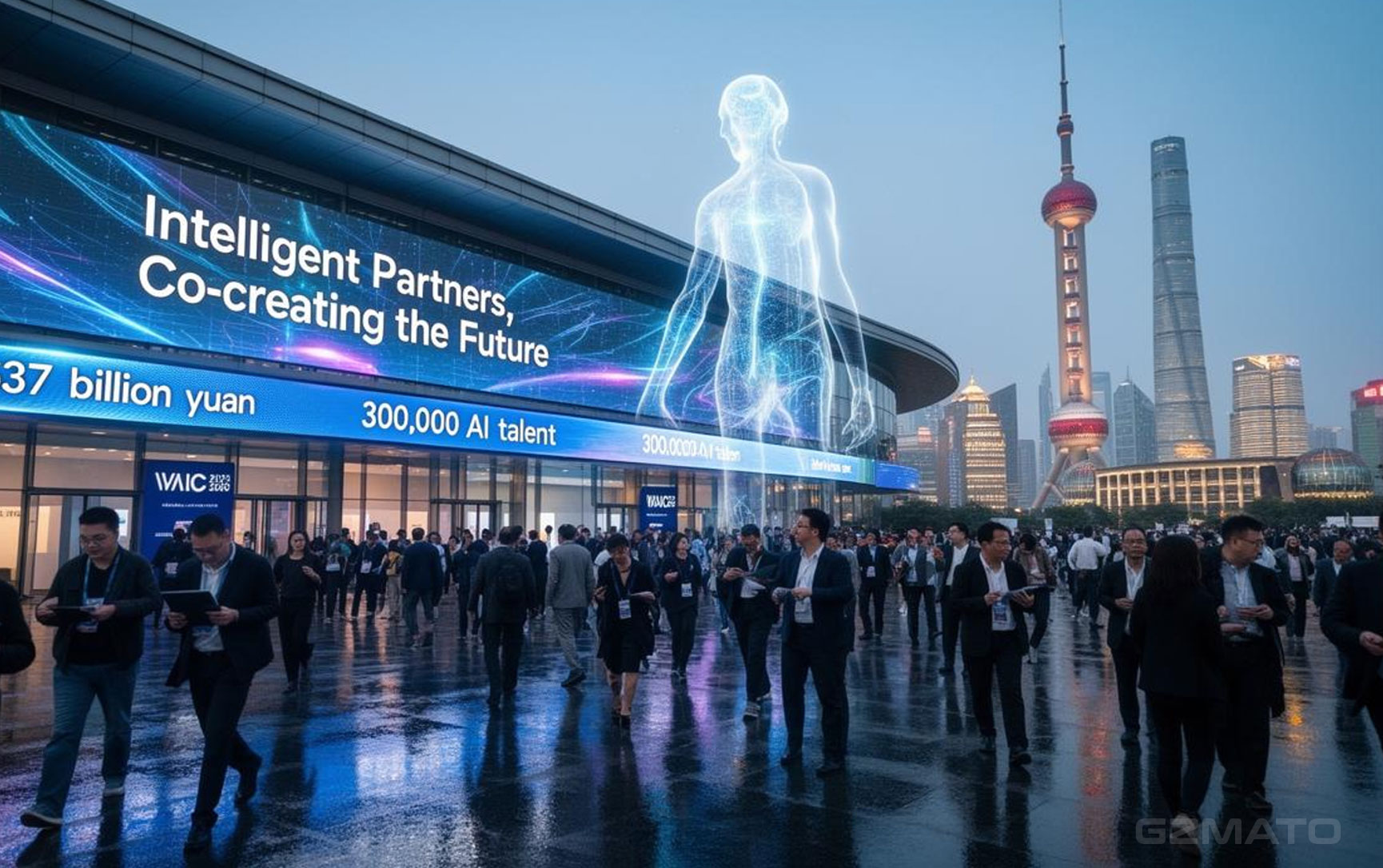
The conference carries the theme "AI Partnership for a Brighter Future" and will be hosted across four venues in Shanghai's Pudong, Zhangjiang, and Xuhui districts . For the first time, six central government ministries and commissions — including the Ministry of Foreign Affairs and the National Development and Reform Commission — are co-hosting the event, signaling AI's elevation to a national strategic priority .
The "Top 10 Treasures": WAIC's Highest Honor
WAIC's "Top 10 Treasures" award is the conference's highest official recognition, selected from thousands of products and applications based on innovation, commercial viability, and real-world impact . Here are the standouts:
Sugon 8000 — The 50,000-Card Domestic AI Supercluster
Sugon's "Dengfeng" is a fully domestically produced 50,000-card AI supercluster that abandons traditional partitioning in favor of "super-fusion" — unified computing across all types. It supports everything from FP64 for scientific computing to INT8 for low-precision AI inference, and covers scientific research, large model training, industrial simulation, and more. The system has already been optimized for over 300 applications across 20+ fields and is connected to the National Supercomputing Internet .
Huawei Atlas 950 SuperPoD
Making its first public appearance in full machine form, the Atlas 950 SuperPoD is built around Huawei's self-developed "Lingqu" high-speed interconnect architecture. A single cabinet supports 64 Ascend NPU cards, scaling up to 8,192 cards — 56.8 times the scale of Nvidia's NVL144 scheme . This isn't just more chips; it's a fundamentally different approach to organizing compute: the entire 8,192-card cluster functions as a single logical computer, eliminating the bottlenecks that cause traditional large clusters to fail. The system delivers 8 EFLOPS of FP8 compute and 16 EFLOPS of FP4 compute, with interconnect bandwidth reaching 16.3 PB/s .
DF1000 — The World's First Software-Defined 3D Near-Memory Computing Chip
This is perhaps the most technically significant debut. DF1000, developed by Shanghai-based Orient Silicon, is a 14nm+ chip that achieves 520 TFLOPS of BF16 compute, 6.4 TB/s memory bandwidth, and 900 GB/s scale-up interconnect — using mature process nodes and entirely domestic supply chain .
How it works: instead of chasing shrinking process nodes (which are restricted), DF1000 uses two technologies: "software-defined chip" architecture that maps algorithms directly to hardware for better utilization, and 3D hybrid bonding that stacks compute and memory die vertically, compressing interconnect distances from tens of microns to sub-micron levels .
The result: equivalent performance to chips built on far more advanced nodes, without HBM, without TSMC, and without any single point of foreign dependency. This represents a genuine alternative path for high-performance AI chips — one built on architectural innovation rather than just chasing the next process node .
Zhiyuan Expedition A3 Ultra — The Only Embodied AI Robot on the "Top 10" List
The A3 Ultra is the first mass-producible, commercially deployable full-size humanoid robot. At 174cm with a human-adapted form factor, it can operate in existing human workspaces without modification. It features 360° vision + LiDAR fusion sensing, 700 TOPS of compute, and a self-developed three-layer heterogeneous computing architecture . It can autonomously build semantic maps, navigate complex environments, and perform full service tasks with its dexterous hands. The robot is designed for 24/7 operation with automatic charging and is already deployed in scenarios including exhibition halls, hotels, retail stores, and guided tours .
STEPX Neo — The World's First L3-Certified Agentic AI Phone
Developed by StepFun (the AI company behind the Step series of models), the STEPX Neo is the first smartphone to pass China's L3 certification for AI terminal intelligence. It runs Step AOS, the industry's first agent-native operating system, with an embedded agent called "Amoo." The phone represents a shift from "manual operation" to "AI-autonomous execution" — the agent can complete tasks across apps, not just respond to queries .
Other Show-Stopping Debuts
"HGR" — Human-Glasses-Robodog Mixed Intelligence System
This system solves a genuinely hard problem: when a person wearing AI smart glasses points to a location (like a delivery drop-off point), the system translates that human-eye perspective into a robodog's eye perspective, automatically making the location the robodog's navigation target. It worked in a live demo — a robodog successfully retrieved a delivery after its human "pointed" through smart glasses . The technology addresses "cross-viewpoint localization," aligning a 1.6-meter human eye height with a 0.4-meter robodog eye height in real-time .
Baidu Companion — The Agent That Actually Gets Work Done
Baidu's entry in the Top 10 list is a general-purpose AI agent designed for real work scenarios. Users describe a task in natural language, and Baidu Companion autonomously understands the task, breaks it down into steps, and calls tools to complete file processing, web operations, data analysis, report writing, and PPT creation — from instruction to deliverable in one workflow .
iFLYTEK AI Glasses
At just 40 grams, these AI glasses integrate real-time translation with a lip-motion recognition noise cancellation system that can isolate a speaker even in crowded environments — making them more than just a wearable screen .
The Bigger Picture: What WAIC 2026 Tells Us About the Industry
From "Showable" to "Scalable"
The most important shift is this: China's AI industry has moved from demonstrating capabilities to delivering deployable systems. WAIC 2018 was about showing what AI could do. WAIC 2026 is about showing what AI can actually deliver in production .
Three data points: China's AI-related industry exceeded 1 trillion yuan in 2025 and is projected to grow over 30% in 2026. Daily token calls in China have reached hundreds of trillions, up from 100 billion in early 2024 to 140 trillion by March 2026. AI penetration in key Chinese industries has now exceeded 80% .
The Agent is the New Interface
2026 is widely seen as the "application year" for AI agents. IDC projects the global agent market to grow at a 139% CAGR through 2030, with Gartner estimating that 40% of enterprise applications will integrate agents this year. IBM and Salesforce predict that by the end of 2026, over 1 billion AI agents will be operational .
Embodied Intelligence: From Demo to Deployment
The global embodied intelligence market grew from ~213 billion yuan in 2018 to 1.09 trillion yuan in 2026. There were 288 funding rounds in China's humanoid and embodied robotics sector in the first half of 2026 alone, with over 46 billion yuan disclosed . Morgan Stanley projects China will ship 28,000 humanoid robots in 2026, up 133% year-over-year .
The Domestic Chip Momentum
China's domestic AI accelerator market share reached 41% in 2025, with Nvidia's share dropping from roughly 70% to 55%. Total domestic accelerator shipments reached 1.65 million units in 2025 . The DF1000 shows there's a path to competitive performance without leading-edge manufacturing — which may be the most significant long-term signal from this year's conference.
Shop Smart Wearables and Tech at Gzmato
Whether you need AI smart glasses, smartwatches, audio gear, or the latest wearables, Gzmato carries the full range of smart tech.
Ray-Ban Meta | Meta Glasses | Rokid AI Glasses | Huawei AI Glasses | Even Realities G2 | XREAL One Pro
Special Offer: Use code TECH2026 for a discount on your first order!
Shop Smart Wearables at GzmatoKey Takeaways
- 36Kr — WAIC 2026 complete preview, July 2026
- Beijing Daily — Five highlights of WAIC 2026 and Top 10 Treasures, July 2026
- TechXue — WAIC 2026 preview: 300 global debuts, agents and embodied AI, July 2026
- CNMO — WAIC 2026 preview: 300 global debuts, agents and embodied AI, July 2026
- International Services Shanghai — WAIC 2026 city-wide experiences, July 2026
- China News — WAIC 2026 Top 10 Treasures announcement, July 2026
- Sina Finance — Zhiyuan Expedition A3 Ultra wins Top 10 Treasure, July 2026

- WAIC 2026
- World Artificial Intelligence Conference
- Huawei Atlas 950
- DF1000 3D chip
- Zhiyuan Expedition A3 Ultra
- STEPX Neo
- AI agent phone
- embodied AI
- China AI
- Gzmato