Traveling the RCEP in 2026: Your Essential Tech Guide
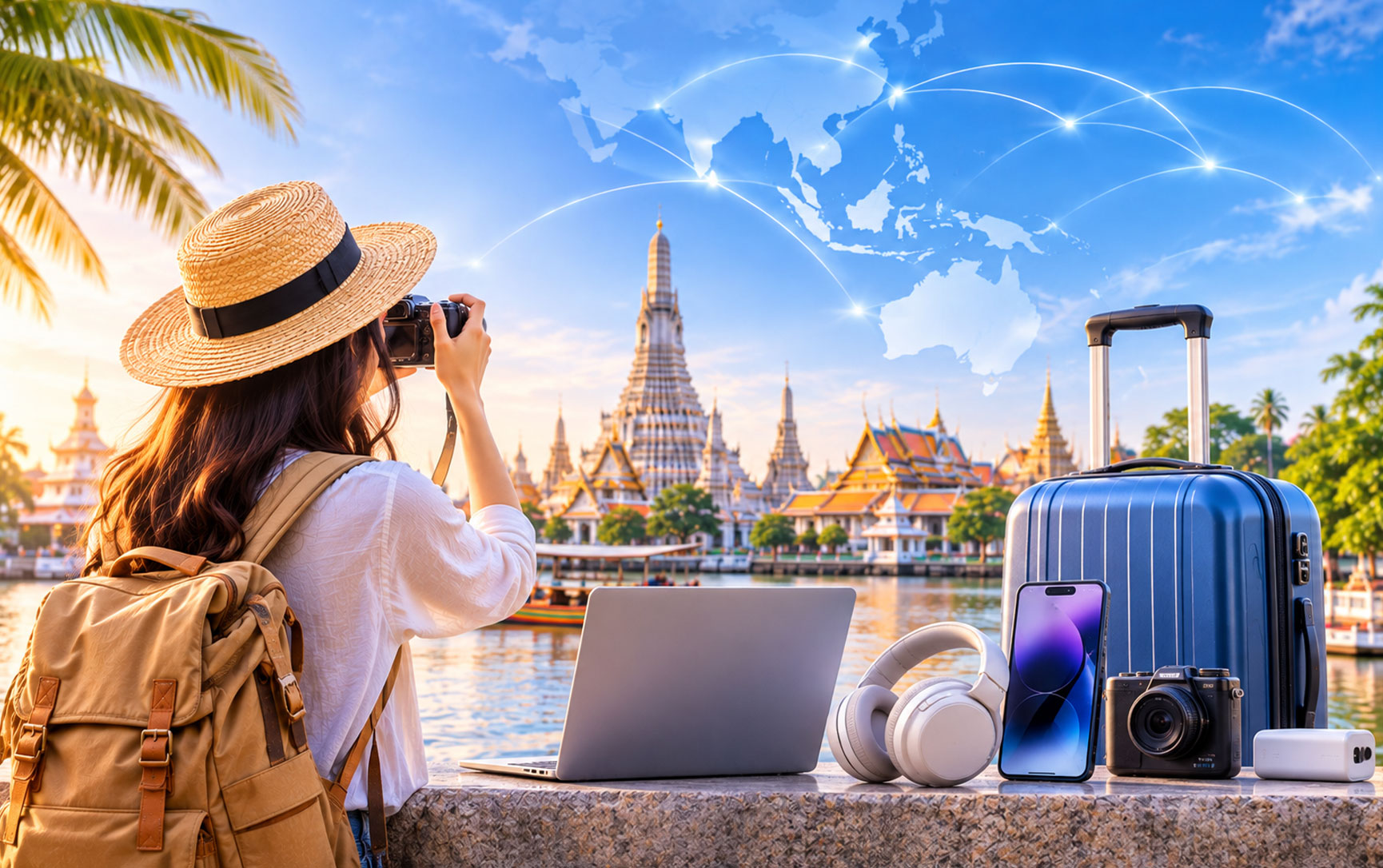
Traveling the RCEP in 2026: Don't Leave Home Without These
November 6, 2026 — In 2026, traveling across the RCEP region (Southeast Asia, Japan, South Korea, Australia) has never been easier. With visa-free policies expanding and direct flights resuming, more Chinese travelers and business professionals are packing their bags. But crossing borders means stepping into a different digital ecosystem.
If you are heading out for a holiday or a business trip, your standard domestic setup won't cut it. Different network bands, foreign plug standards, and payment gateways can turn a dream trip into a frustrating scavenger hunt. Here is the ultimate 2026 electronics checklist for traveling within the RCEP zone.
Network & Connectivity: Don't Get Stuck Offline
The era of buying expensive international roaming packages is over. The smartest way to stay online in 2026 is eSIM.
An eSIM lets you download a local data plan directly from an app before you even board the plane. When you land in Tokyo, Bangkok, or Sydney, you just toggle the eSIM on, and you instantly have high-speed local data. No hunting for physical SIM cards or swapping tiny plastic cards in the back of a taxi.
If you are a frequent traveler with the iPhone Duo, ensure you free up an eSIM slot before your flight, otherwise you won't be able to add a travel data pack on arrival.
Power & Adapters: Surviving the Plug Jungle
Within the RCEP, there is no unified plug standard, which is a nightmare for travelers.
- Japan: Flat 2-pin (US style), 100V.
- Southeast Asia (Thailand, Vietnam): A chaotic mix of flat 2-pin, round 2-pin (EU style), and UK 3-pin.
- South Korea: Round 2-pin (EU style), but often recessed.
- Australia: Angled 3-pin (Type I).
Do not rely on the hotel providing a spare adapter. The ultimate solution is to buy a high-quality GaN (Gallium Nitride) multi-port charger and a universal travel adapter. GaN chargers are half the size of traditional laptop chargers but can power a MacBook Pro, an iPhone, and an Apple Watch simultaneously.
In 2026, a 65W GaN charger (with 2x USB-C and 1x USB-A) is the sweet spot for travel. It can fast-charge your phone and keep a MacBook Air running. Throw one of these and a universal adapter plug into your bag, and you can charge everything from a Tokyo hotel room to an Australian café.
Translation & Payments: Your Cyber Wallet
Getting lost in translation or failing to pay for a taxi because your card got declined is the fastest way to ruin a trip.
For Payments: Set up Apple Pay or Huawei Pay linked to a multi-currency credit card (like UnionPay or Visa/Mastercard). In many RCEP countries, local QR code payments (like PromptPay in Thailand) are dominant, but international credit cards are widely accepted in malls and convenience stores.
For Translation: If you have an iPhone 15 Pro or newer, download the language packs for the Real-time Translation feature in Apple Intelligence. The system-level integration, combined with AirPods, allows you to hold a face-to-face conversation in a foreign language without touching your phone.
If you don't have Apple Intelligence, pre-download offline translation packs in Google Translate or Baidu Translate. A good pair of ANC (Active Noise Cancelling) earbuds is also a lifesaver for noisy budget flights.
The Perfect Travel Gear List
Here is the minimalist, high-efficiency packing list for your 2026 RCEP trip.
| Item | Why You Need It | Recommendation |
|---|---|---|
| eSIM Data Plan | Instant internet on arrival, much cheaper than roaming | Buy an Airalo or Nomad eSIM for Asia-Pacific before flying. |
| 65W GaN Charger | Charges phone and laptop from one tiny brick | Anker or Baseus 65W 3-port charger. |
| Universal Adapter | Fixes the Japan/ASEAN/Korea plug mismatch | Epicka or similar all-in-one travel adapter. |
| 20000mAh Power Bank | Powers your devices during long walking tours | Ensure it is under 100Wh for airline compliance. |
| ANC Earbuds | Blocks out airplane noise and aids translation | AirPods Pro (works with Apple Intelligence). |
| Offline Translate App | Works when you have zero data signal | Pre-downloaded Google/Apple Translate packs. |
Key Takeaways
| # | What You Need to Know Before You Fly |
|---|---|
| 1 | Check your phone's eSIM compatibility. Mainland China iPhones (except the Duo) do not support eSIM, so you must use a physical SIM or roaming. The Duo supports eSIM but has a strict 2-card limit. |
| 2 | Buy a GaN charger, not a bulky laptop brick. A 65W GaN charger can power your phone and laptop simultaneously, saving space and weight. |
| 3 | Do not forget a universal adapter. Japan, Korea, and ASEAN countries have different plugs. One universal adapter covers all of them. |
| 4 | Set up Apple Pay / digital wallets before departure. Ensure your cards are linked and you have backup physical cards in case of terminal failures. |
| 5 | Download offline language packs. Do not rely entirely on having internet. Apple Intelligence's real-time translation is great, but only if the language pack is downloaded. |
| 6 | Bring a sub-100Wh power bank. Anything larger will be confiscated at the airport security check. |
- Apple Support — eSIM compatibility on iPhone models purchased in mainland China.
- IATA — Airline regulations for lithium-ion power banks.
- RCEP Secretariat — Visa and trade facilitation updates for member states.
Apple iPhone | GaN Chargers | Power Banks | Universal Adapters | ANC Earbuds
Special Offer: Use code TECH2026 for a discount on your first order!
Shop Travel Tech at GzmatoTell us your device models and travel destination, and we can help you build the perfect travel kit. Chat with us or open a request.



- travel tech guide
- RCEP travel
- eSIM for China iPhones
- GaN charger travel
- universal travel adapter
- Apple Intelligence translation
- Gzmato