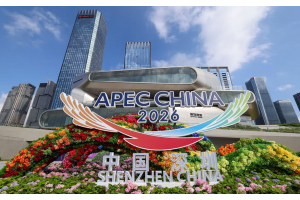
APEC Opens in Shenzhen: Two Signals Sellers Should Not Ignore

November 18, 2026 — The APEC Economic Leaders’ Meeting opens in Shenzhen today. The headlines will focus on bilateral meetings, trade rhetoric, and the symbolic weight of China hosting APEC for the first time in 12 years. For cross-border sellers, none of that matters as much as two operational signals that emerged from the Business Leaders’ Summit yesterday.
The first: AI is no longer a fringe productivity hack. It is now a formal agenda item at the highest-level business forum in the region. The second: a dedicated cross-border e-commerce compliance seminar was held in Shenzhen the same day, with sessions explicitly covering APEC market access, product certification, and data cross-border rules [citation:3][citation:11]. Put together, the message is simple: AI lowers your costs, compliance raises the bar. You need both.
Signal One: AI Is Now Official Infrastructure
Yesterday’s Business Leaders’ Summit included a dedicated session on AI. The framing was not “how to use ChatGPT for marketing.” It was “how to build an open and inclusive AI innovation ecosystem” and ensure that SMEs across the Asia-Pacific can actually access the technology dividend [citation:2][citation:10].
This matters because it changes the tone around AI adoption. For the past two years, sellers using AI for product descriptions, customer replies, or ad copy were early adopters doing something slightly experimental. Now, AI adoption is being discussed at the APEC level as a regional development priority. The subtext is that AI tools will increasingly be built into platform workflows, logistics systems, and compliance processes.
The discussion focused on closing the AI gap between advanced and developing economies in the region, and making sure smaller businesses are not left behind [citation:10]. For sellers, the practical takeaway is not “learn to code.” It is “stop treating AI as optional.” If your competitor is using AI to localize listings for five APEC markets while you are still doing it manually, you are already behind on cost and speed.
Signal Two: Compliance Is Becoming the Entry Ticket
The same afternoon, while APEC delegates discussed regional cooperation, the China Council for the Promotion of International Trade (CCPIT) held a cross-border e-commerce compliance and standardization seminar in Shenzhen’s Longgang District. The agenda was unusually specific: APEC market access rules, product certification, data cross-border flows, intellectual property compliance, tax compliance, and overseas warehouse standards [citation:3][citation:11].
This is not a coincidence of scheduling. It is a deliberate alignment. APEC opens the market opportunity; compliance determines who is allowed to participate. As one analysis put it, the standard and compliance discussion is happening exactly when Asia-Pacific trade agendas are at their densest [citation:11].
What This Means for Your Operations
| Area | Practical Action |
|---|---|
| AI Adoption | If you are not using AI for listing translation, customer service triage, or ad copy variants, start now. The tools are mature enough, and the cost of manual work is becoming a competitive disadvantage. The APEC discussion signals that AI will be embedded in the infrastructure you already use, not a separate “tech” thing. |
| Compliance Audit | Pull out your product certification list for your top three APEC markets. Identify gaps. Certification cycles take months. If you plan to sell into new APEC markets next year, the time to start the certification process is now, not after you have orders. |
| Data Cross-Border | If you handle customer data across borders, review your data flow mapping. The compliance seminar explicitly covered data cross-border rules [citation:3]. This is an area where enforcement is tightening globally, and APEC integration will not exempt you from local privacy laws. |
| Overseas Warehouse Standards | If you use overseas warehouses in APEC markets, watch for emerging standardization requirements. The seminar addressed warehouse operation standards and compliance [citation:3]. Early alignment gives you an advantage when enforcement tightens. |
Key Takeaways
| # | What You Need to Know |
|---|---|
| 1 | APEC Leaders’ Meeting opens in Shenzhen today. The Business Leaders’ Summit featured a dedicated AI session focused on inclusive innovation and SME access [citation:2][citation:10]. |
| 2 | A cross-border compliance seminar was held in Shenzhen the same day, covering APEC market access, product certification, data cross-border, IP, and overseas warehouse standards [citation:3][citation:11]. |
| 3 | AI is being framed as regional infrastructure, not a niche tool. Sellers treating AI as optional will face cost and speed disadvantages. |
| 4 | Compliance is the entry ticket, not a cost center. APEC cooperation lowers trade barriers but raises standardization expectations. |
| 5 | Certification takes months. If you plan to enter new APEC markets in 2027, start the product certification process now. |
| 6 | Overseas warehouse standards are emerging. Sellers using APEC-region warehouses should prepare for tighter operational and compliance requirements. |
- CCTV / QQ News — APEC Business Leaders’ Summit: AI and connectivity on the agenda (Nov 16, 2026)
- CCTV / QQ News — APEC Business Leaders’ Summit: AI session focuses on inclusive innovation for SMEs (Nov 16, 2026)
- CCPIT — Cross-Border E-Commerce Compliance and Standardization Seminar, Shenzhen (Nov 18, 2026)
- Dashi Kuajing — Compliance seminar to address APEC market access and AI in foreign trade (Nov 12, 2026)
- CGTN — APEC takeaways: trade deals and growing consensus on AI (Nov 18, 2026)
Tell us your product category and target markets, and we can help you map out the compliance requirements—or connect you with the right resources. Chat with us or open a request.


- APEC Shenzhen 2026
- APEC AI SME
- cross-border compliance APEC
- APEC market access certification
- Shenzhen compliance seminar
- Gzmato