Zhejiang's Tax Pilot: What Actually Changes for 9610 Sellers
November 28, 2026 — Zhejiang’s tax authorities and commerce department released a draft proposal on November 20 that would fundamentally change how cross-border e-commerce sellers in the 9610 retail export channel are taxed. The public comment period runs until December 20[citation:1][citation:4].
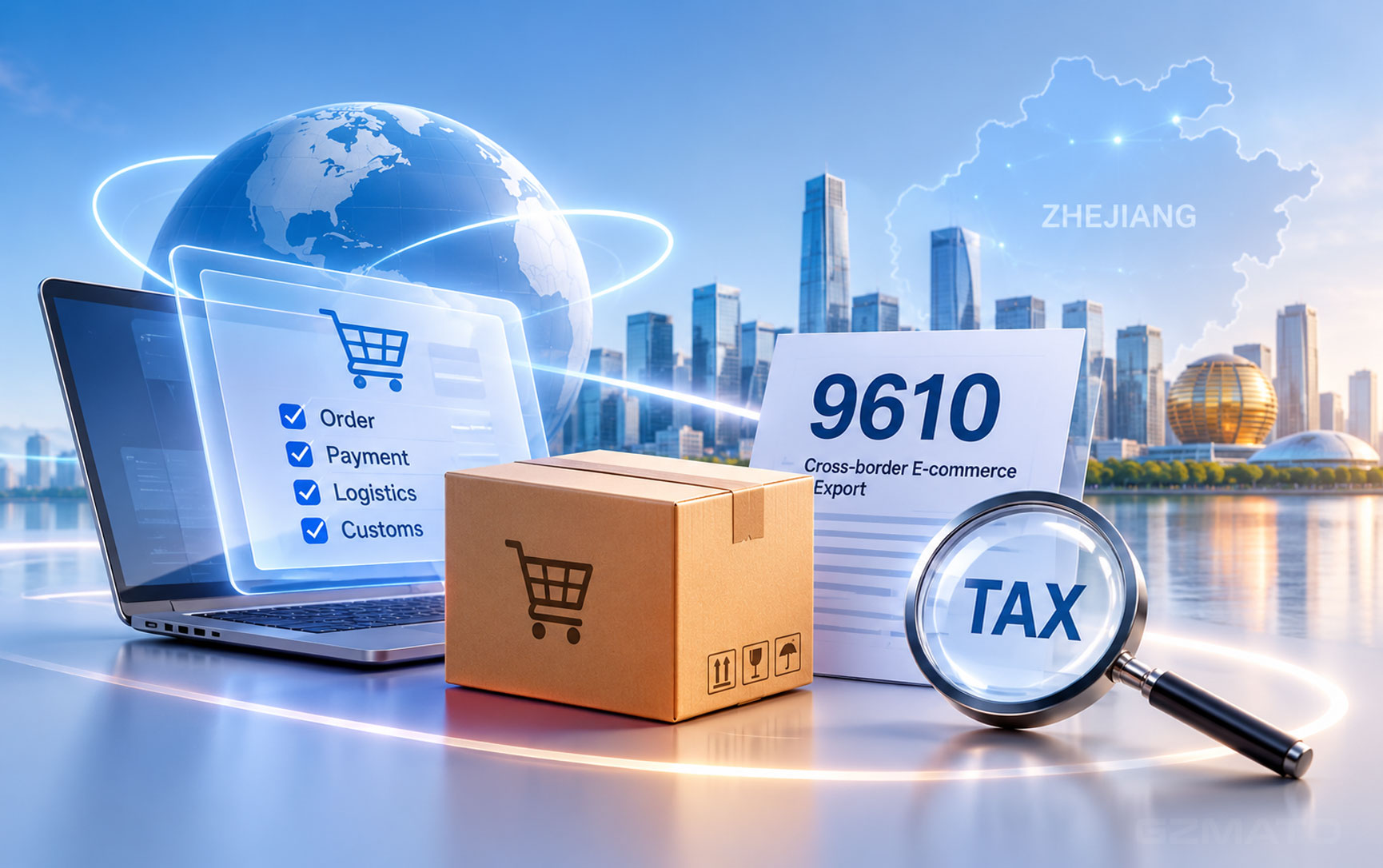
At first glance, the headline number—platforms prepaying 1% of sales revenue on behalf of sellers—looks like a new tax rate or a simplified flat tax. It is neither. The 1% is a prepayment mechanism, not the final tax burden. What matters far more is the underlying shift: the system is moving from verifying paper invoices to tracing transaction data across orders, payments, logistics, and customs declarations[citation:1].
The Shift: From Paper Invoices to Data Trails
For years, the 9610 channel has had a structural problem. Sellers ship small parcels through consolidated logistics. The customs declaration lists the freight forwarder or a single agent as the exporter, not the actual seller behind the goods. The order exists, the payment exists, the shipment exists—but the paper trail does not connect them in a way that tax authorities can verify[citation:3][citation:7].
The result: sellers who lack input invoices cannot easily claim the no-invoice tax exemption that the comprehensive pilot zones were designed to provide. They either pay more tax than they should, or operate in a gray zone that carries risk. Agent export companies, meanwhile, face their own burden: they are listed as the exporter of record but cannot trace who actually owns the goods, exposing them to additional income tax costs[citation:3].
The new model changes this by making the platform the data hub. Platforms that participate will file declarations that identify the actual exporter, issue an Agency Export Goods Certificate, and transmit standardized data packages that sellers can use to support tax-exempt filing[citation:3][citation:6]. The goal is to create a verifiable chain: order → payment → logistics → customs → tax declaration.
A seller who previously could not prove that a specific shipment belonged to them now has a platform-generated record that does. For sellers with thin margins and incomplete input invoices, that record is the difference between paying tax on phantom profits and qualifying for legitimate exemptions. The model has already been tested in Hangzhou since October 2025: as of June 2026, 3,156 sellers completed filing, and 2,014 sellers confirmed RMB 776 million in tax-exempt sales[citation:3].
The 1% Prepayment: What It Is (and Isn't)
The 1% figure has generated the most confusion. It is not a new tax rate. It is a quarterly prepayment calculated from existing policy rates:
- For corporate sellers: 4% deemed profit rate × 25% corporate income tax rate = 1%[citation:6][citation:11].
- For individual businesses and sole proprietorships: 5% commercial deemed profit rate × 20% applicable rate = 1%[citation:6].
Platforms will prepay this amount on the seller’s behalf within five working days after each quarter ends. Sellers can then deduct the prepaid amount against their final income tax liability when they file their annual settlement. If the prepayment exceeds the final liability, the excess is refundable. If it falls short, the seller pays the difference[citation:6][citation:11].
Who Benefits, Who Needs to Prepare
| Seller Profile | What This Pilot Means for You |
|---|---|
| Hangzhou-registered 9610 sellers on participating platforms | Direct beneficiary. You can opt into the pilot, use platform data to support no-invoice exemption claims, and reduce the time spent reconciling declarations. The 1% prepayment smooths cash flow management if you were previously unsure of your quarterly tax exposure. |
| Sellers using 9710, 9810, or overseas warehouses | Not covered. The pilot is limited to 9610 retail export. If your goods move through FBA, overseas warehouses, or B2B channels, this specific mechanism does not apply. You remain subject to existing rules[citation:7][citation:11]. |
| Sellers with complete input invoices | Limited benefit. If you already have clean documentation and claim standard deductions, the 1% prepayment may temporarily tie up cash until your annual settlement. The data traceability still helps, but the cash-flow impact is worth monitoring[citation:7]. |
| Sellers outside Zhejiang | Watch for replication. Guangdong and Shenzhen released parallel drafts on the same day, with identical frameworks. If the pilot succeeds in Hangzhou, expect broader rollout in 2027[citation:2]. |
The pilot is voluntary for both platforms and sellers. Platforms must apply and be approved by provincial tax authorities. Sellers must be registered in Hangzhou and operating on a participating platform. If you are not in Hangzhou or your platform has not opted in, the pilot does not change your obligations today—but it signals where the regulatory direction is heading.
Key Takeaways
| # | What You Need to Know |
|---|---|
| 1 | Zhejiang’s tax pilot is a data-traceability model, not a new tax. The goal is to connect order, payment, logistics, and customs data so sellers can prove what they shipped and qualify for legitimate exemptions[citation:1]. |
| 2 | The 1% is a quarterly prepayment, not the final tax rate. It is calculated from existing deemed profit rates and is deductible against annual income tax liabilities[citation:6][citation:11]. |
| 3 | Platforms file export declarations identifying the actual seller. This creates a verifiable record that supports no-invoice tax exemption claims for sellers who previously lacked documentation[citation:3]. |
| 4 | VAT and annual settlement remain the seller’s responsibility. The platform prepayment does not cover VAT, consumption tax, or the final annual reconciliation. |
| 5 | Scope is narrow: 9610 only, Hangzhou only, participating platforms only. Sellers using overseas warehouses or other trade models are not covered[citation:7]. |
| 6 | Parallel drafts in Guangdong and Shenzhen signal national direction. If the pilot succeeds, broader rollout is likely in 2027[citation:2]. |
| 7 | Comment period ends December 20. Sellers with specific concerns about the data requirements or prepayment mechanics can submit feedback through the Zhejiang tax bureau[citation:1][citation:8]. |
- 100EC.CN — Zhejiang launches cross-border e-commerce tax collection pilot (Nov 25, 2026)
- Ebrun — Hangzhou 9610 export traceability pilot: results and replication (Nov 22, 2026)
- Chuwang — Zhejiang tax pilot: 1% prepayment explained (Nov 23, 2026)
- NetEase — Cross-border tax changes: no-invoice exemption and deemed collection (Nov 26, 2026)
- Bangyue — Three-region 9610 tax pilot: how the 1% is calculated (Nov 25, 2026)
- Seller Home — The real issue for 9610 sellers is identity confirmation, not tax rate (Nov 25, 2026)
- TKFFF — Guangdong, Shenzhen, Hangzhou 9610 tax pilot drafts (Nov 24, 2026)
Tell us your product category and current export model, and we can help you map out what the pilot means for your compliance workflow. Chat with us or open a request.



- Zhejiang cross-border tax pilot
- 9610 tax data traceability
- no-invoice tax exemption
- cross-border e-commerce compliance
- Hangzhou tax pilot
- Gzmato