The AI Chip War Just Escalated: Qualcomm Lands Microsoft & Meta, OpenAI Unveils Its Own Silicon
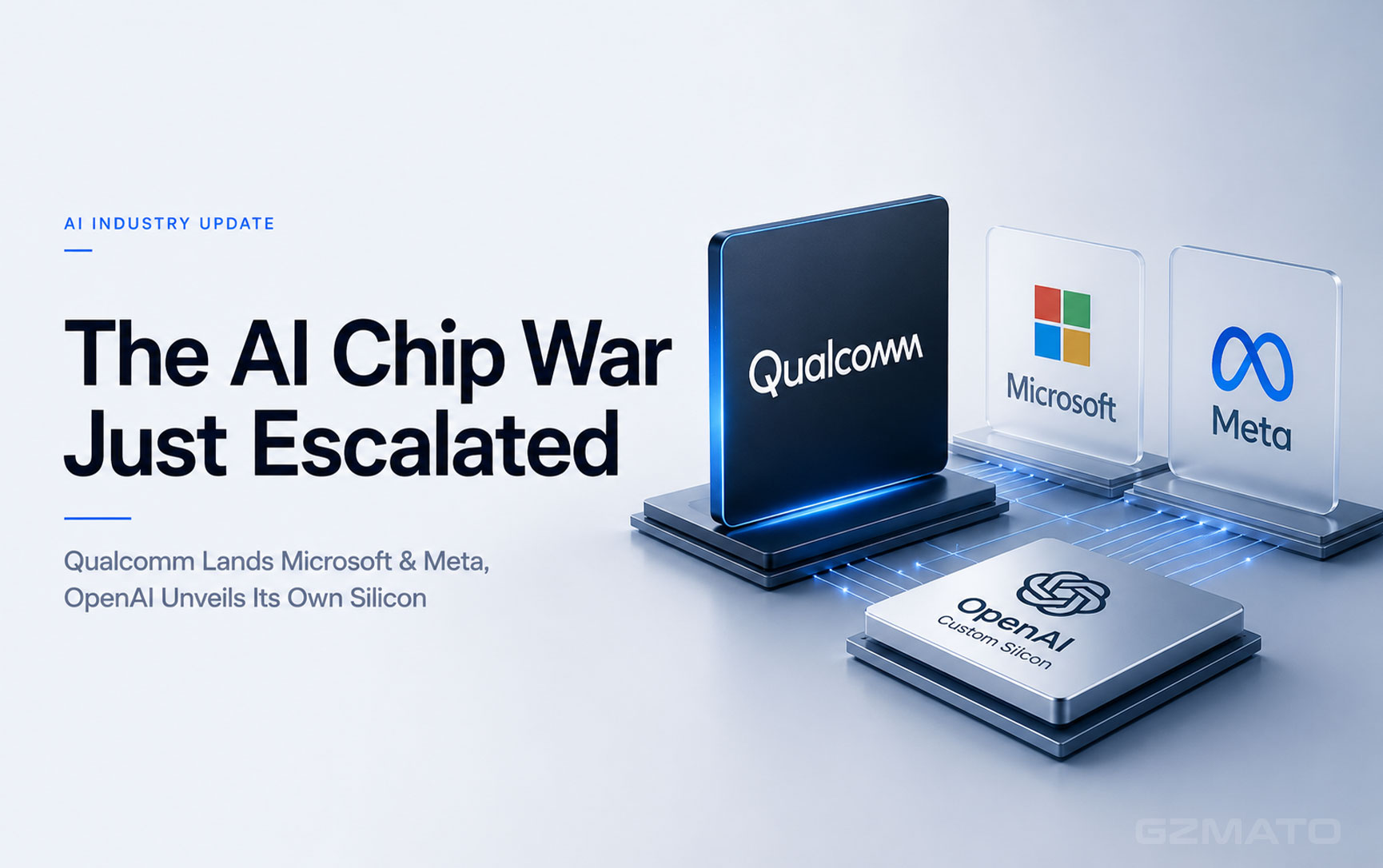
The AI Chip War Just Escalated
On June 24, 2026, two events reshaped the AI chip landscape in a single day.
First, Qualcomm announced it had secured Microsoft and Meta as customers for its new AI chips — a direct assault on Nvidia's dominance [citation:1][citation:2].
Second, OpenAI unveiled its first custom-designed chip, Jalapeño, developed in partnership with Broadcom in just nine months [citation:11][citation:12].
This is not a coincidence. The AI infrastructure market is entering a new phase where the world's largest technology companies and the most important AI labs are all building their own silicon. The era of Nvidia's near-monopoly is ending.
Qualcomm's All-In Bet: Meta, Microsoft, and a $150B Target
At its 2026 Investor Day, Qualcomm outlined the most aggressive pivot in its history: from smartphone chip leader to AI data center infrastructure provider [citation:1].
Meta CEO Mark Zuckerberg personally confirmed that Meta will use Qualcomm's Dragonfly C1000 data center CPU and future generations under a multi-year strategic partnership [citation:1][citation:2].
Microsoft Azure will deploy Qualcomm's HBC (High Bandwidth Compute) platform, including the AI250 accelerator starting in 2027 [citation:1][citation:5].
Qualcomm also confirmed it has two additional hyperscale cloud customers lined up for custom silicon development [citation:3].
| Customer | Product | Timeline |
|---|---|---|
| Meta | Dragonfly C1000 CPU (multi-generation) | 2028+ |
| Microsoft Azure | HBC platform (AI250 accelerator) | 2027+ |
| 2 more hyperscalers | Custom silicon | Undisclosed |
Qualcomm projects its data center business will generate over $15 billion in revenue by fiscal 2029, with the first material contributions arriving as early as fiscal 2027 [citation:1]. The company's non-phone revenue guidance was raised 91% to $40 billion [citation:1].
Qualcomm's key advantage? Cost. Its HBC architecture uses standard DDR memory — the same memory used in smartphones and laptops — rather than expensive HBM memory that Nvidia relies on [citation:3][citation:5]. This could dramatically lower the cost of AI inference for cloud providers.
$3.9B for Software: Why Modular Matters
In parallel with the hardware announcements, Qualcomm agreed to acquire Modular for approximately $3.9 billion in an all-stock deal [citation:7][citation:8].
Modular was founded in 2022 by Chris Lattner and Tim Davis — two engineers who helped build much of today's AI infrastructure, including LLVM, Clang, MLIR, Google's Cloud TPU, and Apple's Swift programming language [citation:8].
The company builds a "neutral software layer" that allows AI models to run across different hardware architectures without needing to rewrite code for each chip — CPU, GPU, NPU, or custom ASIC [citation:7][citation:8].
Modular's flagship products include the Mojo programming language, the MAX inference platform, and AI compiler technology [citation:7].
This acquisition is a direct challenge to Nvidia's CUDA ecosystem — the software platform that has locked millions of developers into Nvidia hardware [citation:7][citation:15].
By acquiring Modular, Qualcomm gains the ability to offer a cross-platform AI software layer that could weaken CUDA's "lock-in" effect. As Qualcomm CEO Cristiano Amon put it: "We believe the future belongs to developer-friendly horizontal platforms that can run across multiple computing environments, giving customers real choice" [citation:7].
This mirrors Nvidia's own strategy — but Qualcomm is building from a different starting point. Nvidia built CUDA to support its GPUs. Qualcomm is building a software layer that could support any chip [citation:1][citation:8].
OpenAI's Jalapeño: 9 Months From Design to Silicon
On the same day, OpenAI revealed its first custom inference chip: Jalapeño [citation:11][citation:12].
Jalapeño is designed specifically for large language model inference — the process of running trained models to generate answers. It is not a general-purpose AI chip; it is purpose-built for the specific workloads OpenAI runs [citation:13].
The development timeline is extraordinary: nine months from blank sheet to tape-out. In the semiconductor industry, a typical high-performance ASIC takes 18-24 months [citation:11][citation:12].
How did they do it?
- AI-assisted design: OpenAI's own models helped accelerate the design and verification process [citation:11]
- Deep collaboration: OpenAI's engineers worked side-by-side with Broadcom's silicon team [citation:12]
- Domain-specific optimization: The architecture was designed around OpenAI's actual workloads — not generic AI tasks [citation:12]
Broadcom CEO Hock Tan described Jalapeño's performance as comparable to Nvidia's Blackwell and Google's TPU [citation:14]. OpenAI's internal tests reportedly show "significantly better" per-watt performance than current state-of-the-art [citation:12].
Jalapeño will begin deployment in late 2026, with a multi-generational roadmap already in place [citation:14].
What This Means for Nvidia and the Industry
Nvidia's stock has surged to nearly $5 trillion on the AI wave. But a pattern is emerging: every major AI player is building its own chips [citation:11][citation:15].
| Company | Chip Initiative | Status |
|---|---|---|
| OpenAI | Jalapeño (inference) | 2026 deployment |
| Microsoft | Maia 200 | 2026 deployment |
| TPU 8t / 8i | Available | |
| Meta | MTIA series (4 chips) | Available |
| Amazon | Trainium series | $225B+ commitments |
| Qualcomm | Dragonfly C1000 / HBC | 2027-2028 |
The software ecosystem is equally important. Nvidia's CUDA has been its true "moat" — locking developers into its hardware [citation:15]. Qualcomm's Modular acquisition and Huawei's CANN/MindSpore ecosystem in China are both attempts to build alternatives [citation:8][citation:15].
Belgian think tank Bruegel recently warned that the AI competition is moving beyond chips to the "full technology stack" — hardware and software working together [citation:15].
Key Takeaways
| # | Key Takeaway |
|---|---|
| 1 | Qualcomm is entering the AI data center market — Meta and Microsoft are onboard. Projected $15B+ revenue by 2029 [citation:1]. |
| 2 | Qualcomm's cost advantage — Uses standard DDR memory instead of expensive HBM, potentially lowering inference costs [citation:3][citation:5]. |
| 3 | Qualcomm's $3.9B Modular acquisition — A direct challenge to Nvidia's CUDA software monopoly [citation:7][citation:8]. |
| 4 | OpenAI's Jalapeño chip — First custom inference chip, designed in just 9 months with Broadcom [citation:11][citation:12]. |
| 5 | AI-assisted chip design — OpenAI used its own models to accelerate chip design, demonstrating a new paradigm [citation:11][citation:12]. |
| 6 | Broadcom partnership — Jalapeño performance is said to be comparable to Nvidia Blackwell and Google TPU [citation:14]. |
| 7 | Inference is the new battleground — Training may stay Nvidia-dominated, but inference is becoming a multi-player market [citation:11]. |
| 8 | Vertical integration — Major AI players (OpenAI, Google, Amazon, Meta) are all building their own chips. Nvidia's dominance is not guaranteed forever [citation:1][citation:11]. |
Sources & Methodology (as of June 25, 2026):
- 华尔街见闻 / 东方财富 — Qualcomm Investor Day coverage and financial targets [citation:1][citation:2]
- 格隆汇 / 界面新闻 — Qualcomm customer announcements [citation:3][citation:5]
- 财联社 / 智东西 — Qualcomm Modular acquisition details [citation:7][citation:8]
- TechWeb — OpenAI Jalapeño chip technical deep dive [citation:11]
- 36氪 / APPSO — OpenAI chip design timeline and AI-assisted development [citation:12]
- 中時新聞網 / 网易 — Broadcom-OpenAI partnership and performance claims [citation:13][citation:14]
- 搜狐 / 参考消息 — Bruegel Institute AI technology stack analysis [citation:15]
AI-Ready Laptops | Fast Chargers | USB-C Cables | Power Banks | Development Kits | Tech Accessories
Special Offer: Use code TECH2026 for a discount on your first order!
Shop Now at Gzmato →

- Qualcomm AI chip
- OpenAI Jalapeño
- Microsoft HBC chip
- Meta Dragonfly C1000
- Nvidia competitor
- AI inference chip