Apple AI Chip Pivot: M7 Ultra 1.5TB Memory, Record $4.7T Market Cap, WAIC 2026
Apple's AI Chip Pivot and a $4.7T Market Cap
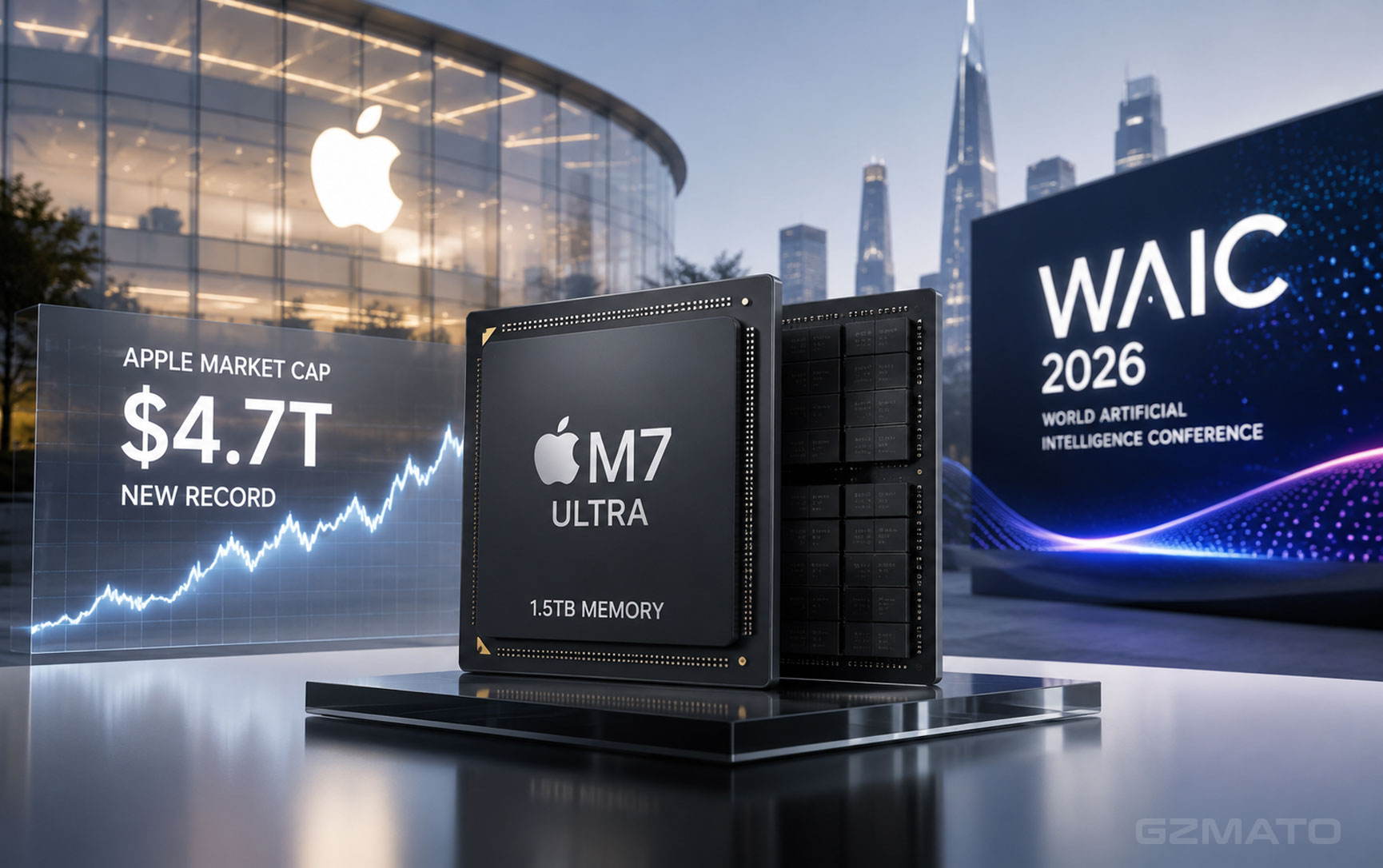
This week has been a tale of two stories in the tech world. On one side, Apple is making the most aggressive pivot in its silicon roadmap in years — skipping an entire generation of high-end chips to accelerate its AI capabilities. On the other, the company's stock hit an all-time high of $320.53, pushing its market cap to $4.71 trillion while the rest of the tech sector sold off[citation:2].
Meanwhile, the 2026 World Artificial Intelligence Conference (WAIC) kicks off this Friday in Shanghai, bringing together 1,100+ exhibitors, 9 Nobel and Turing laureates, and hundreds of global product debuts[citation:3]. Here's what you need to know.
Apple Silicon Shakeup: M6 Pro/Max/Ultra Cancelled
Apple is making one of the most significant changes to its chip roadmap in years. According to Bloomberg's Mark Gurman, Apple will skip the M6 Pro, M6 Max, and M6 Ultra entirely — a first for the company's silicon strategy[citation:1].
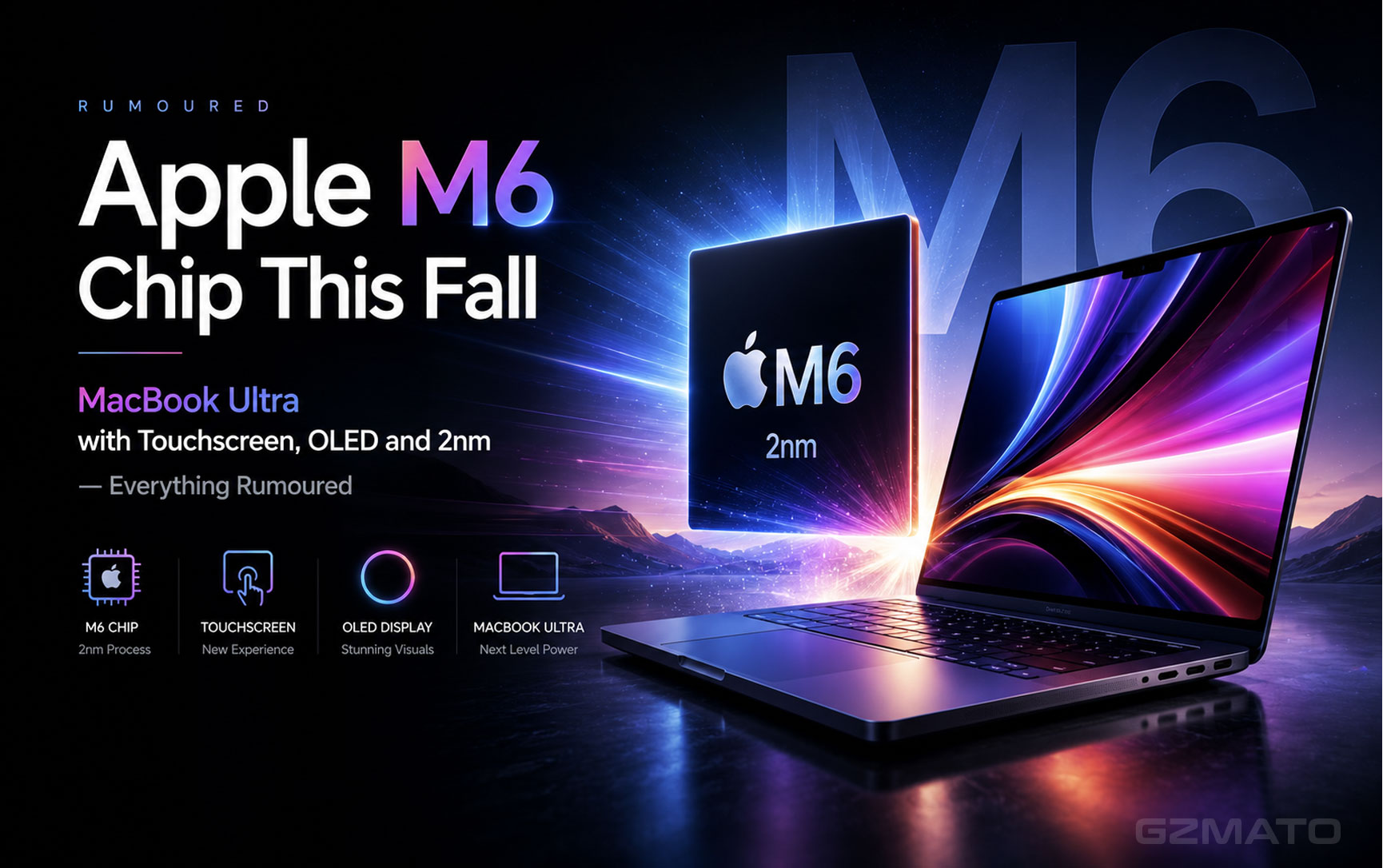
The base M6 chip will still arrive later this year, powering the 14-inch MacBook Pro and likely the MacBook Air refresh[citation:1][citation:8]. But instead of the usual Pro and Max variants that have accompanied every previous M-series generation, Apple is moving directly to the M7 family.
This is a dramatic break from tradition. Historically, Apple has released standard, Pro, Max, and Ultra versions of each M-series generation in a predictable rhythm. The M5 Pro and M5 Max launched in March 2026, and the M5 Ultra is still expected later this year for the Mac Studio[citation:1]. But for M6, the lineup stops at the base chip.
M7 Roadmap: What's Coming and When
| Chip | Expected Release | Key Detail |
|---|---|---|
| M6 | Late 2026 | Base model only; Pro/Max/Ultra cancelled |
| M7 | First half 2027 | Major Neural Engine upgrade, AI-first design |
| M7 Pro / M7 Max | Late 2027 | Higher-end MacBook Pro models |
| M7 Ultra | 2028 | Up to 1.5TB memory, AI performance near Nvidia Blackwell |
| M8 | 2028 | 1.4nm process (TSMC A14) |
The M7 is expected to deliver a significant upgrade to the Neural Engine, Apple's dedicated AI acceleration hardware[citation:1]. The tape-out (finalized design ready for production) for M7 reportedly happened just six months after work began on M6 — an unusually fast cadence that signals Apple's urgency around AI[citation:7].
The M7 Ultra, scheduled for 2028, is where things get particularly interesting. Reports indicate it will support up to 1.5TB of unified memory — roughly double the planned capacity of the M5 Ultra[citation:4][citation:7]. This would enable running trillion-parameter AI models locally, a capability currently limited to data center-class hardware. The M7 Ultra's AI performance is said to approach the level of Nvidia's Blackwell architecture, a major milestone for an integrated processor[citation:10][citation:7].
Apple is also planning a server chip based on the M7 Ultra, codenamed J246, for deployment in its own data centers around 2029[citation:8].
M8: 1.4nm and the Next Leap Forward
Even before the M7 ships, Apple is already planning beyond it. The M8 generation, expected in 2028, will reportedly be built on TSMC's 1.4nm process (A14 node)[citation:4][citation:7].
This represents a significant leap in efficiency and density. Compared to the 2nm N2 process, 1.4nm offers:
• 10-15% higher performance at the same power consumption
• 25-30% lower power consumption at the same performance
• 20%+ higher logic density, enabling more transistors on the same die area[citation:4]
Apple is reportedly developing two high-end chips for the 2028 generation, codenamed Soko and Cardinal, with the 1.4nm process also expected to power the A22 Pro chip for the 2028 iPhone lineup[citation:7][citation:8].
Why Skip M6 Pro? AI Is the Answer
According to Gurman's reporting, Apple accelerated the M7 family specifically because the Neural Engine upgrades planned for M7 were significant enough to justify skipping a generation[citation:1][citation:7].
AI is no longer a feature that Apple's chips support — it's becoming the primary design driver[citation:8][citation:10]. The traditional emphasis on CPU performance, graphics, and battery life is being rebalanced toward AI acceleration, and Apple is willing to disrupt its own product cadence to get there faster.
This pivot has a surprising origin story. The technology that forms the foundation of Apple's AI chip strategy came from the cancelled Apple Car project, which reportedly involved thousands of employees, hundreds of patents, and over $10 billion in spending over a decade[citation:8]. While the car never shipped, the Neural Engine that powers on-device AI across Apple's product line traces its roots to that project. CEO Tim Cook has described the Apple Car project as "the mother of all AI projects"[citation:10].
Apple Stock Hits All-Time High of $320.53
On July 13, Apple shares rose 1.65% to $320.53, breaking above its early June high to set a new all-time record. The company's market capitalization now stands at $4.71 trillion[citation:2].
What makes this particularly noteworthy is the context: the broader tech sector, particularly AI-related hardware stocks, was selling off heavily on the same day[citation:9][citation:12]. The Nasdaq was down more than 400 points (1.55%) as investors rotated out of companies tied to AI infrastructure spending[citation:9].
Investors appear to be rethinking the AI spending narrative. While Amazon has earmarked $200 billion in capital expenditures this year and other tech giants are spending heavily on data centers, Apple's 2026 capex budget stands at a relatively modest $14 billion[citation:9]. Its projected 2026 free cash flow, however, is a record $143 billion[citation:9].
As one analyst put it: "People are worried about the return on AI spending from hyperscalers, and there's a sense that semiconductor stocks have run too far. Investors are flocking back to Apple as a safe bet that avoids those risks"[citation:12].
Apple's $30.98 billion quarterly Services revenue at 77% gross margins provides a durable earnings stream that hardware-focused tech companies can't match[citation:2]. The stock has now risen 45.86% over the past year and 13.74% year-to-date[citation:2]. The company reports fiscal Q3 results on July 30, with management guiding 14-17% revenue growth and 47.5-48.5% gross margins[citation:2].
WAIC 2026 Opens This Week: What to Watch
The 2026 World Artificial Intelligence Conference (WAIC) runs July 17-20 in Shanghai, with major announcements already lined up[citation:3].
By the numbers:
| Metric | 2026 WAIC |
|---|---|
| Exhibition area | 100,000+ sqm (first time) |
| Exhibitors | 1,100+ companies |
| Products on display | 3,000+ items |
| Global product debuts | 300+ |
| Forums | 140+ sessions |
| Speakers | 1,400+ domestic and international |
| Nobel/Turing laureates confirmed | 9 |
Major debuts to watch:
- Huawei Atlas 950 SuperPoD — industry's largest-scale super node, making its public debut in true machine form[citation:6]
- DF1000 3D near-memory computing chip — world's first software-defined near-memory computing 3D chip from Shanghai Dongfang Suanxin Technology[citation:3][citation:6]
- MiniMax M3 multimodal model — industry-leading multimodal AI model[citation:3][citation:6]
- StepFun Agent Operating System — agent OS platform[citation:3][citation:6]
- World's first AI agent smartphone — a major category debut at the conference[citation:3][citation:6]
- Multiple humanoid robots and AI dexterous hands — including a deformable personal robot[citation:6]
Confirmed speakers include Richard Sutton (father of reinforcement learning), Yoshua Bengio (one of the "godfathers of deep learning"), and Kevin Kelly ("godfather of Silicon Valley"), along with 9 Nobel and Turing laureates[citation:3]. The conference will also launch WAIC Academic, a high-level international academic conference chaired by Turing Award winner Andrew Yao[citation:6].
Key Takeaways
| # | What You Need to Know About Apple's AI Pivot and WAIC 2026 |
|---|---|
| 1 | Apple is skipping M6 Pro/Max/Ultra — the base M6 arrives late 2026, but Apple is moving directly to the AI-focused M7 series in 2027[citation:1] |
| 2 | M7 Ultra targets 1.5TB memory — double the planned M5 Ultra capacity, enabling trillion-parameter AI models on-device[citation:4][citation:7] |
| 3 | M7 AI performance approaches Nvidia Blackwell — a major milestone for integrated processor AI capabilities[citation:10] |
| 4 | M8 moves to 1.4nm in 2028 — TSMC's next-generation process with 25-30% power reduction at same performance[citation:4][citation:7] |
| 5 | Apple's Neural Engine came from the cancelled car project — $10B+ in R&D and thousands of engineers laid the foundation for Apple's AI hardware[citation:8][citation:10] |
| 6 | Apple hits record $4.71T market cap at $320.53 — stock rose while the broader AI hardware sector sold off[citation:2] |
| 7 | Apple's low AI spending is now seen as a strength — $14B capex vs Amazon's $200B; investors are rotating to Apple as a "safe bet" that avoids the AI spending overhang[citation:9][citation:12] |
| 8 | WAIC 2026 opens July 17 in Shanghai — 1,100+ exhibitors, 300+ product debuts, 9 Nobel/Turing laureates confirmed[citation:3][citation:6] |
Shop Smart Wearables at Gzmato
Whether you need audio glasses, camera-first glasses, a privacy-conscious HUD, or a full AR experience for gaming and media, Gzmato carries the full range of smart wearables.
Ray-Ban Meta | Meta Glasses | Rokid AI Glasses | Huawei AI Glasses | Even Realities G2 | XREAL One Pro
Special Offer: Use code TECH2026 for a discount on your first order!
Shop Smart Wearables at Gzmato- Bloomberg / Mark Gurman — Apple chip roadmap changes, M7 prioritization, and 1.4nm M8 plans[citation:1][citation:4][citation:7]
- Apple share price data — All-time high of $320.53, $4.71T market cap, July 13, 2026[citation:2]
- WAIC 2026 — Official conference announcements and exhibitor data[citation:3][citation:6]
- ComputerBase — M7 Ultra 1.5TB memory, 1.4nm M8 details[citation:4]
- TipRanks — Apple stock analysis and market context[citation:5][citation:9]
- China Times — Apple Car project origins of Apple's AI strategy[citation:10]
- Apple AI chip
- Apple M6
- Apple M7 Ultra
- Apple M8 1.4nm
- Apple stock record
- $4.7 trillion
- WAIC 2026
- Apple Neural Engine
- Apple Silicon roadmap
- Mark Gurman
- Gzmato