Zhuque-3 Successfully Lands: China's First Commercial Rocket to Recover on Land
- Zhuque-3 Successfully Lands: China's First Commercial Rocket to Recover on Land
- What Is Zhuque-3? A "Natural Gas"-Burning Stainless Steel Rocket
- The Challenge: Getting Up Is Only Half the Battle
- From Failure to Success: The 60-Day Comeback
- What This Means: Two Paths to Reusability, One Clear Direction
- What's Next: From Recovery to Reuse
- Key Takeaways
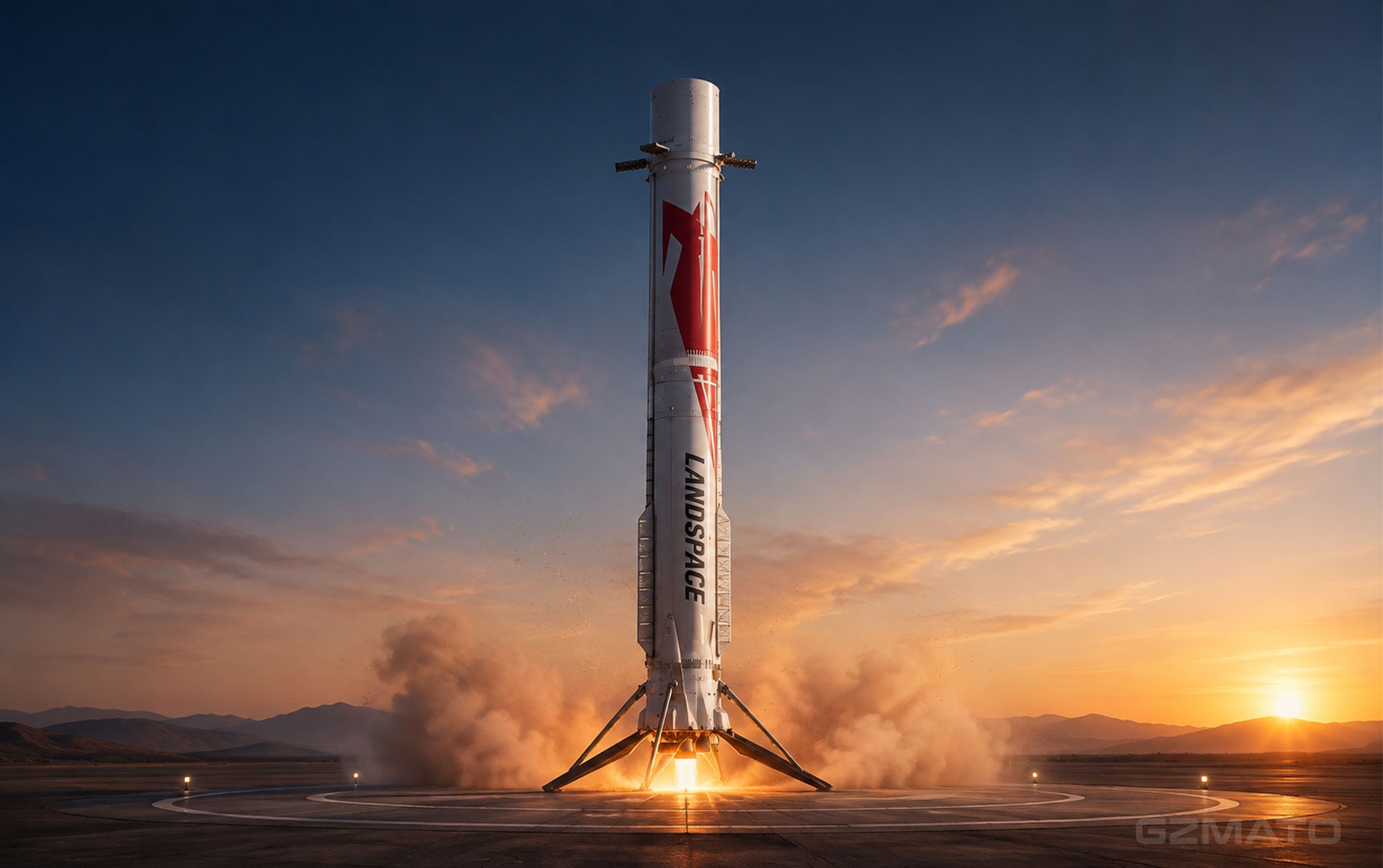
August 19, 2026 — At 7:35 AM Beijing time, the Zhuque-3 reusable rocket lifted off from the Dongfeng Commercial Space Innovation Pilot Zone in northwest China. A little over six minutes later, its first stage separated and began its controlled descent. By 7:41 AM, it had touched down on its landing legs in the Gansu Minqin recovery site — the first time a Chinese rocket had successfully returned and landed on land after launching a payload into orbit.
This was not a test flight. It was a commercial mission carrying a payload — the Honghu-03 satellite, developed by Hongqing Technology — into its target orbit. The Zhuque-3 Y2 mission marked the moment China's commercial space industry crossed a threshold that only one other country had reached before.
What Is Zhuque-3? A "Natural Gas"-Burning Stainless Steel Rocket
Zhuque-3 is the flagship reusable launch vehicle from LandSpace, a private Chinese aerospace company. Its development began in August 2023, and the rocket reached its first flight in just 28 months.
| Specification | Detail |
|---|---|
| Length | 66.1 meters |
| Diameter | 4.5 meters (core stages), 5.2 meters (payload fairing) |
| Takeoff mass | ~570 metric tons |
| Takeoff thrust | 7,542 kN |
| Propellant | Liquid oxygen + methane (TQ-12A engines) |
| First stage engines | 9 TQ-12A engines (thrust adjustable from 40% to 110%) |
| Second stage engines | 1 TQ-15B vacuum engine |
| Structure | Stainless steel (first Chinese stainless-steel launch vehicle) |
| Design life (reuse) | 20 missions |
The choice of liquid oxygen and methane as propellant is significant. Methane (the main component of natural gas) is cheaper, easier to source, burns more cleanly, and leaves less residue than kerosene — making it ideal for reusable engines that need to be inspected and reused quickly. The stainless steel structure is also intentional: stainless steel is more heat-resistant than aluminum or carbon fiber, reducing the need for ablative heat shielding on the first stage during reentry, and lowering maintenance costs between flights.
"Zhuque-3 is a rocket designed for reusability from the ground up," said Blue Arrow Space. "The propellant choice and the stainless steel structure are both about one thing: making reuse practical, not just possible."
The Challenge: Getting Up Is Only Half the Battle
A rocket's first stage typically accounts for about 70% of the total vehicle cost. In a conventional expendable rocket, that cost is thrown away on every flight. Recovering the first stage and reusing it can cut launch costs by a substantial margin.
But recovery is not simple. The first stage of the Zhuque-3 is roughly 45 meters long. During reentry, it travels at supersonic speeds, then must decelerate, orient itself, and land vertically on a pad with meter-level precision. It is a controlled descent — not a fall.
The Zhuque-3's first stage is equipped with several systems to make this possible:
- Grid fins — for aerodynamic steering during reentry
- RCS (Reaction Control System) — for precise attitude control
- Deployable landing legs — for vertical landing
- Throttleable engines — four of the nine first-stage engines are used for the landing burn, with thrust adjustable from 40% to 110% of rated power
LandSpace's Chief Designer, Dong Kui, described the challenge in an interview: "If SpaceX Falcon 9 is a Foundation-level cultivator, then Zhuque-3 is currently at the Core Formation stage." The analogy — drawn from Chinese fantasy literature — is a useful reminder: recovery success is a major milestone, but it is not maturity. Reusability is about repeating this process many times, not just once.
From Failure to Success: The 60-Day Comeback
This success did not come on the first attempt. On December 3, 2025, the Zhuque-3 Y1 mission achieved orbit successfully, but the first stage recovery failed. The rocket made it through reentry, through grid-fin steering, and through the first part of the landing burn. But at an altitude of 3.3 kilometers, the landing ignition sequence encountered an anomaly, and the first stage crashed at the edge of the recovery pad.
Zhuque-3 Chief Commander Dai Zheng recalled the moment: "The Y1 rocket was just one step away from recovery. Our team quickly moved past the disappointment and conducted extensive experiments to find the root cause."
From that failure, LandSpace made a series of improvements for the Y2 mission:
- Simplified landing ignition: The team reduced the number of engines used for the landing burn, simplifying the control system and improving reliability.
- Improved autonomous targeting: The rocket now calculates its landing point in real time during flight, adjusting its trajectory autonomously.
- Enhanced reentry thermal protection: The team optimized the rocket's ability to withstand the extreme heat and aerodynamic forces of reentry.
Additionally, the Y2 mission carried 12 onboard cameras to record the entire flight, reentry, and landing sequence — providing valuable engineering data for future refinements.
Dai Zheng noted that the Y2 success was built directly on the data from the Y1 failure: "The failure provided the data that allowed us to improve the design. The success is a validation of that process."
What This Means: Two Paths to Reusability, One Clear Direction
China now has two successful reusable rocket recovery methods. On July 10, 2026, the Long March 10B achieved the world's first sea-based net recovery of a rocket stage. On August 19, the Zhuque-3 achieved the first land-based recovery using landing legs.
These are complementary, not competing, approaches. Sea-based recovery allows for greater flexibility in landing location, while land-based recovery reduces the need for specialized recovery vessels and may be easier to scale for high-frequency launch operations. LandSpace has emphasized that land recovery has lower facility costs and is easier to maintain for frequent flights.
What both methods share is the same goal: reducing the cost of access to space. A first stage accounts for roughly 70% of the total launch cost. By reusing it, launch operators can spread that cost across many flights, cutting the per-kilogram cost to orbit.
Industry experts believe the successful validation of the Zhuque-3's "liquid oxygen-methane propulsion + stainless steel body + vertical landing" approach will accelerate the deployment of China's low-Earth-orbit satellite constellation.
What's Next: From Recovery to Reuse
Recovery is not the final step. Reuse is. According to LandSpace's public plans, the next major milestone is a reflight of a recovered first stage — essentially, taking the same rocket stage that just flew and launching it again.
That reflight is expected to occur in the fourth quarter of 2026. If successful, it would move the Zhuque-3 from "recoverable" to "reusable" — a distinction that separates pioneers from the rest.
As Dai Zheng put it: "Our goal is to achieve high-frequency reuse and provide strong support for the high-density deployment of China's low-Earth-orbit internet constellation."
Zhuque-3 is designed for 20 reuses. The economics of reusability depend on actually achieving a significant fraction of that number. The Y2 mission proved the rocket can come back. The test ahead is proving it can go again.
Key Takeaways
| # | What You Need to Know About the Zhuque-3 Recovery |
|---|---|
| 1 | First Chinese rocket to recover on land after orbital launch — Zhuque-3 Y2 launched from Dongfeng at 7:35 AM and landed its first stage in Minqin, Gansu, at 7:41 AM on August 19, 2026 |
| 2 | Developed by a private company — LandSpace, a Chinese commercial aerospace firm, designed and built the rocket entirely in-house |
| 3 | Stainless steel + liquid methane design — the rocket is built for reusability from the ground up, with a stainless steel structure and methane fuel that reduce maintenance costs between flights |
| 4 | 60 days from first failure to second success — the Y1 mission in December 2025 reached orbit but failed to recover; the Y2 mission applied lessons from that failure |
| 5 | 70% cost savings potential — the first stage accounts for ~70% of total launch cost; recovery and reuse can significantly reduce per-launch costs |
| 6 | Land recovery vs. sea recovery — China now has two successful recovery methods (sea net from Long March 10B and land legs from Zhuque-3), demonstrating technical breadth |
| 7 | Next milestone: reflight — LandSpace aims to fly a recovered stage again in Q4 2026, moving from "recoverable" to "reusable" |
- 中国青年网 / 中新社 — Zhuque-3 launch and recovery coverage, August 2026
- 人民网北京 — Zhuque-3 Y2 technical details and improvements, August 2026
- 新华社 — First land recovery announcement, August 2026
- China.org.cn — English-language mission summary and specifications
- 封面新闻 / 人民日报 — Zhuque-3 Chief Commander Dai Zheng interview
- 中华网 — Deputy Chief Designer Dong Kui interview and Falcon 9 comparison
- 光明网 / 科技日报 — Mission success and next steps


- Zhuque-3
- reusable rocket
- LandSpace
- China rocket recovery
- commercial space
- liquid methane rocket
- stainless steel rocket
- Honghu-03 satellite
- Gzmato