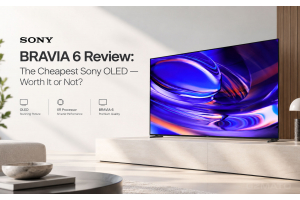
Sony BRAVIA 6 Review: The Cheapest Sony OLED — Worth It or Not?
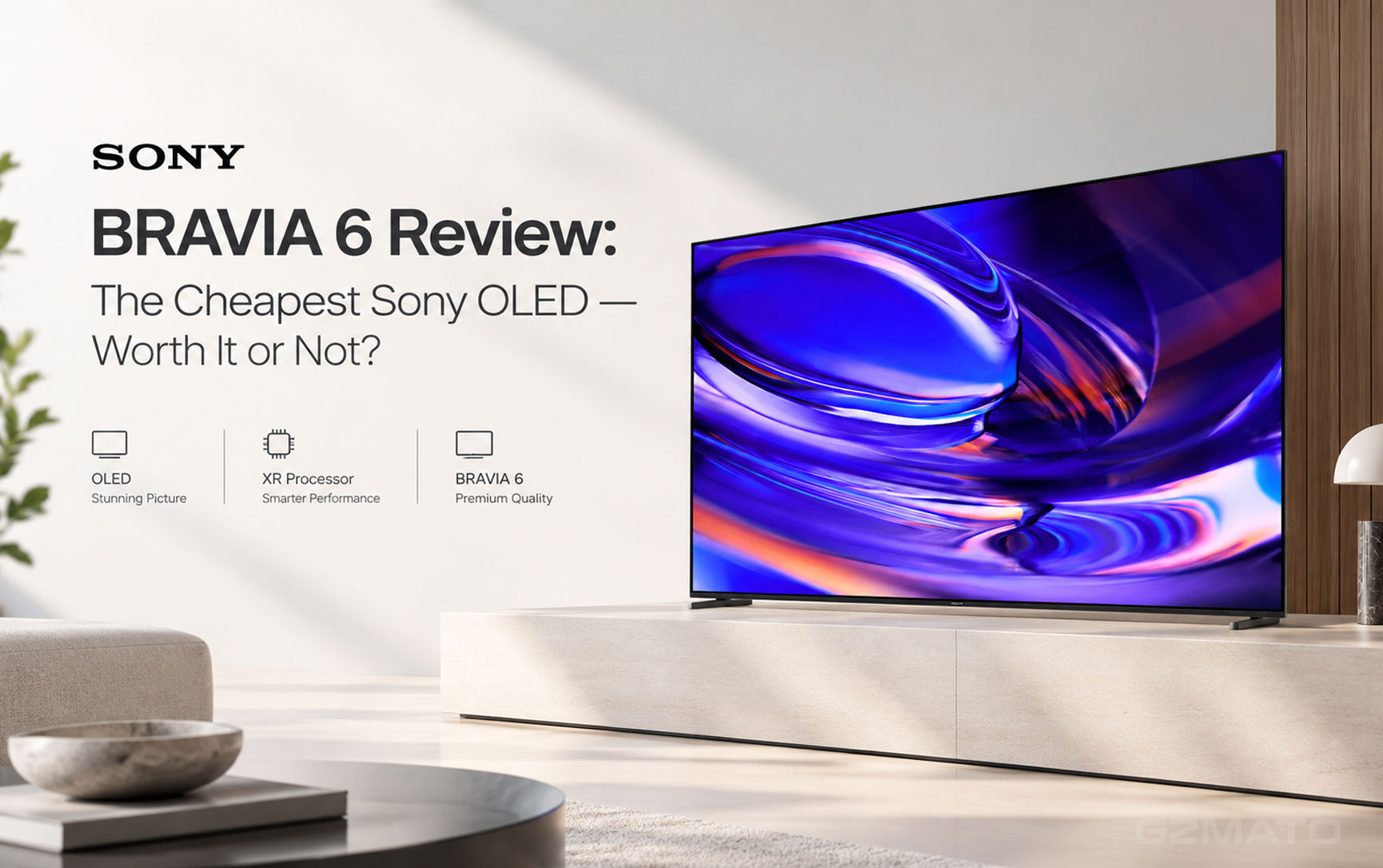
October 4, 2026 — Sony has quietly launched the BRAVIA 6, its most affordable OLED TV to date. But “affordable Sony OLED” comes with a specific set of trade-offs, and understanding them is the difference between a smart purchase and a regretful one.
This is not a stripped-down BRAVIA 8 II. It is a different kind of compromise: Sony kept the OLED panel and the big-screen options, but cut the premium processor and the anti-reflective coating. Whether that trade-off works for you depends entirely on how and where you watch.
Pricing: What You Pay for Each Size
The BRAVIA 6 is available in five sizes. U.S. pricing is confirmed by Sony and multiple outlets[citation:1][citation:18]. European pricing is slightly lower in euros but follows the same ladder[citation:19].
| Size | U.S. Price | EU Price (approx.) | Position |
|---|---|---|---|
| 48" | $1,300 | €1,199 | Smallest, most affordable |
| 55" | $1,500 | €1,299 | Standard living room |
| 65" | $2,000 | €1,699 | Popular size |
| 77" | $3,000 | €2,699 | Large format |
| 83" | $4,000 | €3,199 | Largest Sony OLED since 2023 |
What You Get (and What You Give Up)
The BRAVIA 6 is built around a deliberate set of choices. Here is what Sony kept, and what it removed.
What You Get
- OLED panel with infinite contrast — The WOLED panel from LG Display delivers perfect blacks and pixel-level contrast, the core advantage of OLED technology[citation:2].
- Four HDMI 2.1 ports — This is the headline feature. All four ports support 4K 120Hz, VRR, and ALLM. That means you can connect a PS5, an Xbox, a gaming PC, and a soundbar simultaneously without swapping cables[citation:14][citation:15].
- Five sizes, including 83 inches — This is the first 83-inch Sony OLED since the A80L in 2023. If you want a very large OLED, this is currently your only Sony option[citation:18].
- Google TV with Gemini — The interface includes Google TV and the Gemini assistant, with a built-in far-field microphone for voice control[citation:2].
- Dolby Vision, Atmos, and DTS:X — Full HDR and immersive audio format support[citation:1][citation:2].
What You Give Up
- No XR processor — The BRAVIA 6 uses a MediaTek Pentonic 800 chip, not Sony’s Cognitive XR processor. This affects upscaling of non-4K content and complex scene processing. If you watch a lot of cable TV or older content, the difference is noticeable[citation:2][citation:15].
- No anti-reflective coating — Sony’s premium OLEDs have a proprietary anti-glare treatment. The BRAVIA 6 does not. Combined with the WOLED panel’s higher reflectivity, this TV performs best in a room with controlled lighting — not in front of a large window[citation:2].
- Lower peak brightness (~1,000 nits) — Compared to the BRAVIA 8 II’s ~1,880 nits, the BRAVIA 6 is dimmer. In dark rooms this matters less; in bright rooms it matters a lot[citation:15].
- Basic 20W stereo audio — The Acoustic Surface Audio+ system (which vibrates the panel itself) is gone. The BRAVIA 6 uses a conventional 20W 2.0 speaker system. Sony includes a raised stand position so you can slide a soundbar underneath[citation:2].
BRAVIA 6 vs BRAVIA 8 II: Which One Should You Buy?
This is the real decision for most buyers. Both are Sony OLEDs, but they are built for different people.
| Feature | BRAVIA 6 | BRAVIA 8 II |
|---|---|---|
| Panel | WOLED (LG Display) | QD-OLED (Samsung Display) |
| Peak Brightness | ~1,000 nits | ~1,880 nits |
| Processor | Pentonic 800 | Cognitive XR |
| Anti-Reflective Coating | No | Yes |
| HDMI 2.1 Ports | 4 | 2 |
| Audio | 20W stereo | Acoustic Surface Audio+ |
| Sizes | 48" – 83" | 55" / 65" / 77" |
| 65" Price | $2,000 | $2,800 |
If you game with multiple devices, watch in a dark room, and want a large screen on a budget, the BRAVIA 6 is the better value. If you watch in a bright room, want Sony’s best processing, and prioritize picture quality above all, the BRAVIA 8 II justifies its premium — but only in the 55" and 65" sizes it offers.
Who Should Buy the BRAVIA 6
This TV is not for everyone. Here is an honest breakdown.
| Buy It If You... | Skip It If You... |
|---|---|
| Watch primarily in a dark or controlled-light room | Have a bright living room with large windows |
| Want a large OLED (77" or 83") on a budget | Only need 55"–65" and can stretch to the 8 II |
| Have multiple game consoles and a PC | Rarely game and don’t need four HDMI 2.1 ports |
| Use a soundbar or external audio system | Rely on the TV’s built-in speakers |
| Watch mostly 4K streaming content | Watch a lot of cable TV or older, lower-resolution content |
The TCL Factor: Why This TV Exists
To understand why Sony launched a budget OLED now, you have to look at the bigger picture.
In early 2026, Sony signed a strategic partnership with TCL to form a joint venture for its home entertainment business. TCL holds 51% and Sony 49%, with the new company scheduled to begin operations in April 2027[citation:4][citation:5]. The BRAVIA brand remains, but the operating logic is shifting toward TCL’s cost discipline and supply chain efficiency.
Sony’s TV business has been shrinking for years. In 2025, Sony’s global TV shipments were estimated at just 4.1 million units, with a market share below 2%. TCL, by contrast, shipped over 30 million units and held roughly 14% of the market[citation:12].
The BRAVIA 6 is the first visible result of this new direction: a Sony-branded OLED that competes on price, using an LG Display panel and a MediaTek processor, rather than Sony’s proprietary XR silicon. It is a pragmatic product, not a prestige one.
Key Takeaways
| # | What You Need to Know About the Sony BRAVIA 6 |
|---|---|
| 1 | Sony’s cheapest OLED — $1,300 for 48", up to $4,000 for 83". Five sizes total. |
| 2 | WOLED panel, not QD-OLED — peak brightness around 1,000 nits, lower than the BRAVIA 8 II’s ~1,880 nits. |
| 3 | Four HDMI 2.1 ports — more than the more expensive BRAVIA 8 II, thanks to the Pentonic 800 chip. |
| 4 | No XR processor and no anti-reflective coating — the two biggest compromises for picture quality. |
| 5 | Best for dark rooms and gamers — not ideal for bright living rooms or built-in speaker use. |
| 6 | 83-inch option — the first large Sony OLED in years, and currently the only way to get a Sony OLED above 77". |
| 7 | A TCL-era product — the BRAVIA 6 reflects Sony’s new pragmatic direction after the TCL joint venture. |
- IT之家 — BRAVIA 6 launch, sizes, U.S. pricing[citation:1]
- HomeCineSolutions — WOLED SE panel details, processor limitations, audio specs[citation:2]
- Yahoo Tech — Official launch confirmation, pricing breakdown[citation:6]
- CNET — Competitive positioning against LG B6 and Samsung S90H[citation:13]
- Pocket-lint via Perplexity — Four HDMI 2.1 ports, Pentonic 800 chip[citation:14]
- Fillion Électronique — BRAVIA 6 vs 8 vs 8 II specification comparison[citation:15]
- HDTVTest — 83-inch model confirmation and pricing[citation:18]
- AV Magazine — European pricing and processor details[citation:19]
- Sony China — TCL joint venture announcement[citation:4]
- TrendForce — Market share analysis and TCL partnership context[citation:5]
- 证券时报 — Sony TV shipments and market share data[citation:12]
- Sony BRAVIA 6
- Sony cheapest OLED
- BRAVIA 6 review
- BRAVIA 6 vs BRAVIA 8 II
- Sony OLED 2026
- WOLED vs QD-OLED
- Sony BRAVIA 6 price
- Gzmato