The AstraTennis Moment: Humanoid Robots Smash Records at the World Robot Games
- The AstraTennis Moment: Humanoid Robots Smash Records at the World Robot Games
- By the Numbers: 2,056 Robots, 51 Events, 16 Countries
- The Sprint: 9.32 Seconds and 14.5 m/s
- The High Jump: 2.88 Meters
- The AstraTennis Moment: When AI Stepped Off the Chessboard and Onto the Court
- Beyond Sports: The "Last Mile" Skills
- Key Takeaways
August 23, 2026 — On the opening night of the second World Humanoid Robot Games in Beijing's National Speed Skating Oval, the "Ice Ribbon," a humanoid robot named Tiangong Ultra crossed the finish line in 9.39 seconds. It wasn't just a victory over other robots. It was a victory over a record set by Usain Bolt seventeen years earlier [citation:4][citation:10].
Moments earlier, a robot had cleared 2.88 meters in the standing high jump, more than doubling the previous year's best result and surpassing the human world record of 2.45 meters [citation:4]. In a tennis exhibition match, a robot volleyed, ran, dove for shots, fell, stood back up, and continued playing against a world-class human athlete — all on live television [citation:8][citation:10].
This is not a science fiction preview. This is what happened on August 22, 2026, in Beijing. The question is no longer whether robots can move — it's whether they can work, compete, and eventually, coexist with us in the physical world.
By the Numbers: 2,056 Robots, 51 Events, 16 Countries
The games, running August 22-26 at the National Speed Skating Oval, have grown substantially since the inaugural event in 2025. This year's edition features 666 teams from 16 countries, 2056 robots, and 1301 matches across 51 events [citation:1][citation:5][citation:6]. The number of robots has more than quadrupled year-over-year [citation:1][citation:6].
The event is co-hosted by the Beijing Municipal Government and China Central Television, with teams from the United States, Germany, Japan, and Brazil joining the competition [citation:5]. The five-day event includes 29 competitive events and 21 scenario-based events covering real-world applications [citation:7].
But the numbers only tell part of the story. The real narrative is about what these robots did on the field.
The Sprint: 9.32 Seconds and 14.5 m/s
Before the official opening ceremony, during a preparatory heat, a robot from the Honor team, named "Lightning," ran 100 meters in 9.32 seconds, with a peak speed of 14.5 meters per second [citation:2][citation:7]. The human world record, set by Usain Bolt in 2009, is 9.58 seconds [citation:2][citation:4].
During the opening ceremony, Tiangong Ultra from the Tianzhuo team clocked 9.39 seconds, which was still enough to break Bolt's record [citation:4][citation:10]. Both times represent a significant leap from the previous games' best time of 21.50 seconds [citation:15].
The hardware behind the feat reflects rapid engineering progress. Honor's "Lightning" robot was optimized for short-distance sprinting: the team elongated its legs by 10 centimeters to increase stride length, used topology optimization for weight reduction, and upgraded joint motors for higher torque and faster response [citation:7][citation:11].
It is worth noting that these were not human-controlled demonstrations. The rules require robots to complete events autonomously, with only the 100-meter and 400-meter obstacle races still permitting remote control [citation:6].
The High Jump: 2.88 Meters
In the standing high jump event, a humanoid robot cleared 2.8843 meters, surpassing the human world record of 2.45 meters set by Cuban athlete Javier Sotomayor in 1993 [citation:4][citation:10]. The result is particularly striking in comparison to the first games, where the best jump was just 95.64 centimeters — a threefold improvement in one year [citation:10][citation:15].
Both the sprint and high jump records were achieved by Beijing-based X-Humanoid's Tiangong Ultra robot [citation:4].
- Robot count: From 514 (2025) to 2,056 (2026) — quadrupled
- Team count: From 280 to 666 — 138% increase [citation:1]
- Countries: Expanded from 4 to 16 [citation:5]
- Autonomy requirement: All events except 100m and 400m obstacle races must be fully autonomous [citation:6]
- Scenario events: Expanded from 6 to 21, covering 9 real-world scenarios [citation:6]
The AstraTennis Moment: When AI Stepped Off the Chessboard and Onto the Court
The most significant moment of the games may not have been a record at all. It was a tennis match.
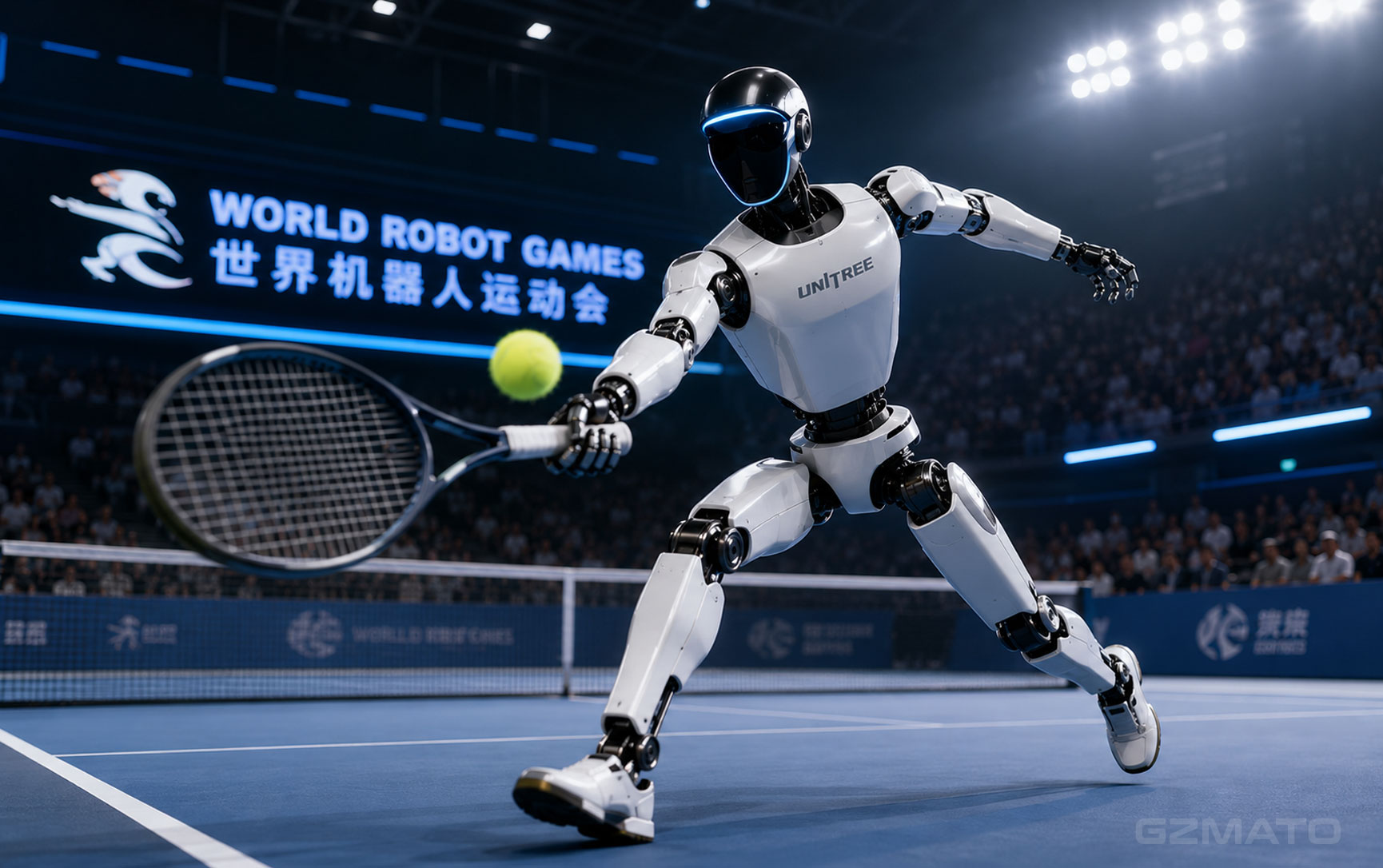
On the opening night, a humanoid robot named Xingzi, developed by Beijing-based Galaxy General Robotics, played a mixed doubles match and a singles match against Chinese tennis legend Zheng Jie, a former Wimbledon and Australian Open doubles champion [citation:8][citation:10]. The match was broadcast live globally [citation:3][citation:8].
The robot served, hit forehands and backhands, ran down wide shots, approached the net, and executed overheads. It adjusted its positioning based on its partner's movements, changed tactics according to the flow of the match, and even dove for a ball, fell, and stood back up to continue the point [citation:3][citation:8].
"Humanoid robots are evolving rapidly," said Li Yanfeng, a Beijing resident and spectator. "At first, I wasn't accepting of artificial intelligence. I was even a bit resistant, because of the possibility that it might replace or displace humans. But now that I see this development is unstoppable, I decided to come and take a look" [citation:4].
This moment has been described in Chinese media as the "AstraTennis moment" — a comparison to AlphaGo's 2016 victory over Lee Sedol in the board game Go [citation:3][citation:8]. The analogy is instructive. AlphaGo demonstrated AI's ability to master a digital, rule-bound game with near-infinite but clearly defined possibilities. Tennis, by contrast, takes place in the physical world, where the ball's speed, spin, bounce, and the opponent's movements are variables the robot must perceive, predict, and respond to in fractions of a second.
The robot was powered by Galaxy General's self-developed embodied intelligence model, which integrates perception, control, and movement into a single system [citation:13]. It was trained through simulation and then transferred to the physical robot, demonstrating a form of learning that bridges virtual and real environments [citation:13].
Beyond Sports: The "Last Mile" Skills
While the competitive events drew the headlines, the games also included a substantial focus on practical, real-world tasks. Scenario-based events accounted for 21 of the 51 total events — more than 40% of the program [citation:5].
These events placed robots in simulated real-world settings: industrial assembly lines, hotel lobbies, homes, retail stores, and rescue scenarios [citation:5]. The tasks were designed to be difficult, repetitive, dangerous, or dirty — conditions where humanoid robots might eventually replace human workers.
Specific scenario events included powder weighing, picking up items with tweezers, opening bottles and lids, assembling parts, organizing books, and completing household chores [citation:1][citation:5]. Unlike the competitive events, the goal is not speed or strength, but precision: can the robot see clearly, hold steadily, and act accurately? The industry's goal is for robots to master these "last meter" skills and move directly from winning awards to winning orders [citation:1].
This year's games also included a larger focus on dexterous hand manipulation, with eight dedicated micro-manipulation events designed to test fine motor control. The robots' hands were tested on tasks like powder weighing, which requires both visual precision and tactile control [citation:5][citation:11].
As Jiang Guangzhi, executive deputy director of the games' organizing committee and director of the Beijing Municipal Bureau of Economy and Information Technology, put it: "On the field, every additional centimeter in the long jump or every additional kilogram lifted is the result of engineers continuously optimizing the design, precision machining, and testing of joint motors and reducers. It's through these incremental improvements that we push the limits of humanoid robot technology" [citation:1].
Key Takeaways
| # | What You Need to Know About the World Humanoid Robot Games |
|---|---|
| 1 | 2,056 robots from 16 countries — the games have more than quadrupled in size since 2025, with 666 teams and 1,301 matches across 51 events [citation:1][citation:5] |
| 2 | Human records broken — a robot ran 100m in 9.32 seconds (vs. Bolt's 9.58) and jumped 2.88m in the standing high jump (vs. 2.45m human record) [citation:2][citation:4] |
| 3 | The "AstraTennis moment" — a humanoid robot played a full tennis match against a human professional on live TV, demonstrating real-time perception, decision-making, and physical coordination [citation:3][citation:8] |
| 4 | From performance to autonomy — all events except two obstacle races require full robot autonomy, testing perception systems and AI decision-making rather than remote control [citation:6] |
| 5 | "Last meter" skills — 21 scenario events focused on practical tasks like assembly, rescue, and household chores, designed to prepare robots for real-world work [citation:5] |
| 6 | China's humanoid robot dominance — Chinese robots accounted for 97% of global humanoid robot shipments in H1 2026 [citation:5] |
- Xinhua News / CCTV — Games scale, team count, autonomy rules, and scenario event details [citation:1][citation:5][citation:6]
- AP News — International coverage, human record comparisons, and Unitree context [citation:4]
- The Paper — AstraTennis moment coverage and technical analysis [citation:3][citation:8]
- Beijing Daily / China Daily — Opening ceremony and event details [citation:9][citation:10][citation:11]
- Xinhua / Beijing Youth Daily — Sprint and high jump performance data [citation:2][citation:7]

- World Humanoid Robot Games
- humanoid robot
- robot sprint
- robot tennis
- AstraTennis
- Tiangong Ultra
- Galaxy General Robotics
- Chinese humanoid robot
- Gzmato