S4000 High-Altitude Wind Power Completes Full-Process Test: A Milestone for Clean Energy
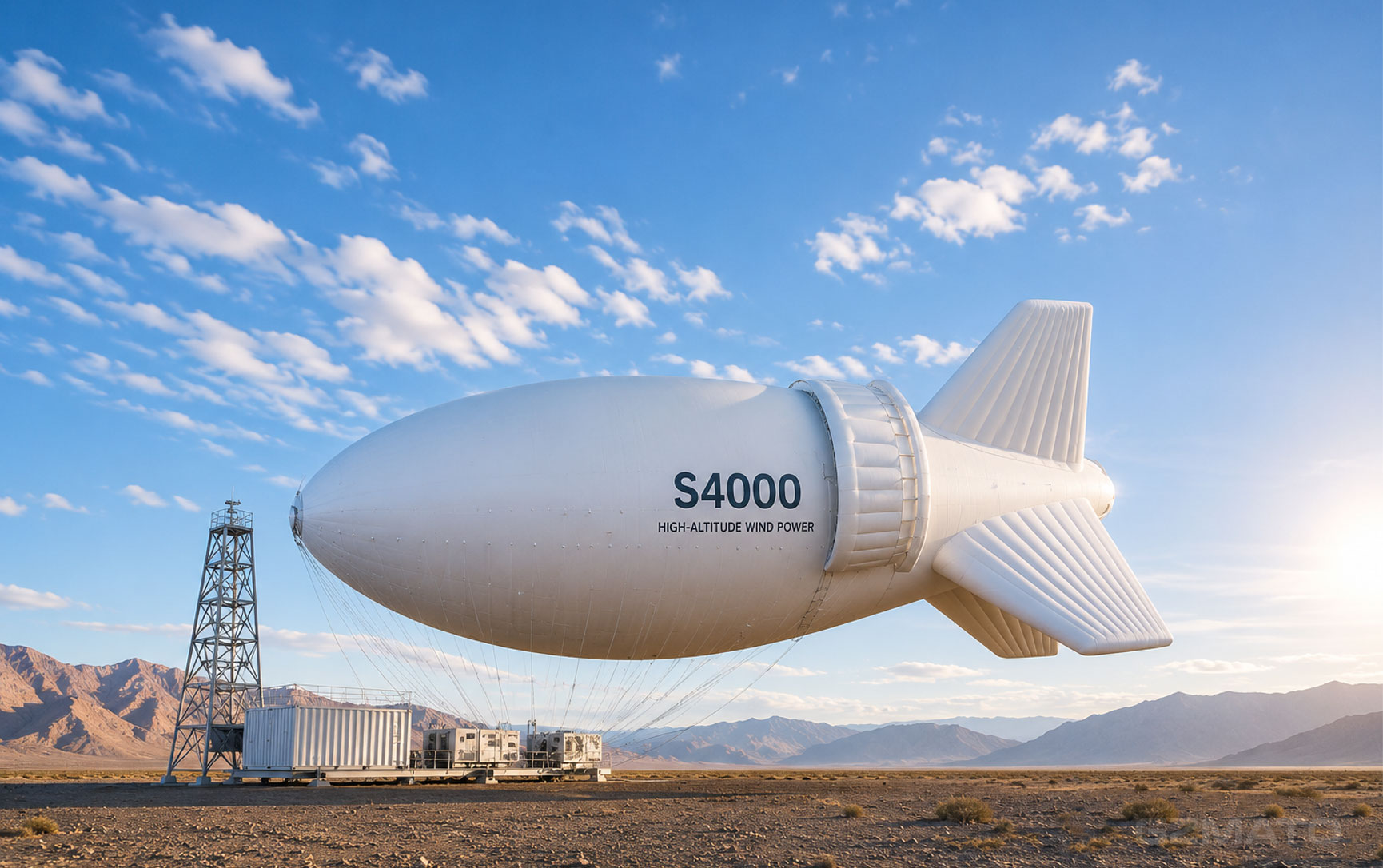
August 22, 2026 — In a quiet corner of northwest China, a different kind of wind turbine took to the sky. The S4000 Stratosphere Airborne Wind Energy System (SAWES), developed entirely in China, completed its first full-process flight test at an undisclosed test base in the region . The system ascended to its operating altitude, maintained position, generated electricity, and returned to the ground safely — all without incident .
This is not a conventional wind turbine. It is a flying device — a tethered aircraft that harvests wind energy at altitudes where the wind never stops blowing. With a maximum operating altitude of 4,000 meters and a design life of 20 years, the S4000 represents a significant milestone for China's high-altitude wind power technology, moving it from iterative development toward engineering deployment .
What Is S4000? A "Kite" That Generates Electricity
Unlike conventional wind turbines — the towering, three-bladed structures that dot hillsides and coastlines — the S4000 is an airborne device. It ascends to high altitudes, where wind speeds are stronger and more consistent than at ground level, and generates electricity that is transmitted back to the ground through a tether .
The system is an upgraded version of the S2000, a predecessor that proved the concept at lower altitudes . The S4000 uses a new configuration with significantly improved overall performance . It can reach a maximum operating altitude of 4,000 meters, making it suitable for deployment across most of China's territory . The system is designed to be directly integrated with mainstream power grids and has a 20-year design life .
According to the Chinese Academy of Engineering, the system's maximum generation altitude is expected to reach 8,000 to 10,000 meters in future iterations, with a unit capacity of 1 to 2 gigawatts .
Why High-Altitude Wind? Because the Wind Never Stops
Conventional wind turbines have limits. They operate at heights of 50 to 200 meters, where wind is intermittent and variable. They generate electricity only when the wind blows within a specific speed range — too little, and they stall; too much, and they must shut down to avoid damage.
High-altitude wind, by contrast, is persistent. At 4,000 meters, wind speeds are higher and more stable. The S4000 can operate in conditions that would shut down conventional turbines, and because it is tethered, it does not require the massive foundations and tall towers that make conventional wind farms expensive to build and maintain.
The system's flight validation test in August 2026 covered the full operational process: ascent, station-keeping, power generation testing, and stable recovery . All performance targets were met, demonstrating the system's reliability in complex and extreme high-altitude environments .
This is a milestone, not a finished product. But it is a significant step forward in what has historically been a difficult technology to commercialize. High-altitude wind power has been pursued by companies in the United States and Europe for years, but engineering challenges have kept it from reaching scale.
A Milestone for China's Energy Transition
The S4000 test is not happening in isolation. High-altitude wind power has been incorporated into China's 15th Five-Year renewable energy development plan (2026-2030), making it a strategically supported technology . The successful test fills a critical gap in the engineering application of China's high-altitude wind power technology, enhancing the country's ability to supply clean energy in high-altitude areas .
In the broader context of China's energy strategy, the S4000 is one piece of a larger puzzle. The country is the world's largest producer of wind power, with over 400 gigawatts of installed capacity as of 2025. But most of that capacity is on land, in regions like Inner Mongolia and Xinjiang, far from coastal population centers.
High-altitude wind power could change that math. If systems like the S4000 can be deployed at scale, they could generate electricity in regions where conventional wind is less viable — and potentially at a lower cost per kilowatt-hour than current land-based turbines.
Chinese Academy of Engineering projections suggest that by 2035, high-altitude wind power could account for a meaningful share of China's renewable energy mix. The S4000 is the first step toward that reality.
Key Takeaways
- 央视新闻 / 央广网 — S4000 full-process test report and specifications
- CCTV — S4000 test confirmation, policy context, and engineering significance
- Global Times / People's Daily — English-language coverage and international context
- IT之家 — Technical specifications and S2000 comparison
- 川观新闻 — Context on China's week of technological milestones
- S4000
- high-altitude wind power
- China renewable energy
- stratospheric wind energy
- airborne wind turbine
- S2000
- 15th Five-Year Plan
- Gzmato