The Bioelectric Code: How Scientists Are Using Electrical Signals to Regrow Limbs and Reverse Cancer
The Hidden Electrical Blueprint of Life
Cut a planarian flatworm into three pieces, and something remarkable happens. The head grows a new tail. The tail grows a new head. The middle section grows both. Within weeks, you have three perfect, genetically identical worms [citation:1].
But in a laboratory at Tufts University, researchers went further. They didn't edit the worm's DNA. Instead, they manipulated the faint electrical signals passing between cells at the wound site. The result? A worm with two heads — one at each end. When these worms reproduced, their offspring also had two heads, despite their DNA being completely unchanged [citation:1].
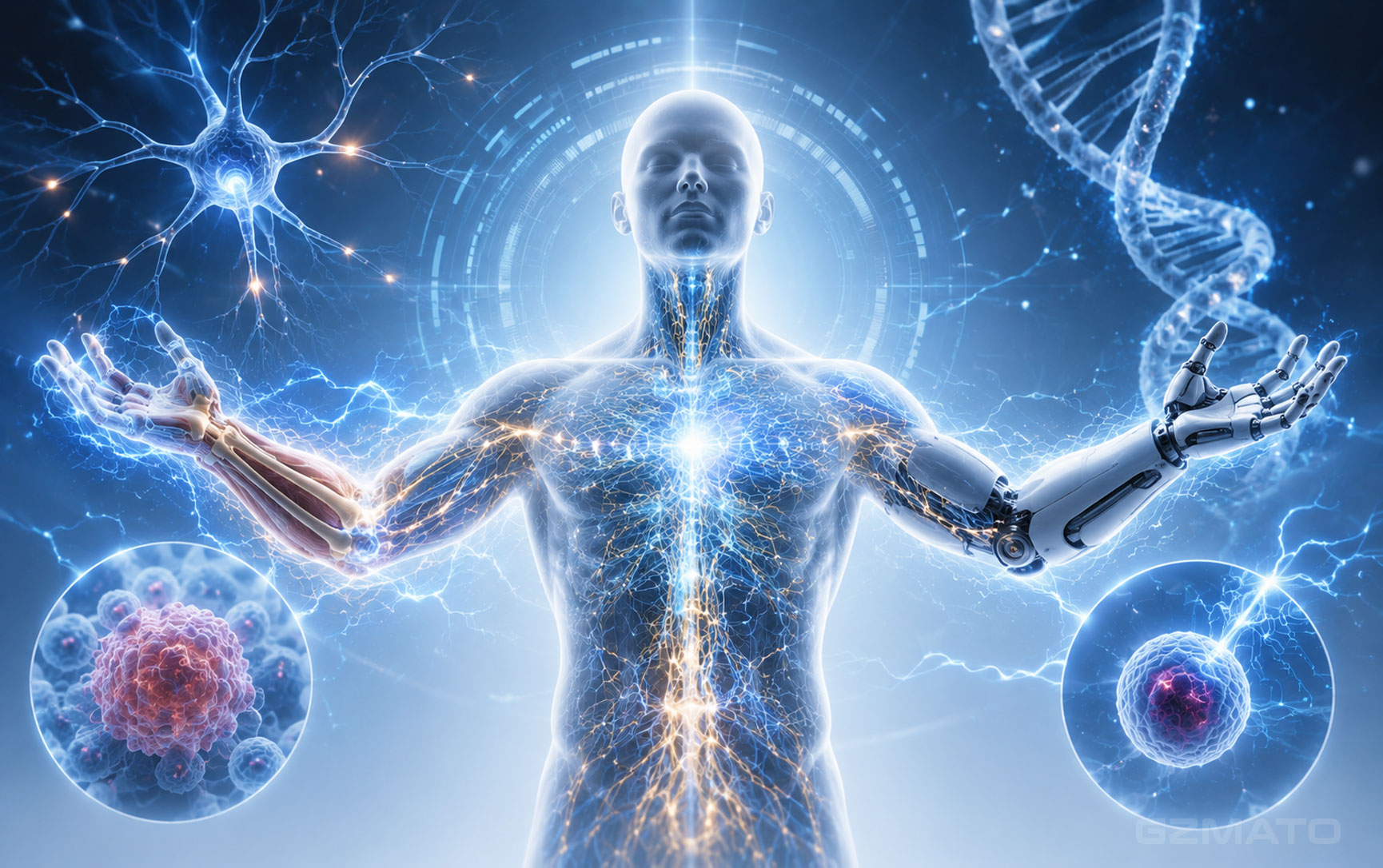
This is not a story about genetics. It is a story about something far more surprising: bioelectricity — the invisible electrical language that cells use to communicate, coordinate, and remember what the body is supposed to look like.
Who Is Dr. Michael Levin?
Dr. Michael Levin is the Vannevar Bush Distinguished Professor of Biology at Tufts University and the director of the Allen Discovery Center [citation:11].
His background is unusual: he holds degrees in both computer science and biology — a combination that has shaped his unique approach to understanding life as an information-processing system [citation:11]. Over the past two decades, his lab has pioneered the study of bioelectricity in regeneration, embryonic development, and cancer [citation:11].
Levin has been recognized for his groundbreaking work. His graduate research on the molecular basis of left-right asymmetry was named by Nature as a "Milestone in Developmental Biology." He has published over 400 peer-reviewed papers and continues to push the boundaries of what we think is possible in medicine [citation:11].
Most biologists study genes and proteins. Levin studies information. He views the body not as a machine made of chemical parts, but as a "cognitive" system — a collective intelligence of cells that communicate, make decisions, and solve problems. His lab treats tissues like programmable computers, using electrical signals to send commands rather than rewriting the genetic code [citation:11].
What Is Bioelectricity?
Every cell in your body is a tiny battery. It pumps charged ions — potassium, sodium, calcium — across its membrane, maintaining a small but measurable voltage. This isn't the high voltage of your toaster; it's a subtle, steady electrical field that cells use to communicate [citation:1].
These signals are ancient. Evolution discovered bioelectricity billions of years ago, around the time single-celled organisms first banded together into multicellular life. To coordinate, they needed a language. Electricity was the perfect medium — fast, scalable, and information-rich [citation:1].
Today, every cell in your body participates in this electrical conversation. But it's not just about sending signals; it's about storing information. Levin's research has shown that bioelectric patterns act as a kind of "memory" that tissues use to know what they are supposed to look like [citation:1][citation:3].
DNA vs. Bioelectricity
Think of it this way: if DNA is the hardware — the parts list for every protein in your body — then bioelectricity is the operating system. It tells the parts where to go, what to build, when to start, and when to stop [citation:1].
In one experiment, researchers could visualize the electrical charges in a developing frog embryo and see the pattern of the face light up in the voltage map days before the physical face formed. The electricity drew the map; the cells just colored it in [citation:1].
Regeneration: Waking Up Dormant Potential
Some animals — salamanders, flatworms, zebrafish — can regenerate lost limbs, organs, and even parts of their brains. Humans cannot. But here's the surprising part: we still have the machinery. It's just dormant [citation:1].
When a salamander loses a leg, the cells at the wound site don't just patch it up. They consult a bioelectric "setpoint" — an electrical blueprint of a healthy limb — and build until reality matches the plan. Once the leg is complete, growth stops [citation:1].
Levin's lab has shown that similar mechanisms exist in animals that don't naturally regenerate. By manipulating voltage gradients at wound sites, researchers have induced frogs to grow extra toes on severed legs and even grown functioning eyes on the tails and guts of tadpoles [citation:9].
Cancer as an Electrical Breakdown — and a Fix
This is perhaps the most surprising and promising part of Levin's work.
We tend to think of cancer as a genetic disease — mutations that make cells grow uncontrollably. But Levin's research shows that cancer is also a failure of communication [citation:1].
Think of a normal organ as a choir, singing in harmony. A cancer cell is a member of the choir that has stopped listening to the conductor. It goes "deaf" to the bioelectric signals of its neighbors. It reverts to a unicellular state, treating the rest of the body as a hostile environment [citation:1].
But here's the breakthrough: when researchers artificially reconnect tumor cells to the bioelectric network of surrounding tissues — when they open the "chat lines" again — the cancer cells often normalize. They remember they are part of a kidney, a lung, a breast. They stop growing. They become healthy again [citation:1].
Levin's team has already demonstrated this principle in laboratory models: normalizing bioelectric signals suppressed tumor growth and even reversed cancerous behavior in cells with mutated DNA [citation:3][citation:9].
The Road Ahead
Despite the excitement, there are significant challenges ahead:
- Mapping the code: The bioelectric patterns that control growth and form are complex. It will take years to decode them systematically [citation:9]
- Translation to humans: Most of the work so far has been in frogs, flatworms, and cell cultures. Regenerating a human limb or reversing human cancer is a much larger challenge [citation:1]
- Timing: Levin himself has said that regenerative medicine for humans is "going to be possible at some point in the future" — not tomorrow, not next year, but within the coming decades [citation:13]
- Safety and ethics: The ability to rewrite the body's electrical blueprint raises questions about control, identity, and the definition of natural life — questions that will need to be addressed alongside the science [citation:1]
But the direction is clear. Levin's work suggests that the body is not a fixed, immutable machine. It is a dynamic, reprogrammable system — and the key to reprogramming it is not chemicals or genes, but information.
Key Takeaways
| # | Key Takeaway |
|---|---|
| 1 | Bioelectricity is the "software" of life — It controls how cells build and repair the body, acting as an electrical blueprint that DNA alone cannot provide [citation:1]. |
| 2 | DNA is hardware; bioelectricity is the operating system — Cells use electrical signals to coordinate growth, regeneration, and tissue maintenance [citation:1][citation:3]. |
| 3 | Regeneration is possible in humans — the machinery already exists — We have dormant regenerative capabilities that bioelectric signals could potentially reactivate [citation:1][citation:13]. |
| 4 | Cancer can be "normalized," not just destroyed — Restoring bioelectric communication can turn cancer cells back into healthy cells, even with mutated DNA [citation:1][citation:3]. |
| 5 | Cells form a collective intelligence — They communicate, make decisions, and solve problems as a group, using bioelectric networks as their language . |
| 6 | Dr. Michael Levin is leading this field — His Tufts lab has pioneered molecular tools to read and write bioelectric patterns in non-neural tissue [citation:11]. |
| 7 | Human applications are still years away — But the roadmap is clear: birth defects, organ regeneration, and cancer could all be treated with bioelectric interventions in the coming decades [citation:9][citation:13]. |
Sources & Methodology (as of June 30, 2026):
- Everand — Bioelectricity and Morphogenesis: The Electric Blueprints of Life (2026 book)
- The Tim Ferriss Show — Dr. Michael Levin interview (January 2026)
- MedBound Hub — Bioelectricity in regeneration and cancer (2026)
- The Levin Lab at Tufts University — Official lab website
- Caltech Medical Engineering Seminar — Levin seminar announcement (April 2026)
- Scientific American / sciam.tw — "It's Electric" (2013 feature on Levin's work)
- Semantic Scholar — Zhang & Levin, "Bioelectricity is a universal multifaced signaling cue" (2025)
Health Tech | Fitness Trackers | Smart Devices | Fast Chargers | USB-C Cables | Tech Accessories
Special Offer: Use code TECH2026 for a discount on your first order!
Shop Now at Gzmato →


- bioelectricity
- Michael Levin
- limb regeneration
- cancer normalization
- bioelectric code
- regenerative medicine
- cellular software