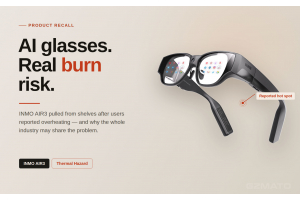
INMO AIR3 Recall: AI Glasses Burn Hazard Reveals Industry-Wide Thermal Challenge
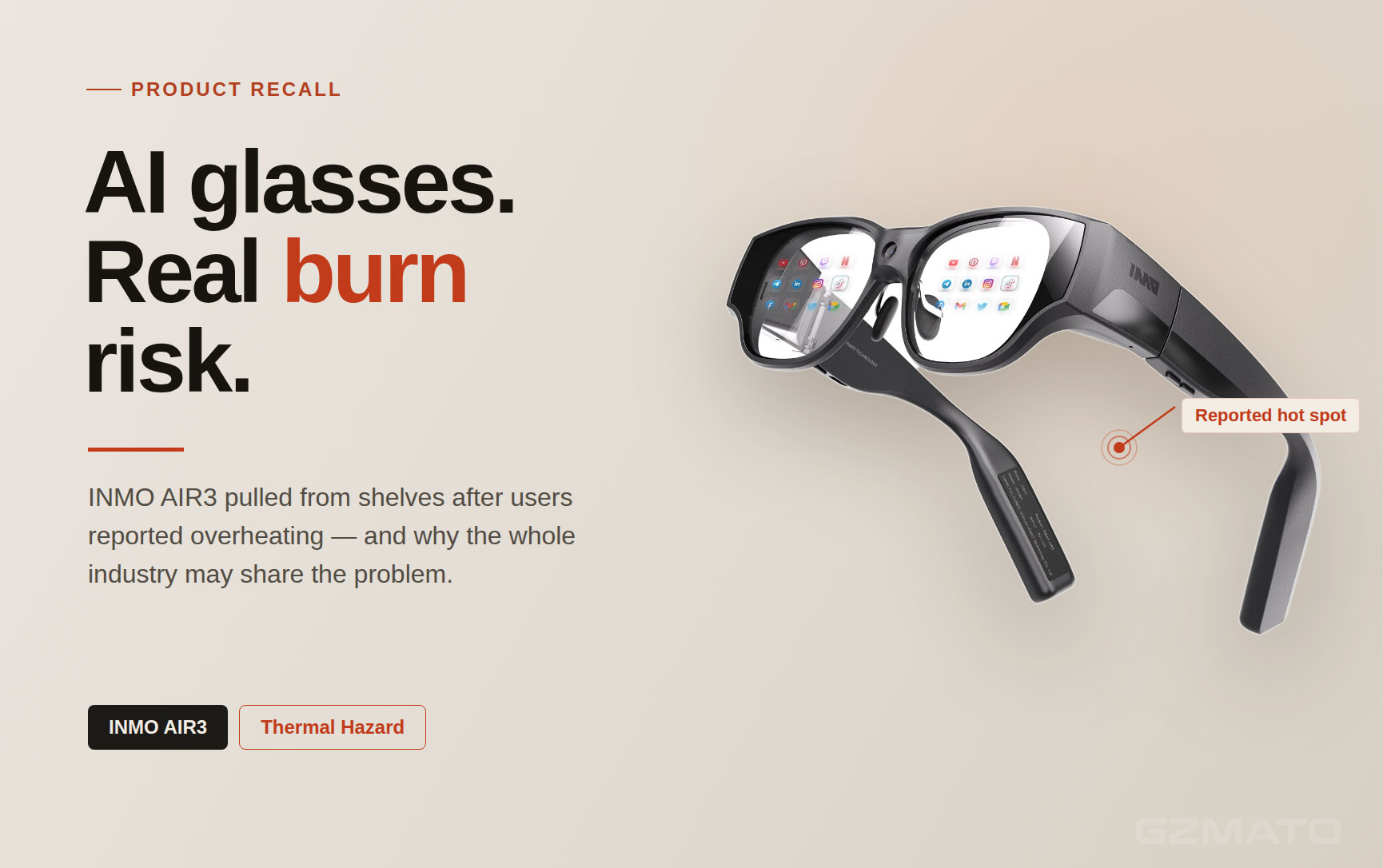
September 30, 2026 — On September 24, the U.S. Consumer Product Safety Commission (CPSC) and Health Canada simultaneously issued recall notices for the INMO AIR3 smart glasses. The reason: the left temple could overheat during extended use, posing a burn hazard.
The recall covers approximately 1,643 units in the United States and 120 in Canada, sold between December 2025 and August 2026 for $900 to $1,300. The company has received 10 reports of overheating, including users experiencing a burning sensation on their face and left ear.
This is not a story about a single faulty product. It is a story about a category-wide engineering problem that AI glasses manufacturers have been quietly struggling with — and one that the INMO AIR3 recall has now brought into the open.
What Actually Happened
The recall notice is specific. The left temple of the AIR3 can overheat during extended use, and the CPSC classified this as a hazard that could cause "serious injury or death" from burns. Health Canada's notice uses similar language.
Ten incidents have been reported in the US. Users described a burning sensation on the left side of their face and ear. No injuries have been reported in Canada.
| Recall Detail | Information |
|---|---|
| Product | INMO AIR3 Smart Glasses (black, "AIR3" and "INMO" on right temple label) |
| Hazard | Left temple can overheat during extended use; burn hazard |
| Units Affected | ~1,643 US, ~120 Canada |
| Sold Period | December 2025 – August 2026 |
| Sales Channels | Amazon, Kickstarter, inmoxr.com |
| Price Range | $900 – $1,300 |
| Remedy | Free firmware update to V3.16 (not a return) |
| Incidents | 10 reports of overheating, no injuries reported |
The remedy is unusual for a safety recall: instead of asking users to return the product, INMO is asking them to update the firmware. The company says V3.16 "completely fixes" the overheating issue.
Why "Third-Party Apps" Caused a Hardware Problem
INMO's official explanation is that the overseas version of AIR3 allows users to install third-party Android applications. Some of these apps, which were not officially tested, invoke abnormal power consumption patterns. That power draw, concentrated in the left temple where the processor and battery sit, generated more heat than the thermal design could dissipate.
The company has since removed the problematic apps from its ecosystem and optimized the device's power management strategy.
This incident illustrates how thin the line between software and hardware has become in wearable AI devices. The AIR3's thermal design was presumably validated against a set of approved applications. Opening the platform to arbitrary third-party apps introduced power behaviors the hardware wasn't designed for. The result was a safety recall — triggered by software.
The China domestic version is not affected because it does not allow third-party app installation. INMO emphasized that this is a "software-level" issue, not a hardware defect.
The AI Glasses Thermal Problem Nobody Wants to Talk About
The INMO AIR3 recall is not an isolated incident. It is a symptom of a fundamental engineering constraint that affects every AI glasses manufacturer.
The physics is brutal. AI glasses must fit a processor, battery, camera, display, speakers, microphones, and wireless radios into a frame weighing just a few dozen grams. Unlike a smartphone, which can dissipate heat across a large surface area, glasses touch skin directly at the temples and nose — where even a few degrees of temperature rise becomes uncomfortable, and at higher temperatures, dangerous.
| Constraint | Why It's Hard |
|---|---|
| Weight | Everyday eyeglasses weigh ~30g. Most smart glasses are 50g+. The AIR3 weighs ~135g |
| Surface Area | Glasses have almost no room for heat spreaders. Traditional graphite sheets need more area than the temple provides |
| Skin Contact | The device touches the face directly. Safety thresholds for skin temperature are around 43°C |
| Power Demand | AI processing, video recording, and display output all generate heat. More capable AI = more heat |
Industry experts have been warning about this. Mike Housholder of xMEMS said in August: "You now have complex chips generating heat, and the glasses sit on your skin all day. You can't just spread heat; you have to get it out before it sinks into the plastics and then sinks into your skin."
Meta has been working on the problem. In April 2026, a Meta patent for micro heat pipe technology was published, describing a system less than 2mm thick that can manage heat in the temple arms while adapting to head movement. Apple, Snap, and Huawei are also developing ultra-thin thermal solutions. But these are not yet shipping in consumer products at scale.
Our Perspective: What Needs to Change
The INMO AIR3 recall is a warning shot. Here is what we believe the industry needs to do — and what buyers should demand.
1. Thermal safety must be a first-class design requirement, not an afterthought
The AIR3's thermal design appears to have been validated against a limited set of applications. Once the platform was opened to third-party apps, the thermal envelope was exceeded. This suggests that thermal testing needs to account for worst-case power draw, not just average usage. If a device can be pushed beyond safe temperatures by installing an app, the design is insufficient.
One reader of our earlier coverage, Stephen Roach, proposed a different angle: instead of treating the frame material as a passive shell, treat it as an active part of the thermal path.
The idea is worth taking seriously. The key insight is that material choice alone doesn't solve the problem — but a combined material and thermal path design might. The frame can't just be a shell; it has to be part of the system. And as Roach notes, the heat still needs a destination. Whether that's an active cooling zone, a larger passive surface, or a combination of both, the principle is the same: get the heat away from the skin, and then get it out of the device.
2. Open platforms need stronger power governance
INMO's decision to open the overseas version to third-party apps created value for users — but it also created risk. A more robust approach would be to implement per-app power budgets or thermal throttling that limits how much power any single application can draw. The device should protect itself, regardless of what software is running.
3. The industry needs transparent thermal standards
There is currently no standardized way for consumers to compare the thermal safety of different AI glasses. Companies publish battery life and weight, but not sustained power draw or skin-contact temperature limits. Buyers deserve to know: will this device stay below safe temperatures during extended use? A voluntary labeling standard would help.
4. OTA recalls are not a substitute for hardware safety
INMO's response — a firmware update — is efficient and minimizes disruption to users. But it also means the burden of safety rests on the user remembering to update. A safer approach would be to disable the overheating path automatically until the update is applied, or to provide a clear, persistent warning. Software fixes are valuable, but they should not be the only line of defense for a device that touches a user's skin.
What This Means for Buyers
If you are considering an AI glasses purchase, the INMO AIR3 incident offers several lessons.
| What to Watch For | Why It Matters |
|---|---|
| Open vs. closed app ecosystems | Open platforms offer flexibility but introduce thermal risk from untested apps. Closed platforms are more predictable but more limited. |
| Weight and heat | Heavier devices often pack more processing power — which means more heat. Lightweight designs may be safer for all-day wear. |
| Frame material and thermal design | Look for manufacturers that discuss thermal management openly. A frame that's just plastic may trap heat; a frame designed as part of the thermal path is safer. |
| Company safety record | How a company responds to safety incidents matters. Look for transparency and proactive fixes, not just marketing claims. |
| Regulatory certifications | Products sold in the US and EU must meet safety standards. Check for CE, FCC, and any recall history. |
The Guangdong Consumer Council's 2026 smart glasses comparison test noted that while physical safety was generally well-assured, companies still need to "improve product safety management mechanisms" and "strengthen application review." The INMO case shows why that matters.
Key Takeaways
| # | What You Need to Know About the INMO AIR3 Recall |
|---|---|
| 1 | INMO AIR3 recalled in US and Canada — 1,643 US units, 120 Canadian units, over left temple overheating that poses a burn hazard |
| 2 | 10 overheating reports, no confirmed injuries — users described burning sensations on face and left ear |
| 3 | Root cause: third-party apps on overseas version — untested apps invoked abnormal power draw, exceeding the device's thermal design |
| 4 | Fix is a firmware update, not a return — users need to update to V3.16 to resolve the issue |
| 5 | China version not affected — domestic AIR3 does not allow third-party app installation |
| 6 | The real issue is industry-wide — AI glasses face a fundamental thermal challenge: powerful chips in a tiny frame that touches skin all day |
| 7 | A material-level solution is worth exploring — modified phenolic resin paired with micro heat pipes could turn the frame into a heat spreader rather than a heat trap, as proposed by reader Stephen Roach |
| 8 | Thermal safety needs to become a design priority — open platforms need power governance, and the industry needs transparent thermal standards |
- U.S. Consumer Product Safety Commission (CPSC) — Official recall notice, hazard classification, product details, remedy
- Health Canada — Joint recall notice, Canadian unit count, safety instructions
- 澎湃新闻 (The Paper) — INMO official statement, third-party app explanation, China version unaffected
- 钛媒体 (TMTPost) — In-depth analysis, timeline of overheating reports, product positioning
- 南都·湾财社 (Sohu) — INMO response to media, software-level framing, domestic version clarification
- 大洋网 / 广州日报 — INMO official statement, app review strengthening
- Electronic Specifier — AI glasses thermal constraints, weight thresholds, engineering challenges
- xMEMS Labs — Active thermal management for wearables, industry perspective
- 广东省消委会 — Smart glasses comparison test, safety recommendations, consumer guidance
- VR陀螺 — Meta micro heat pipe patent, thermal management approaches, skin temperature safety threshold
- heise online — INMO AIR3 specifications, weight, battery, display details
- Stephen Roach — Reader contribution on modified phenolic resin and heat pipe thermal design

- INMO AIR3 recall
- 影目 INMO
- AI glasses burn hazard
- INMO AIR3 overheating
- smart glasses thermal management
- AI glasses heat problem
- CPSC recall
- Health Canada recall
- Gzmato